Cost to Build a House in Louisiana: 2026 Complete Guide
Detailed 2026 cost guide to build a house in Louisiana, covering parish variations, flood zone requirements, and material pricing.

Calculating the true cost to build a house in Louisiana requires looking far beyond standard national averages. The state's unique environmental challenges—ranging from high water tables and hurricane-force winds to expansive clay soils—dictate specific structural requirements that heavily influence final budgets. As of 2026, the baseline cost for a standard 2,000-square-foot home ranges from $220,000 to $320,000 ($110 to $160 per square foot). However, building in coastal parishes or designated flood zones can push this cost to $210 per square foot or higher due to mandatory elevation and wind-mitigation upgrades.
2026 Louisiana Build Snapshot
- Average Cost per Sq Ft: $145 (Statewide median)
- Most Expensive Region: Orleans Parish (New Orleans)
- Most Affordable Region: Caddo Parish (Shreveport)
- Mandatory Code Upgrades: 130+ mph wind resistance (Southern parishes), FEMA flood compliance
Louisiana Construction Cost Matrix by Region
Labor rates, soil conditions, and parish-specific building codes create drastic price variations across the state. The table below breaks down estimated construction costs (excluding land) for a standard 2,000-square-foot, single-story home in 2026.
| Region / Parish | Cost per Sq Ft | Total Est. (2,000 sq ft) | Primary Cost Drivers |
|---|---|---|---|
| New Orleans (Orleans) | $180 - $240 | $360,000 - $480,000 | Historic district compliance, high labor costs, mandatory deep piling foundations, strict flood codes. |
| Baton Rouge (E. Baton Rouge) | $145 - $185 | $290,000 - $370,000 | Expansive clay soil requiring reinforced slab-on-grade, moderate wind mitigation requirements. |
| Lafayette (Lafayette) | $135 - $170 | $270,000 - $340,000 | Acadian architectural details (steeper roof pitches), standard slab foundations, moderate humidity-proofing. |
| Shreveport (Caddo) | $110 - $145 | $220,000 - $290,000 | Lower regional labor rates, fewer coastal wind mandates, standard shallow frost-line foundations. |
Mandatory Louisiana Building Upgrades (The Hidden Costs)
When estimating your budget, you must account for the 'Louisiana Tax'—the premium required to make a home resilient against Gulf Coast weather and hydrology. Ignoring these will result in failed inspections or uninsurable properties.
1. Flood Zone Elevation and Pilings
If your lot is in a FEMA-designated AE or VE flood zone, your lowest floor must be elevated above the Base Flood Elevation (BFE). According to the National Flood Insurance Program (NFIP), failure to meet BFE requirements voids access to federal flood insurance.
- Stem Wall / Crawl Space Elevation: Adds $12,000 - $18,000. Suitable for low-risk AE zones requiring 1-3 feet of elevation.
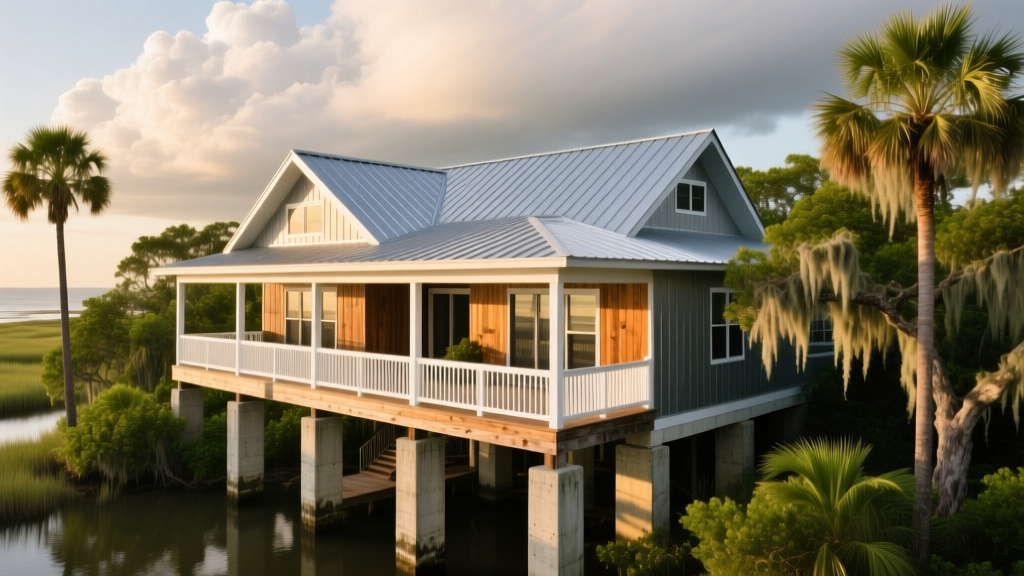
- Concrete or Timber Pilings: Adds $25,000 - $45,000+. Required in coastal VE zones or areas with severe storm surge risks. This involves driving pilings 20-40 feet into the ground and constructing a structural wood or concrete deck to support the home.
2. Wind Mitigation and FORTIFIED Standards
The Louisiana State Uniform Construction Code mandates high-wind resistance in southern parishes. Beyond basic code, many builders now construct to the IBHS FORTIFIED Home standard to secure massive discounts on Louisiana Citizens or private windstorm insurance policies.
- Roof Decking: Must be sealed with a peel-and-stick membrane (e.g., Grace Ice & Water Shield) and fastened with 8d ring-shank nails instead of standard smooth nails. Adds ~$2,500.
- Impact-Resistant Windows: Required in coastal zones. Upgrading from standard dual-pane to impact-rated vinyl (e.g., PGT WinGuard) adds $12,000 - $18,000 to a standard home.
- Continuous Load Path: Requires specialized hurricane ties (e.g., Simpson Strong-Tie H2.5A) connecting the roof trusses to the top plates and down to the foundation. Adds ~$1,800 in materials and labor.
3. Soil Stabilization and Slab Engineering
Southern and central Louisiana feature highly expansive clay soils that swell when wet and shrink during droughts, causing severe foundation cracking. Standard slab-on-grade foundations are insufficient in many subdivisions.
Expert Insight: In areas like Baton Rouge and Lafayette, geotechnical engineers frequently recommend post-tensioned (PT) concrete slabs or drilled concrete piers driven to stable load-bearing strata. A PT slab costs roughly $3.50 to $5.00 more per square foot than a conventional rebar-reinforced slab but drastically reduces the risk of catastrophic foundation failure.
Material & Labor Breakdown for a 2,000 Sq Ft Home
Below is a realistic 2026 cost allocation for a mid-tier 2,000-square-foot build in a non-coastal, moderate-risk zone (e.g., Baton Rouge), assuming a total budget of $310,000 ($155/sq ft).
- Site Prep & Foundation (Post-Tension Slab): $34,000 (11%)
- Framing & Structural Sheathing (ZIP System): $58,000 (18.7%)
- Exterior Finishes (Fiber Cement Siding & Brick Veneer): $32,000 (10.3%)
- Roofing (Architectural Shingles, Class 4 Impact): $14,500 (4.7%)
- Major Systems (HVAC, Plumbing, Electrical): $55,000 (17.7%)
- Interior Finishes (Drywall, Flooring, Cabinets): $72,000 (23.2%)
- Permits, Inspections, & Builder Overhead/Profit: $44,500 (14.4%)
Navigating Parish Permit Fees and Impact Costs
Permitting in Louisiana is handled at the parish and municipal levels, leading to a fragmented fee structure. Budgeting for soft costs requires understanding your specific jurisdiction's requirements.
- Zoning and Planning Approval: $500 - $1,500. Required before pulling building permits to ensure setback and lot-coverage compliance.
- Building Permit Fees: Typically calculated per $1,000 of construction valuation. Expect to pay $1,200 - $2,500.
- Floodplain Development Permit: $150 - $500. Mandatory if touching a flood zone; requires submitting an Elevation Certificate post-construction.
- Utility Impact Fees: $1,500 - $3,500. Covers water and sewer capacity connections. Rural parishes may require a private aerobic septic system instead, costing $8,000 - $12,000.
Cost-Saving Strategies Specific to the Gulf Coast
While you cannot cut corners on structural resilience, you can optimize material selections to manage the overall cost to build a house in Louisiana without sacrificing durability.
Opt for Standing Seam Metal Over Premium Shingles
While a 26-gauge standing seam metal roof costs 30% more upfront than architectural asphalt shingles, it routinely qualifies for up to a 35% discount on the wind/hail portion of your homeowner's insurance policy in Louisiana. Over a 15-year period, the insurance savings often eclipse the initial material premium, and metal roofs eliminate the tear-off and disposal costs associated with 15-year shingle replacement cycles.
Pre-Treat for Subterranean Termites During Construction
Louisiana's high moisture and warm climate make it a hotspot for Formosan and native subterranean termites. Skipping pre-construction soil treatment to save $1,500 is a critical error. Applying a borate-based treatment like Bora-Care to all structural wood framing before drywall installation, combined with a perimeter soil termiticide, provides a multi-layered defense that is vastly cheaper than post-construction remediation and structural repair.
Right-Size Your HVAC with Latent Load in Mind
Do not simply oversize your AC unit. An oversized unit will cool the air too quickly, shutting off before it has adequately dehumidified the space, leading to mold growth in wall cavities. Work with an HVAC contractor to perform a Manual J load calculation that prioritizes latent (moisture) removal. Installing a 16 SEER2 variable-speed system paired with a standalone whole-home dehumidifier (like an Aprilaire E100) costs roughly $2,500 more than a standard setup but prevents tens of thousands of dollars in mold remediation and drywall replacement.
Frequently Asked Questions
Is it cheaper to build a barndominium in Louisiana?
Yes, a post-frame barndominium can reduce structural costs by 15% to 20% compared to traditional stick-built homes. By utilizing engineered wood trusses and a concrete slab, you eliminate the need for extensive interior load-bearing walls. However, finishing the interior to residential standards costs the same as a traditional home, bringing the total savings to roughly 10% overall.
How do I verify if my lot requires an elevation certificate?
Before purchasing land, request the parish's Flood Insurance Rate Map (FIRM) panel for the specific parcel. If the lot is in Zone X (shaded), it is considered a moderate flood risk and generally does not require mandatory elevation. Zones A, AE, and V strictly require elevation certificates and BFE compliance. Data from the National Association of Home Builders (NAHB) confirms that site-specific geographical constraints are among the top variables in regional construction pricing.
Are modular homes a viable option for Louisiana flood zones?
Modular homes are highly viable and increasingly popular. They are built to the exact same IRC (International Residential Code) standards as site-built homes. For flood zones, modular units can be crane-lifted and secured directly onto pre-installed concrete piling foundations, significantly reducing the time the materials are exposed to Louisiana's humid, rain-heavy construction season.
Written by
David NakamuraDavid Nakamura is a licensed architect (AIA) and construction technology writer focused on sustainable building methods, mass timber engineering, and high-performance building envelopes. He holds a Master of Architecture from the University of Washington and is a certified Passive House Consultant (CPHC). David spent eight years at the Seattle firm Mithun, where he led the design of three LEED Platinum projects, before founding his own practice specializing in net-zero residential design. He serves on the editorial advisory board of GreenBuilder Magazine and has authored peer-reviewed papers on cross-laminated timber (CLT) connections for the Journal of Structural Engineering. In his spare time, David teaches woodworking at Pratt Fine Arts Center and kayaks the Puget Sound.
More from David Nakamura
View all
Construction Cost
Labor Cost to Build a Deck Per Sq Ft: 2026 Installation Guide
Discover the exact labor cost to build a deck per sq ft in 2026. This installation guide breaks down contractor rates, complexity factors, and hidden fees.
Aug 4, 2026

Construction Cost
How Much Does It Cost to Build a 3 Bedroom House? Financing Guide
Learn exactly how much it costs to build a 3 bedroom house and explore 2026 financing options, construction loan types, and budget frameworks for your build.
Aug 4, 2026

Construction Cost
Cost to Build a Tennis Court: 2026 Guide
How much does it cost to build a tennis court in 2026? Breakdowns for asphalt, concrete, and synthetic surfaces plus fencing and lighting.
Jul 30, 2026