How Much Does It Cost to Build a Putting Green? DIY Savings
Discover how much does it cost to build a putting green in your backyard. Compare professional vs. DIY costs and learn expert money-saving strategies.
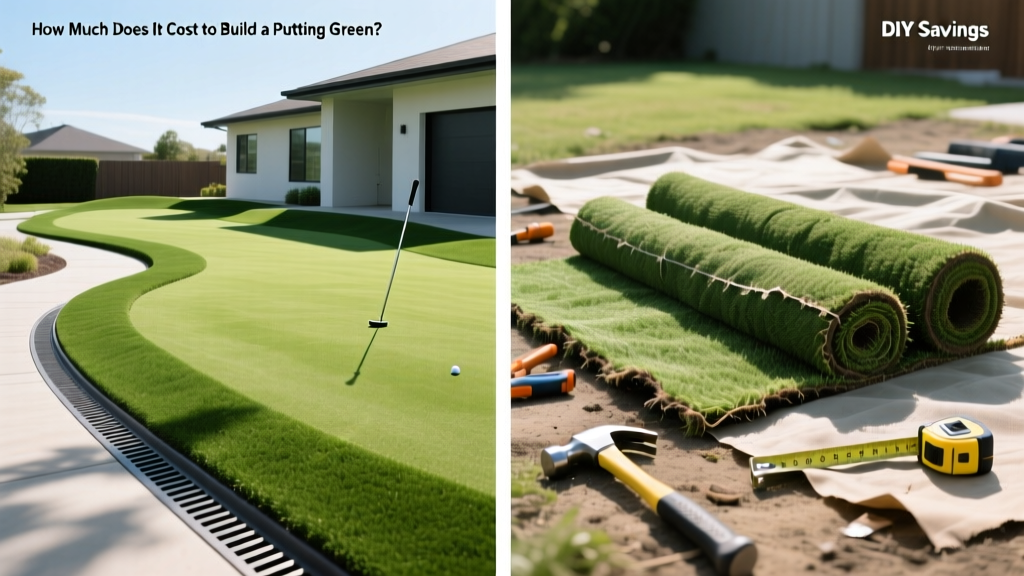
The Real Cost: Professional vs. DIY Putting Green Installation
When evaluating how much does it cost to build a putting green, the final price tag depends entirely on your labor tolerance, site conditions, and material sourcing strategy. A professionally installed backyard synthetic putting green typically ranges from $18 to $35 per square foot. For a standard 500-square-foot green, expect to pay between $9,000 and $17,500 for a turnkey solution. However, by leveraging strategic DIY methods, hybrid labor models, and smart material substitutions, you can reduce this cost to $6 to $10 per square foot ($3,000 to $5,000 total) without sacrificing ball roll quality or long-term durability.
According to HomeGuide's landscaping cost database, the primary cost drivers are site excavation, base material compaction, and the grade of the synthetic turf itself. Understanding where the money goes is the first step in aggressively cutting your budget.
| Installation Method | Cost Per Sq. Ft. | Total (500 Sq. Ft.) | Labor Required |
|---|---|---|---|
| Professional Turnkey | $18 - $35 | $9,000 - $17,500 | None |
| Pre-Cut DIY Kit | $9 - $14 | $4,500 - $7,000 | High (Weekend Warrior) |
| Scratch-Built DIY | $6 - $10 | $3,000 - $5,000 | Extreme (Heavy Excavation) |
| Hybrid (Pro Base + DIY Turf) | $12 - $16 | $6,000 - $8,000 | Moderate (Turf Lay Only) |
Material Breakdown: Where Your Budget Actually Goes
To manipulate your budget, you must understand the technical specifications of the materials required. The Synthetic Turf Council (STC) guidelines emphasize that a putting green is only as good as its subsurface base and fiber memory. Here is the exact material stack you need to price out:
- The Turf (40% of budget): You need a turf with a face weight between 40 oz and 60 oz per square yard and a pile height of 3/8 to 1/2 inch. Polypropylene (PP) turf costs $6 to $9 per square foot but flattens under heavy foot traffic within 3 to 5 years. Nylon turf (such as SYNLawn Precision Pro or Global Syn-Turf Putt-46Bicolor) costs $11 to $15 per square foot but offers superior fiber memory and UV resistance, lasting 15+ years.
- The Base (30% of budget): A proper base requires 4 to 6 inches of Class II road base topped with 1 to 2 inches of decomposed granite (DG) or crushed limestone chat. This must be compacted to 95% Proctor density to prevent settling.
- The Infill (10% of budget): You need 2 to 3 pounds per square foot of fine, rounded #30 mesh silica sand. Avoid angular masonry sand, which will slice the turf fibers over time. Antimicrobial acrylic infills like Envirofill cost roughly $1.50 per pound, while standard silica sand costs around $0.25 per pound.
- Seaming and Adhesives (10% of budget): Polyurethane turf glue and seaming tape are non-negotiable for joining rolls. A standard 3-gallon bucket of turf adhesive costs around $150 and covers roughly 150 linear feet of seam.
- Drainage and Fabric (10% of budget): Non-woven geotextile weed barrier fabric and 4-inch perforated PVC piping for French drains.
3 Proven Money-Saving Strategies for Backyard Greens
Strategy 1: The Hybrid Excavation Approach
Excavation and base compaction are where DIYers fail, blow their budgets on equipment rentals, and suffer physical burnout. Renting a mini-skid steer (like a Toro Dingo) costs $250 to $350 per day, plus $400 for a vibratory plate compactor. Instead, hire a local grading or landscaping contractor strictly for the earthwork phase. Paying a professional $3 to $5 per square foot to excavate 6 inches, lay the geotextile fabric, and laser-grade the aggregate base saves you 50% of the total turnkey price. You then take over for the turf rolling, seaming, and infill brooming, which requires patience but zero heavy machinery.
Strategy 2: Base Material Substitution
Decomposed granite (DG) is the gold standard for the top layer of a putting green base, but in many regions, it must be shipped from distant quarries, inflating delivery costs to $120+ per ton. Consult your local quarry for 'screened aggregate base' or 'crushed limestone chat' (often called ABC - Aggregate Base Course). The critical metric is the gradation: you need a 3/8-inch minus aggregate that locks together when wetted and compacted to create a hard, concrete-like surface. This local substitution can cut your base material delivery costs by up to 60%.
Strategy 3: Strategic Contouring Over Massive Cut-and-Fill
Many homeowners want dramatic, Augusta-style undulations. However, building up mounds requires importing massive amounts of base rock, while deep valleys require extensive excavation and retaining walls. Design your green to follow the natural topography of your yard. Limit contour changes to a maximum of 2 to 3 inches across the entire surface. This subtle slope is enough to challenge your putting stroke while drastically reducing the tonnage of base rock you need to purchase and compact.
Critical Failure Modes That Destroy Your Investment
Warning: The $5,000 Drainage Mistake
Skipping the geotextile weed barrier or failing to install a 1% to 2% slope away from structures will result in catastrophic base heave. In freeze-thaw climates, trapped water under impermeable synthetic turf will expand, creating ridges that ruin the Stimpmeter reading and tear the turf backing. According to United States Golf Association (USGA) course architecture standards, proper subsurface drainage is paramount. Always install a perforated 4-inch PVC drain pipe tied to a daylight exit point if your native soil percolation rate is slower than 1 inch per hour. Never lay turf directly over expansive clay without a crushed rock drainage buffer.
Build Path Decision Matrix
Use this framework to determine which construction path aligns with your budget, physical capability, and timeline.
- Choose Professional Turnkey If: Your budget exceeds $12,000, your yard requires complex retaining walls or massive grading, and you demand a 10+ year structural warranty.
- Choose the Hybrid Method If: You have $6,000 to $8,000, you are comfortable using a utility knife and seaming tape, but you lack the physical stamina to move 20 tons of crushed rock by wheelbarrow.
- Choose Scratch-Built DIY If: Your budget is strictly under $5,000, you have access to free or cheap heavy equipment (e.g., a tractor on a family farm), and you are building a small 200-square-foot practice area rather than a sprawling multi-hole green.
Sourcing and Maintenance FAQs
Can I use regular artificial grass for a putting green?
No. Standard landscape turf has a pile height of 1.5 to 2.5 inches and a thatch layer designed for cushioning. A golf ball will sink into the thatch, making putting impossible. You must use specialized putting green turf with a dense, short pile (3/8 to 1/2 inch) and minimal thatch to allow the ball to roll true.
How much does it cost to maintain a synthetic putting green?
Maintenance costs are negligible compared to natural bentgrass or Bermuda greens. Budget roughly $50 to $100 annually for a stiff bristle push broom to keep the fibers upright and a leaf blower to remove organic debris. Every 3 to 4 years, you may need to spend $150 on a top-dressing of fresh silica sand to replenish the infill that washes away during heavy storms.
Does adding a chipping pad increase the cost significantly?
Adding a 100-square-foot chipping pad with a longer pile height (1 inch) and a shock-pad underlayment to receive pitch shots will add roughly $800 to $1,200 to your total material cost. It is a highly recommended addition that prevents the base from denting when struck by high-lofted wedge shots.
Written by
Sarah WhitfieldSarah Whitfield is a chartered quantity surveyor (MRICS) and construction cost analyst with 15 years of experience in material pricing, procurement strategy, and project budgeting. She earned her degree in Construction Management from the University of Reading (UK) and has worked on projects ranging from $2M custom homes to $180M mixed-use developments across North America and Europe. Sarah currently leads cost estimating for BuildMat Insight, maintaining a proprietary database of 4,000+ material price points updated quarterly. She is a frequent contributor to RSMeans cost data panels and has presented at the International Cost Engineering Council (ICEC) congress. Based in Denver, CO, Sarah is an avid trail runner and volunteer mentor for Women in Construction.
More from Sarah Whitfield
View all
Wood & Lumber
What Are the Different Types of Wood? A Builder's Guide
Compare structural softwoods, finish hardwoods, and engineered lumber. Analyze Janka ratings, MOE values, and 2026 pricing for construction.
Aug 4, 2026

Walls & Panels
Steel Framing vs Wood Framing: Corrosion and Moisture Defense
Compare steel framing vs wood framing for moisture resistance. Learn about galvanized coatings, condensation risks, and corrosion protection strategies.
Jul 21, 2026

Stone & Masonry
How to Cut Stone Veneer: Wet Saw vs Grinder Comparison
Compare the best tools for cutting stone veneer. We review wet saws, angle grinders, and chop saws to help you achieve clean, chip-free cuts.
Jul 21, 2026