Gaga Ball Pit Cost to Build: 2026 Regional Price Analysis
Discover the true gaga ball pit cost to build in 2026. We break down regional lumber prices, labor rates, surfacing requirements, and hidden site prep expenses.

The True Gaga Ball Pit Cost to Build: 2026 Regional Breakdown
Estimating the gaga ball pit cost to build requires moving beyond generic backyard project calculators. Whether you are installing a pit for a summer camp, a school playground, or a residential backyard, the final price is heavily dictated by regional material premiums, local labor rates, and strict safety surfacing requirements. In 2026, a standard 24-foot octagonal gaga pit ranges from $3,400 to $9,500+ fully installed. This wide variance is not arbitrary; it is the direct result of localized lumber markets, frost-line excavation requirements, and the sheer volume of impact-attenuating surfacing needed to meet federal safety guidelines.
This regional price analysis deconstructs the exact material specifications, hidden site-prep variables, and geographic cost multipliers you need to build an accurate budget for your specific zip code.
Core Material Specifications and Geometry
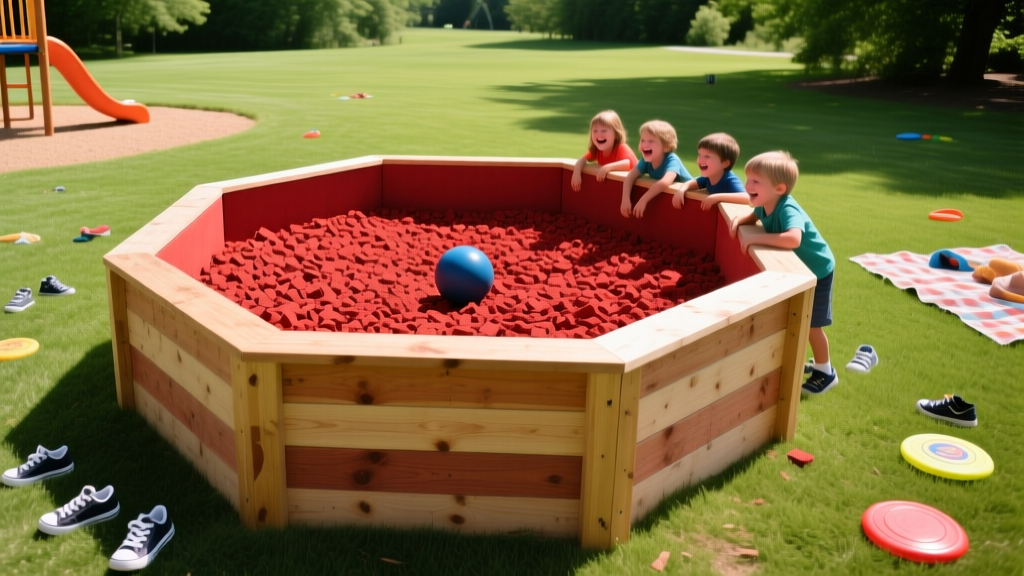
Before analyzing regional costs, we must establish the baseline material requirements for a commercial-grade, 24-foot octagonal pit. A 24-foot diameter octagon features eight sides measuring approximately 10 feet each, yielding an 80-foot perimeter. To achieve the standard 22-inch wall height required to keep the ball in play while allowing smaller children to enter, builders use two stacked courses of 2x12 lumber.
Lumber and Hardware Matrix
| Component | Specification / Grade | Quantity (24ft Pit) | 2026 Avg Unit Cost |
|---|---|---|---|
| Corner Posts | 6x6 Pressure-Treated (UC4B Ground Contact) | 8 (48" lengths) | $38 - $55 each |
| Wall Boards | 2x12 Pressure-Treated (UC4A or UC4B) | 16 (10ft lengths) | $22 - $34 each |
| Fasteners | 1/2" x 6" Hot-Dipped Galvanized Carriage Bolts | 64 bolts + nuts/washers | $2.15 - $3.50 per set |
| Post Anchors | Simpson Strong-Tie E-Z Base or concrete mix | 8 units / 16 bags | $18 - $25 / $6 per bag |
Expert Insight: Never substitute UC4B (Ground Contact) rated posts with UC3B (Above Ground) lumber to save money. According to the American Wood Protection Association (AWPA), UC4B is mandatory for structural members in direct contact with soil or fresh water. Using UC3B posts in a gaga pit will result in severe subterranean rot and structural failure within 36 to 48 months, especially in high-moisture regions.
Regional Cost Matrix: Where Are You Building?
Lumber pricing in 2026 remains highly regionalized. The Pacific Northwest and Southeast benefit from proximity to timber mills, while the Midwest and Northeast pay significant freight premiums. Labor rates for excavation and carpentry further widen the gap.
2026 Regional Pricing Estimates (24ft Octagon, Fully Installed)
- Northeast (NY, MA, CT): $6,800 - $9,500. High union-prevailing labor rates ($85-$130/hr) and rocky soil excavation requirements drive costs up. Frost lines require 48-inch post holes.
- Southeast (GA, NC, FL): $3,400 - $5,200. Proximity to Southern Yellow Pine mills keeps lumber costs at national lows. Shallow frost lines (12-18 inches) reduce excavation time and concrete volume.
- Midwest (OH, IL, MI): $4,500 - $6,500. Moderate labor rates ($55-$85/hr). Deep frost lines (42+ inches) require extensive augering and concrete, offsetting the lower regional labor costs.
- West Coast (CA, WA, OR): $6,200 - $8,900. Strict local permitting, high prevailing wages, and premium environmental compliance for lumber treatments elevate the baseline cost.
Surfacing: The Hidden Cost Multiplier
The most frequently underestimated line item in the gaga ball pit cost to build is the impact-attenuating surfacing. Because gaga involves rapid lateral movement, diving, and frequent falls, bare dirt or grass is unacceptable and creates a severe liability risk.
The Consumer Product Safety Commission (CPSC) Public Playground Safety Handbook mandates specific depths for loose-fill materials based on fall height. While gaga pits have low walls, the dynamic nature of the game necessitates a minimum of 9 to 12 inches of compacted loose-fill surfacing.
Surfacing Material Comparison
| Material | Cost per Cu. Ft. (Bulk) | Volume Needed (24ft Pit @ 1ft Deep) | Total Surfacing Cost | Maintenance Profile |
|---|---|---|---|---|
| Virgin Rubber Mulch | $4.50 - $6.00 | ~450 cu. ft. | $2,025 - $2,700 | Low; requires occasional raking and top-offs every 3 years. |
| Engineered Wood Fiber (EWF) | $1.25 - $2.00 | ~450 cu. ft. | $560 - $900 | High; compacts over time, requires annual topping and ADA-compliance raking. |
| Poured-in-Place Rubber (PIP) | $9.00 - $14.00 | ~450 sq. ft. (2" thick) | $4,050 - $6,300 | Very Low; seamless, ADA accessible, 10+ year lifespan. |
Budget Warning: Do not calculate surfacing volume based solely on the geometric area of the octagon (approx. 432 sq. ft.). You must account for a 2-foot overage around the perimeter to prevent material displacement during active play, bringing your actual coverage area closer to 500 square feet.
Site Preparation and Excavation Variables
Regional geology dictates your site preparation budget. A gaga pit must be perfectly level; a 2-degree slope across a 24-foot span results in a 6-inch height discrepancy, causing the ball to perpetually roll to one side and ruining the game mechanics.
- Flat, Sandy Loam (Southeast/Midwest): Site prep is minimal. A skid-steer with a grading bucket can level the pad in 2 hours. Cost: $300 - $450.
- Heavy Clay or Rocky Soil (Northeast/Appalachia): Requires rock excavation, potential blasting or heavy ripping, and the importation of crushed stone (DG or 3/4" minus) to create a stable, free-draining base pad. Cost: $1,200 - $2,800.
- Drainage Integration: In high-water-table regions, installing a 4-inch perforated French drain pipe wrapped in landscape fabric beneath the surfacing layer is mandatory. Without it, the pit will flood and trap water against the UC4B lumber, accelerating hardware corrosion. Add $400 - $600 for drainage materials and trenching labor.
Labor Rates: DIY vs. Professional Installation
If you are hiring a landscape contractor or playground installation firm, expect labor to account for 40% to 55% of the total invoice. A professional crew of three can typically excavate, set posts, frame the octagon, and spread surfacing in 16 to 24 man-hours.
Building the pit yourself saves roughly $1,500 to $3,500 in labor. However, the primary challenge is not carpentry; it is moving the surfacing. Shoveling and wheelbarrowing 450 cubic feet of rubber mulch (which weighs roughly 15-20 lbs per cubic foot) equates to moving over 4 tons of material by hand. If DIYing, budget for a skid-steer or mini-loader rental ($350/day) just for material handling and site grading.
Common Estimation Mistakes to Avoid
When finalizing your gaga ball pit cost to build, audit your estimate for these three frequent omissions:
- Ignoring Frost Heave: In USDA Plant Hardiness Zones 5 and below, setting posts directly in concrete without extending below the frost line will result in severe frost heave. The freezing soil will push the posts upward unevenly, warping the octagon and snapping carriage bolts within two winters. Always use sonotubes to pour concrete footings below the local frost depth.
- Using Interior-Rated Hardware: Standard zinc-plated bolts from big-box stores will corrode rapidly when in contact with the copper-based preservatives (like MCQ or CA-C) used in modern pressure-treated lumber. You must specify hot-dipped galvanized or stainless steel hardware to prevent chemical corrosion.
- Omitting Landscape Fabric: Laying a heavy-duty, woven geotextile landscape fabric (minimum 3 oz/sq yd) between the native soil and the loose-fill surfacing is non-negotiable. Without it, earthworms and rain will pull the soil up into the rubber mulch, turning the pit into a muddy, compacted hazard within one season.
By mapping your specific regional lumber premiums, calculating the exact volumetric requirements for CPSC-compliant surfacing, and accounting for localized frost-line excavation, you can transform a vague ballpark figure into a precise, defensible construction budget.
Written by
David NakamuraDavid Nakamura is a licensed architect (AIA) and construction technology writer focused on sustainable building methods, mass timber engineering, and high-performance building envelopes. He holds a Master of Architecture from the University of Washington and is a certified Passive House Consultant (CPHC). David spent eight years at the Seattle firm Mithun, where he led the design of three LEED Platinum projects, before founding his own practice specializing in net-zero residential design. He serves on the editorial advisory board of GreenBuilder Magazine and has authored peer-reviewed papers on cross-laminated timber (CLT) connections for the Journal of Structural Engineering. In his spare time, David teaches woodworking at Pratt Fine Arts Center and kayaks the Puget Sound.
More from David Nakamura
View all
Construction Cost
Labor Cost to Build a Deck Per Sq Ft: 2026 Installation Guide
Discover the exact labor cost to build a deck per sq ft in 2026. This installation guide breaks down contractor rates, complexity factors, and hidden fees.
Aug 4, 2026

Construction Cost
How Much Does It Cost to Build a 3 Bedroom House? Financing Guide
Learn exactly how much it costs to build a 3 bedroom house and explore 2026 financing options, construction loan types, and budget frameworks for your build.
Aug 4, 2026

Construction Cost
Cost to Build a Tennis Court: 2026 Guide
How much does it cost to build a tennis court in 2026? Breakdowns for asphalt, concrete, and synthetic surfaces plus fencing and lighting.
Jul 30, 2026