2026 Cost to Build Pool in Houston: Detailed Breakdown
Discover the true 2026 cost to build pool in Houston. Detailed breakdown covering expansive clay soil prep, gunite, permitting, and equipment.

The Houston Soil Reality: Expansive Clay and Shell Engineering
Estimating the cost to build pool in Houston requires more than just measuring the backyard and picking a tile color. The defining variable in Harris County construction is the soil. Much of the Greater Houston area sits atop the Beaumont and Houston Black clay formations. These expansive clays swell significantly during heavy Gulf rains and shrink drastically during summer droughts, creating immense hydrostatic pressure and differential settlement.
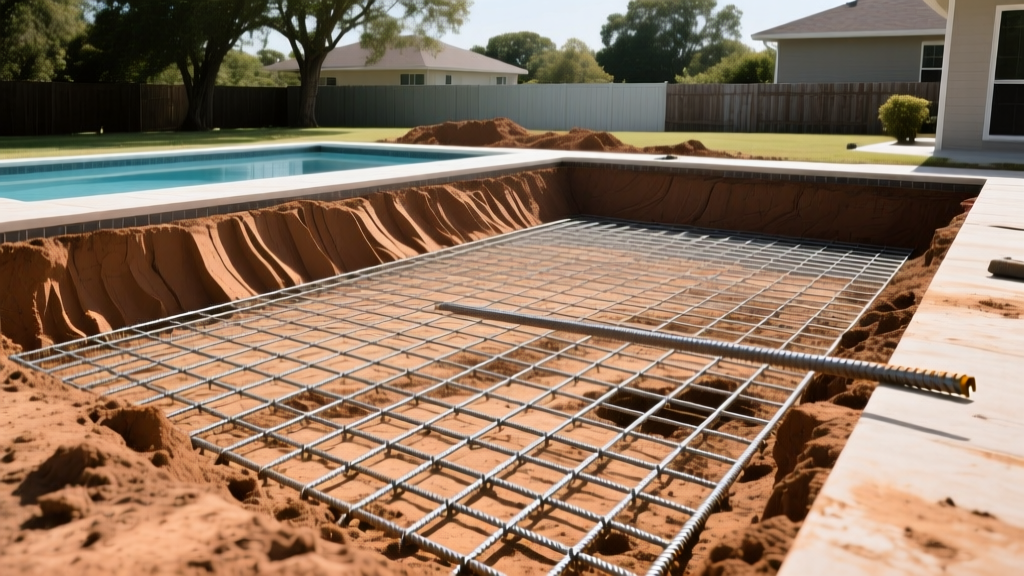
Because of this aggressive soil profile, fiberglass and vinyl-liner pools are exceptionally rare and generally ill-advised in the Houston market. Gunite (dry-mix shotcrete) reinforced with a continuous #3 or #4 steel rebar grid tied at 8-inch to 10-inch centers is the mandatory standard. The steel must be elevated off the earth using 2-inch dobies (concrete chairs) to ensure the gunite fully encapsulates the rebar, preventing rust jacking from the region's high humidity.
2026 Line-Item Cost Breakdown for a Standard 14x28 Gunite Pool
The following matrix reflects current 2026 pricing for a standard 14x28 foot freeform or geometric gunite pool in the Greater Houston area. Prices account for recent labor adjustments and material supply chain stabilizations.
| Construction Phase | Standard Base Cost | Houston Soil/Access Adder |
|---|---|---|
| Excavation & Haul-Off | $4,500 - $7,000 | +$1,500 (clay disposal fees) |
| Soil Engineering & Bell Piers | N/A | $5,000 - $12,500 |
| Steel Reinforcement & Plumbing | $8,000 - $11,000 | +$800 (Schedule 80 upgrades) |
| Gunite Shell (8-10 inch) | $14,000 - $18,000 | $0 |
| Tile, Coping & Decking (600 sq ft) | $12,000 - $22,000 | $0 |
| Equipment, Automation & Gas | $9,000 - $16,000 | $0 |
| Pebble Plaster & Chemical Start-up | $6,500 - $10,000 | +$500 (hard water treatment) |
Total Estimated Range: $59,000 to $97,300+ for a fully engineered, turnkey gunite pool in Houston. High-end custom features (infinity edges, sheer descents, integrated spas) will push this well past $125,000.
Plumbing and Coping: Adapting to Shifting Earth and High Heat
Plumbing Shear Protection
In stable soils, Schedule 40 PVC is sufficient for underground pool plumbing. In Houston, the ground shifts enough to snap rigid PVC at the skimmer and main drain connection points. Specify flexible PVC for the main runs, and mandate Schedule 80 PVC or specialized flexible couplings at all rigid penetration points. This $800 upgrade prevents catastrophic underground leaks that require jackhammering the new deck to repair.
Coping and Decking Material Selection
Houston's subtropical climate features intense UV exposure and high ambient humidity. Material selection for the pool coping and surrounding deck must account for both thermal expansion and barefoot comfort.
- Lueders Limestone: The premier choice for Houston. It remains remarkably cool under direct Texas sun, offers natural slip resistance, and handles hydrostatic pressure well. Cost: $18 - $26 per linear foot for coping.
- Travertine: Highly popular but requires caution. Houston's hard water will stain unsealed travertine with calcium deposits. If using travertine, specify a tumbled finish and apply a high-quality penetrating silane/siloxane sealer annually.
- Stamped Concrete: Generally discouraged. Without deep control joints and post-tension cables, Houston's clay will crack stamped concrete decks within two seasons.
Equipment Upgrades and Hard Water Chemistry
Texas has stringent energy efficiency mandates for pool equipment. According to the U.S. Department of Energy, variable speed pumps (VSPs) are now the baseline standard, reducing pumping energy costs by up to 90% compared to single-speed models.
For a 14x28 pool, specify the Pentair IntelliFlo3 VSF or the Hayward TriStar VS. Both feature built-in diagnostics and integrate seamlessly with automation systems like the Pentair IntelliCenter. Expect to pay $2,200 to $3,500 for a fully automated VSP and control panel setup.
Permitting: City of Houston vs. Unincorporated MUDs
Permitting costs and timelines vary wildly depending on your exact jurisdiction. The City of Houston One-Stop Permitting Center enforces strict barrier codes: a minimum 4-foot fence with self-closing, self-latching gates that open outward, away from the pool. Permit fees for the City typically range from $400 to $800, with a 3-to-5-week approval timeline.
If you reside in unincorporated Harris County or within a Municipal Utility District (MUD), you bypass city permitting but must answer to the MUD's architectural control committee. MUDs often impose strict setback rules, drainage easements, and noise ordinances that dictate when heavy excavation equipment can operate. Always pull the specific MUD deed restrictions before finalizing the pool's footprint, as moving a design after engineering has been stamped can cost $1,500+ in revision fees.
Long-Term Upkeep in a Subtropical Climate
The Pool & Hot Tub Alliance (PHTA) emphasizes that regional climate dictates long-term maintenance costs. Houston's long, humid summers create an ideal breeding ground for mustard and black algae. To mitigate this, budget for the following annual maintenance realities:
| Maintenance Item | Frequency | Estimated Annual Cost |
|---|---|---|
| Weekly Chemical Balancing & Skimming | 40+ weeks/year | $1,800 - $2,400 |
| UV System Bulb Replacement (Ozone/UV) | Every 2-3 years | $150 (amortized) |
| Acid Wash / Scale Removal | Every 5-7 years | $600 - $900 |
| Deck Sealing (Travertine/Limestone) | Annually | $400 - $700 |
By engineering the shell specifically for Houston's expansive clay, upgrading underground plumbing to withstand soil shear, and treating the initial fill water for high calcium content, homeowners can ensure their investment survives the region's unique environmental stressors while maintaining structural integrity for decades.
Written by
Priya KapoorPriya Kapoor is a real estate market analyst and construction economics researcher with expertise in housing affordability, development feasibility, and infrastructure investment. She holds a Master of Regional Planning from Cornell University and previously worked as a senior analyst at CBRE's Investment Properties group, where she modeled returns for $4B in mixed-use development pipelines. Priya now runs an independent research practice advising developers, municipalities, and REITs on construction cost forecasting and market timing. She publishes the quarterly "BuildMat Market Pulse" report tracking material price indices across 12 commodity categories. Based in Austin, TX, Priya serves on the board of Habitat for Humanity Austin and is a marathon runner.
More from Priya Kapoor
View all
Construction Cost
Cost to Build a 1600 Sq Ft Home in 2026: Full Breakdown
Accurate 2026 cost to build a 1600 sq ft home—material, labor, and regional pricing breakdowns included. Plan your budget with real-time estimates.
Aug 11, 2026

Wood & Lumber
Name the Types of Wood for Pressure Treatment and Preservation
Learn how to name the types of wood best suited for pressure treatment. Compare species treatability, chemical retention levels, and 2026 preservation costs.
Aug 4, 2026

Stone & Masonry
Stone Veneer Suppliers Lindenhurst: 2026 Cost Analysis
Analyze 2026 stone veneer costs in Lindenhurst, NY. Compare local supplier pricing, delivery fees, and Suffolk County installation labor rates.
Aug 4, 2026