How Much Does It Cost to Build a Golf Simulator? 2026 Regional Guide
Discover how much it costs to build a golf simulator in 2026. We break down regional construction rates, hardware tiers, and hidden build-out expenses.

The True Cost of Building a Golf Simulator: Beyond the Launch Monitor
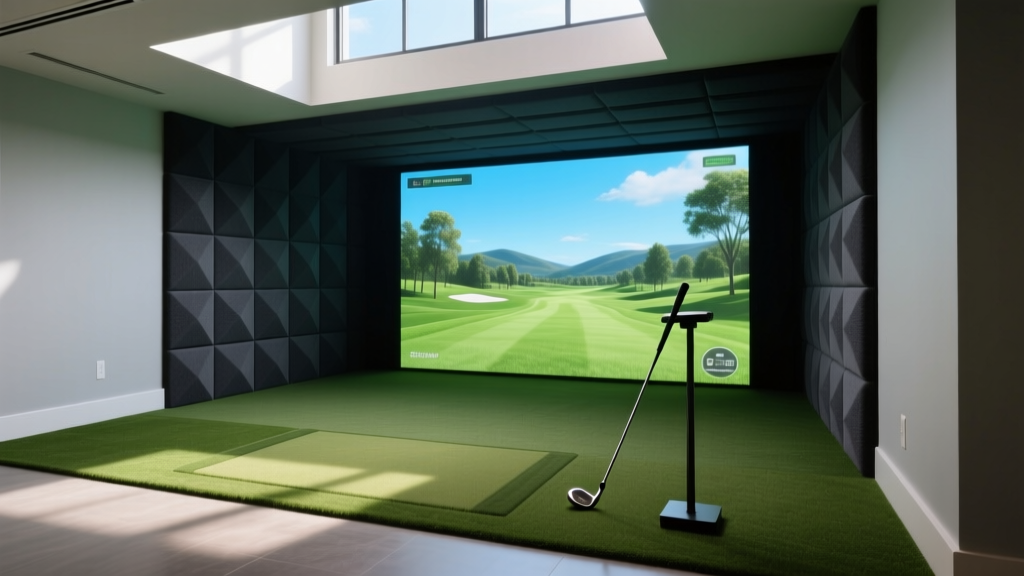
When homeowners ask how much does it cost to build a golf simulator, they often fixate on the launch monitor price tag. However, the hardware is only one variable in a complex construction equation. In 2026, the national average for a complete, mid-tier residential golf simulator build-out ranges from $28,000 to $48,000. This encompasses the launch monitor, projector, impact screen, enclosure, turf, computing hardware, and the physical room construction.
The physical build-out—framing, drywall, electrical, and acoustic treatment—is where regional price disparities drastically alter your final budget. A 400-square-foot basement conversion in the Northeast will cost significantly more in labor and material transport than an identical build in the Southeast. Below, we deconstruct the exact costs, structural requirements, and regional variances you need to budget for a professional-grade indoor golf facility.
Regional Construction & Build-Out Cost Matrix
Physical construction costs are heavily dictated by local labor rates and regional material indices. According to the U.S. Bureau of Labor Statistics, construction and extraction occupations see wage variations of up to 35% between the highest-paying and lowest-paying states. When framing a simulator bay, installing acoustic insulation, and running dedicated electrical circuits, these hourly disparities compound quickly.
| Region | Framing & Drywall (per sq ft) | Electrical & Lighting | Acoustic Treatment | Estimated Build-Out Total (15x20 Room) |
|---|---|---|---|---|
| Northeast (NY, MA, CT) | $18 - $26 | $2,800 - $4,200 | $3,500 - $5,000 | $14,500 - $19,000 |
| West Coast (CA, WA, OR) | $16 - $24 | $2,500 - $3,800 | $3,200 - $4,800 | $13,000 - $17,500 |
| Midwest (IL, OH, MI) | $11 - $16 | $1,800 - $2,600 | $2,500 - $3,500 | $9,500 - $13,000 |
| Southeast (FL, GA, NC) | $10 - $15 | $1,600 - $2,400 | $2,200 - $3,200 | $8,500 - $12,000 |
Why Regional Labor Rates Skew Your Total Budget
The most volatile line item in your simulator build is finish carpentry and electrical work. Running a dedicated 20-amp circuit for your projector and gaming PC, alongside installing recessed LED lighting that won't interfere with infrared launch monitor cameras, requires a licensed electrician. In high-cost-of-living areas like the San Francisco Bay Area or Greater Boston, electrician rates frequently exceed $150 per hour, pushing a simple wiring job from $800 to over $2,500.
Hardware Tiers: Launch Monitors and Projectors (2026 Pricing)
Hardware dictates the fidelity of your ball flight data and the visual immersion of the course software. The market has stratified into three distinct tiers. For comprehensive hardware specifications and current direct-from-manufacturer pricing, you can reference the TrackMan 4 official product page or Foresight Sports' GCQuad documentation.
- Tour-Grade ($16,000 - $24,000): TrackMan 4 (approx. $21,500) and Foresight GCQuad with FSX Play (approx. $16,500). These utilize Doppler radar and high-speed quadrascopic cameras, respectively, offering sub-1% margin of error on spin rates and club path.
- Prosumer ($8,000 - $12,000): Uneekor QED (approx. $8,500) and Foresight GC3 (approx. $9,000). Ceiling-mounted infrared systems like the QED are ideal for multi-sport simulators as they leave the floor entirely clear of trip hazards.
- Entry-Level ($600 - $3,500): Garmin R10 ($599) and SkyTrak+ ($2,999). Excellent for swing feedback, but often struggle with precise spin-axis measurements on severe mishits compared to overhead units.
The Projector Variable: Do not compromise on the projector. You need a laser projector with a minimum of 5,000 lumens to combat the ambient light of a basement. The Panasonic PT-VMZ71U (approx. $4,500) or the Epson Pro L200F are industry standards for 16:10 aspect ratio impact screens, providing the necessary short-throw capabilities to mount safely behind the golfer without casting shadows.
Structural Dimensions and the "10-Foot Ceiling" Myth
A pervasive myth in simulator construction is that a 10-foot ceiling is sufficient. While a 10-foot ceiling (120 inches) allows most golfers to swing a standard 45-inch driver, it ignores the psychological barrier of swinging near a hard surface. Tall golfers (6'2" and above) or those with steep swing planes will subconsciously alter their mechanics to avoid hitting the ceiling drywall.
Electrical, HVAC, and Acoustic Requirements
Building a golf simulator is effectively building a home theater that must withstand 180-mph projectile impacts. The mechanical systems require specific foresight.
Acoustic Decoupling
The sound of a golf ball hitting a nylon impact screen registers at roughly 95-105 decibels—equivalent to a jackhammer. If your simulator is located beneath a living space, you must decouple the ceiling. Use resilient channels and fill the joist bays with Rockwool Safe'n'Sound mineral wool insulation. Standard fiberglass batts will do nothing to mitigate the low-frequency thud of a driver impact.
The HVAC Gotcha
Simulator rooms are typically sealed to control ambient light, which destroys airflow. Furthermore, a high-end laser projector and a gaming PC running GSPro software at 4K resolution will generate over 1,500 watts of continuous heat. Without dedicated cooling, a sealed 300-square-foot room will increase in temperature by 10 to 15 degrees within an hour of use. Install a dedicated ductless mini-split system (e.g., a 9,000 BTU Mitsubishi or Daikin unit) to maintain a 68°F baseline, ensuring your PC doesn't thermal-throttle mid-round.
Hidden Costs That Derail Simulator Budgets
When calculating how much it costs to build a golf simulator, contractors and homeowners frequently overlook the ancillary tech and finishing requirements. Budget an additional 15% for these hidden costs:
- High-End Computing Hardware ($2,000 - $3,500): Running modern golf software like GSPro requires a robust GPU. An NVIDIA RTX 4070 or better is mandatory to render 4K course topography at a stable 60fps without input lag.
- Lighting Interference Mitigation ($400 - $800): Standard LED dimmer switches often emit infrared frequencies that blind camera-based launch monitors like the Uneekor QED or SkyTrak. You must purchase specialized flicker-free, IR-shielded LED bulbs and isolated dimmers for your bay lighting.
- Turf Cutting and Transition Strips ($600 - $1,200): Buying a 15x10 roll of 1-inch thick nylon turf is only step one. Cutting the hole for your drop-in putting cup, gluing the turf to a plywood subfloor without creating seams, and installing aluminum transition strips to prevent trip hazards requires specialized tools and adhesives.
- Software Subscriptions ($250 - $1,000 annually): While some monitors include basic software, premium platforms like TGC 2019 or E6 Connect require annual or lifetime licenses to access full course libraries and online multiplayer features.
According to recent U.S. Census Bureau construction index reports, material costs for specialized electrical components and lumber continue to experience micro-fluctuations based on supply chain realities. Locking in your contractor's material estimates early in the planning phase prevents mid-build budget creep.
Written by
Marcus ChenMarcus Chen is a licensed structural engineer (PE) and building materials analyst with over 12 years of experience across residential, commercial, and industrial construction. He holds a Master of Science in Civil Engineering from UC Berkeley and spent six years at Thornton Tomasetti before transitioning to independent consulting and technical writing. Marcus specializes in material selection for seismic-prone regions, concrete reinforcement strategies, and lifecycle cost analysis. His work has been cited by the American Concrete Institute (ACI) and the Structural Engineers Association of California (SEAOC). When he is not on a job site or at his desk, you will find him hiking the Sierra Nevada or restoring a 1920s craftsman bungalow in Oakland, CA.
More from Marcus Chen
View all
Construction Cost
How Much Did the Eiffel Tower Cost to Build?
How much did the Eiffel Tower cost to build in 1889? We adjust for inflation and compare its budget to modern skyscraper construction.
Aug 4, 2026

Fire Resistance
What Is a Fire Resistant Material? Testing & Certification Guide
Discover what is a fire resistant material through ASTM and UL testing. Learn how fire ratings, certifications, and assemblies work in construction.
Aug 4, 2026

Construction Cost
How Much Did the Burj Khalifa Cost to Build?
How much did the Burj Khalifa cost to build? We break down the $1.5B project and extract 5 money-saving strategies for your next build.
Jul 30, 2026