How Much Does It Cost to Build a Hydroelectric Plant in 2026?
Discover how much it costs to build a hydroelectric plant in 2026. Explore CapEx breakdowns, micro-hydro pricing, and money-saving strategies.

The True Cost Spectrum: Micro, Small, and Utility-Scale Hydro
When developers, rural cooperatives, or private landowners ask, how much does it cost to build a hydroelectric plant, the answer spans a massive financial spectrum. In 2026, the capital expenditure (CapEx) is strictly dictated by the generation capacity, site topography, and civil engineering requirements. According to data from the International Renewable Energy Agency (IRENA), global weighted average costs for new utility-scale hydropower hover around $1,800 to $2,500 per kilowatt (kW). However, for private developers focusing on micro and small-scale run-of-river (RoR) projects, the economics shift dramatically.
2026 Baseline Cost Estimates by Scale
- Micro-Hydro (5kW - 100kW): $4,000 - $8,000 per kW (Total: $20,000 - $800,000). Higher per-kW cost due to lack of economies of scale, but lowest absolute capital requirement.
- Small Hydro (100kW - 10MW): $3,000 - $6,000 per kW (Total: $300,000 - $60M). The sweet spot for private equity and rural co-ops.
- Utility-Scale (10MW+): $1,500 - $3,500 per kW (Total: $15M - $3.5B+). Requires massive civil dam infrastructure, typically restricted to state-backed entities.
For the scope of this guide, we will focus on the actionable money-saving strategies for micro and small-scale run-of-river installations, where material selection and engineering choices can shave hundreds of thousands of dollars off the final budget.
Capital Expenditure (CapEx) Breakdown by Component
Understanding where your capital goes is the first step in value-engineering your project. A standard small-scale RoR hydroelectric plant divides its budget across three primary pillars. Skimping on the wrong pillar leads to catastrophic O&M costs later.
| Component Category | % of Total CapEx | Cost Drivers & Material Variables |
|---|---|---|
| Civil Works & Intake | 35% - 45% | Diversion weir construction, intake desilting basins, penstock trenching, and powerhouse foundation. |
| Electro-Mechanical | 40% - 50% | Turbine (Pelton, Francis, Crossflow), generator, governor, switchgear, and SCADA control systems. |
| Grid Interconnection & Permitting | 10% - 20% | Step-up transformers, transmission line extensions, environmental impact studies, and FERC/state licensing. |
5 Proven Money-Saving Strategies for Hydro Construction
Reducing the cost to build a hydroelectric plant does not mean cutting corners on structural integrity. It means substituting legacy 20th-century materials with modern polymers, optimizing hydraulic head, and utilizing modular manufacturing. Here are five specific strategies to deploy in 2026.
Strategy 1: Specify HDPE or FRP Penstocks Over Welded Steel
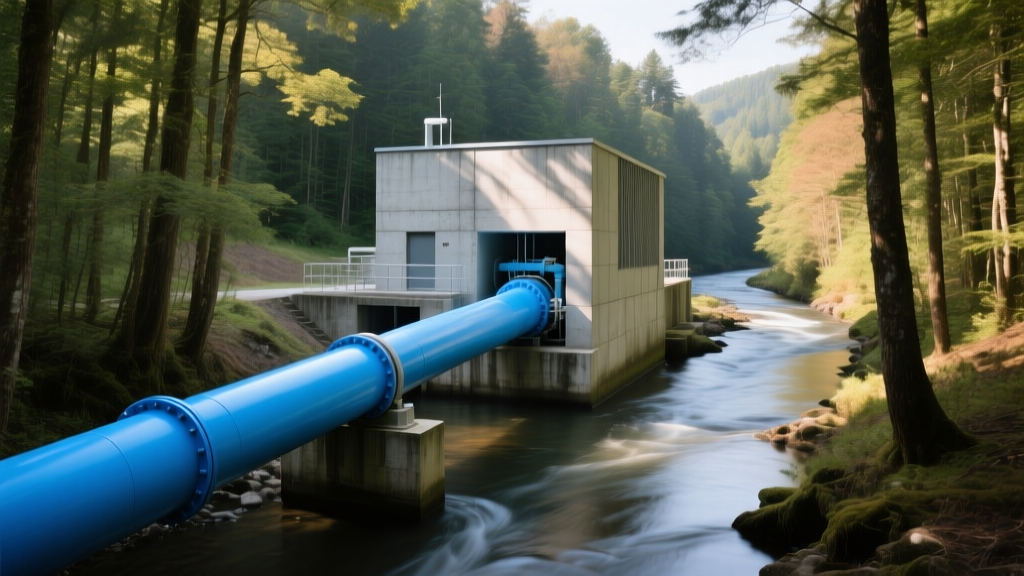
The penstock—the pipe that delivers pressurized water to the turbine—is historically one of the largest material expenses. Legacy designs default to welded or flanged carbon steel. In 2026, High-Density Polyethylene (HDPE) and Fiberglass Reinforced Pipe (FRP) are the superior financial choices for low-to-medium head sites.
For sites operating under 150 PSI of static head pressure, specifying SDR-11 (Standard Dimension Ratio) HDPE pipe reduces material costs by 30% to 40% compared to steel. Furthermore, HDPE is joined via thermal butt-fusion, eliminating the need for certified welders and X-ray weld inspections. The interior smoothness of HDPE (Hazen-Williams C-factor of 150 vs. steel's 100) also reduces friction losses, allowing you to use a slightly smaller diameter pipe while maintaining the same flow rate, compounding your savings on both materials and trenching width.
Strategy 2: Opt for Run-of-River (RoR) to Eliminate Dam Costs
Impoundment (dam-based) hydro requires massive concrete structures, spillway engineering, and extensive reservoir land acquisition. By designing a Run-of-River system, you utilize the natural flow and elevation drop of the stream without creating a large reservoir. RoR systems require only a low-profile diversion weir and a settling basin. This bypasses millions of dollars in concrete pouring, heavy earthmoving, and the multi-year environmental permitting associated with altering aquatic habitats and fish migration routes.
Strategy 3: Deploy Modular 'Skid-Mounted' Powerhouses
Constructing a custom, climate-controlled concrete powerhouse building is expensive and time-consuming. Modern micro and small-hydro developers are utilizing pre-fabricated, skid-mounted powerhouse modules. These are built in controlled factory environments, integrating the turbine, generator, electronic load controller (ELC), and switchgear onto a single steel chassis. Once the civil foundation is poured, the skid is craned into place, reducing on-site electrical and mechanical commissioning time from months to weeks.
Strategy 4: Utilize Coanda Screens for Intake Filtration
Traditional vertical bar trash racks require expensive automated mechanical rakes or constant manual labor to clear leaves, ice, and debris. If debris enters the penstock, it causes severe abrasive wear to the turbine runners. Investing $15,000 to $25,000 upfront in a Coanda-effect screen (a self-cleaning, wedge-wire screen set at a 45-degree angle) utilizes the surface tension of water to pull flow through the slots while debris slides off the face. This eliminates the need for automated rakes and reduces turbine maintenance costs by an estimated 20% over the plant's lifespan.
Strategy 5: Match the Turbine to the Specific Head/Flow Curve
Over-specifying a turbine is a common CapEx trap. Selecting the correct turbine architecture based on your exact hydraulic head (vertical drop) and flow rate (volume) prevents massive cost overruns.
Turbine Selection Matrix for Cost Optimization
- High Head / Low Flow (200m+ head): Pelton Wheel. Highest efficiency, but precision-cast stainless steel buckets are expensive. Money-Saving Tip: For micro-hydro, look for cast-iron or fabricated steel Pelton runners which cost 30% less than forged stainless, provided your water chemistry is not highly corrosive.
- Medium Head / Medium Flow (30m - 200m): Francis Turbine. Complex geometry requires expensive 5-axis CNC machining. Avoid for budget-constrained micro-projects.
- Low Head / High Flow (2m - 30m): Crossflow (Banki-Michell). The ultimate budget turbine. Its simple cylindrical design with straight blades can be manufactured by standard local machine shops, drastically cutting procurement costs and allowing for on-site bearing replacements without specialized tools.
Hidden Cost Traps and How to Avoid Them
When calculating how much it costs to build a hydroelectric plant, developers frequently underestimate secondary infrastructure and regulatory hurdles. The U.S. Department of Energy Water Power Technologies Office frequently cites grid interconnection and geotechnical surprises as the primary drivers of budget overruns.
Warning: The 3-Phase Power Proximity Trap
Your site may have perfect hydraulic conditions, but if the nearest 3-phase utility transmission line is 5 miles away, the cost to extend the grid infrastructure can easily exceed $250,000. Always conduct a utility interconnection feasibility study before purchasing land or finalizing hydrological surveys. If grid extension is cost-prohibitive, pivot the project design to an off-grid battery-inverter microgrid, though this introduces its own battery degradation CapEx.
Tip: Geotechnical Penstock Routing
Never route a penstock directly down a natural ravine or water chute without a geotech survey. Flash floods and rockfalls will destroy exposed pipes. Trenching and burying the penstock adds to initial earthwork costs but prevents catastrophic $100,000+ pipe replacement events. If trenching through solid bedrock is required, factor in $40 to $80 per linear foot for rock excavation and blasting permits.
Financial Modeling: Levelized Cost of Energy (LCOE) vs. Upfront Savings
Ultimately, the goal is not just to minimize the upfront cost to build a hydroelectric plant, but to optimize the Levelized Cost of Energy (LCOE) over a 40-to-50-year operational lifespan. Hydropower boasts some of the lowest LCOE figures in the renewable sector, frequently dropping below $0.04 per kWh once the CapEx is amortized.
However, aggressive upfront cost-cutting can ruin your LCOE. For example, saving $10,000 by purchasing a refurbished, un-governed induction generator instead of a modern permanent magnet generator (PMG) with an electronic load controller will result in poor power quality, utility grid-rejection penalties, and frequent voltage blowouts. Always evaluate material substitutions through the lens of 20-year O&M projections, not just the initial invoice.
'The most successful small-hydro projects in the 2020s are those that treat civil works as permanent, 100-year infrastructure, while treating electro-mechanical components as modular, swappable assets designed for 25-year replacement cycles.' — Industry Consensus, National Hydropower Association
Authoritative Sourcing & Next Steps
Before breaking ground, validate your site's hydrology using at least 10 years of USGS stream gauge data to account for drought cycles and climate-induced flow variations. For detailed, region-specific cost modeling and feasibility grant opportunities, consult the National Renewable Energy Laboratory (NREL) Water Power research portal. By combining modern polymer materials, modular skid designs, and rigorous site-specific turbine matching, developers can significantly compress the capital required to bring clean, baseload hydroelectric power online in 2026 and beyond.
Written by
Priya KapoorPriya Kapoor is a real estate market analyst and construction economics researcher with expertise in housing affordability, development feasibility, and infrastructure investment. She holds a Master of Regional Planning from Cornell University and previously worked as a senior analyst at CBRE's Investment Properties group, where she modeled returns for $4B in mixed-use development pipelines. Priya now runs an independent research practice advising developers, municipalities, and REITs on construction cost forecasting and market timing. She publishes the quarterly "BuildMat Market Pulse" report tracking material price indices across 12 commodity categories. Based in Austin, TX, Priya serves on the board of Habitat for Humanity Austin and is a marathon runner.
More from Priya Kapoor
View all
Construction Cost
Cost to Build a 1600 Sq Ft Home in 2026: Full Breakdown
Accurate 2026 cost to build a 1600 sq ft home—material, labor, and regional pricing breakdowns included. Plan your budget with real-time estimates.
Aug 11, 2026

Wood & Lumber
Name the Types of Wood for Pressure Treatment and Preservation
Learn how to name the types of wood best suited for pressure treatment. Compare species treatability, chemical retention levels, and 2026 preservation costs.
Aug 4, 2026

Stone & Masonry
Stone Veneer Suppliers Lindenhurst: 2026 Cost Analysis
Analyze 2026 stone veneer costs in Lindenhurst, NY. Compare local supplier pricing, delivery fees, and Suffolk County installation labor rates.
Aug 4, 2026