How Much Does It Cost to Build a Parking Ramp? 2026 Financing Guide
Discover how much it costs to build a parking ramp in 2026 and explore strategic financing options like municipal bonds, P3s, and TIF districts.

The Baseline: Calculating Parking Ramp Construction Costs
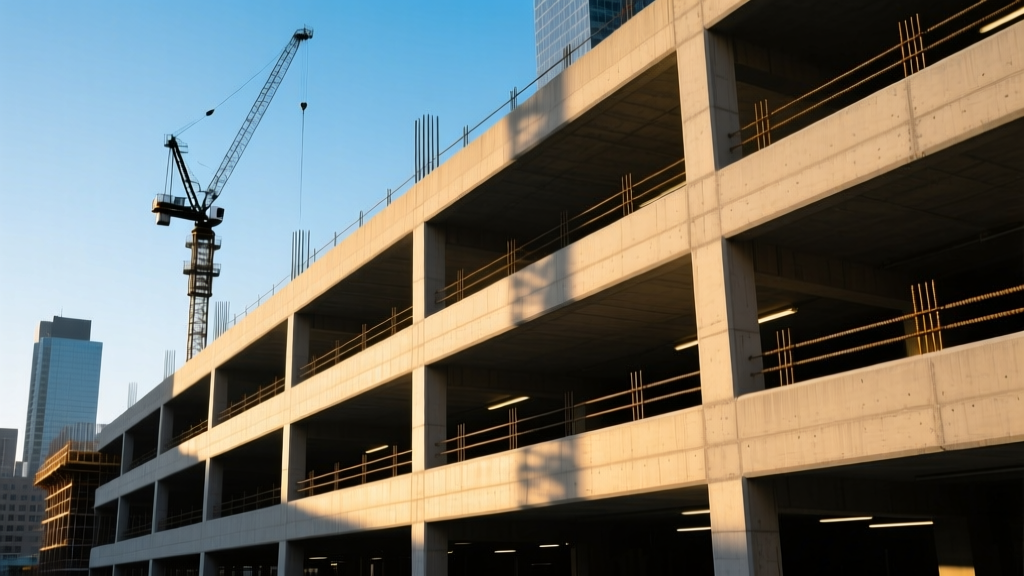
When developers, university planners, and municipal authorities ask how much does it cost to build a parking ramp, the answer requires looking beyond simple square footage. In 2026, the national average for structured parking construction ranges from $32,000 to $52,000 per parking stall, or roughly $380 to $550 per square foot. However, these hard costs are only the foundation of the financial pro forma. Structured parking is a capital-intensive asset class with long payback periods, making the financing structure just as critical as the concrete mix design.
According to research from the UCLA Institute of Transportation Studies, the true cost of parking includes land acquisition, structural engineering, and the opportunity cost of the land itself. To accurately underwrite a parking ramp project, stakeholders must first understand how structural methodologies dictate upfront capital requirements.
2026 Hard Cost Matrix by Structural Type
| Structural System | Avg. Cost per Sq. Ft. | Avg. Cost per Stall | Construction Timeline | Best Use Case |
|---|---|---|---|---|
| Cast-in-Place (CIP) Post-Tensioned | $380 - $440 | $32,000 - $38,000 | 14 - 18 months | Complex geometries, seismic zones, mixed-use podiums |
| Precast Concrete | $420 - $490 | $36,000 - $43,000 | 9 - 12 months | Repetitive layouts, fast-track municipal projects |
| Structural Steel with Concrete Deck | $480 - $550+ | $42,000 - $52,000 | 10 - 14 months | Expansions, lightweight soil conditions, architectural facades |
Structuring the Capital Stack for Structured Parking
Parking ramps rarely pencil out on pure private equity. The return on investment (ROI) is heavily dependent on local parking rates, which are often politically capped in municipal environments. Therefore, assembling a blended capital stack is mandatory for project viability. Here are the primary financing vehicles utilized in 2026:
1. Municipal Revenue Bonds
For public or quasi-public entities, issuing municipal revenue bonds is the standard approach. Unlike General Obligation (GO) bonds, which are backed by the full taxing power of a municipality, revenue bonds are repaid exclusively from the net operating income (NOI) generated by the parking facility. According to the U.S. Securities and Exchange Commission's municipal securities guidelines, investors in revenue bonds take on higher risk, which necessitates a higher yield and a rigorous feasibility study proving that parking revenues will comfortably cover debt service.
2. Tax Increment Financing (TIF)
If the parking ramp is part of a larger downtown revitalization or transit-oriented development (TOD), TIF districts can subsidize 20% to 40% of the capital cost. TIF captures the future increase in property tax revenues generated by the surrounding development and redirects those funds to pay off the parking infrastructure bonds. This effectively shifts the financial burden from the parking users to the broader economic uplift the ramp creates.
3. Public-Private Partnerships (P3)
In a P3 model, a private concessionaire designs, builds, finances, and operates the ramp in exchange for the right to collect parking revenues over a 30- to 50-year term. This transfers the construction and operational risk off the public balance sheet. The private partner typically utilizes commercial construction loans and institutional equity, demanding a higher rate of return but delivering a turnkey asset to the city or university.
Underwriting the Asset: What Lenders Scrutinize
Whether you are approaching a commercial bank for a construction loan or a bond underwriter for municipal debt, the underwriting process for a parking ramp hinges on specific financial metrics. Lenders do not just look at the physical cost; they stress-test the revenue model.
- Debt Service Coverage Ratio (DSCR): Lenders typically require a minimum DSCR of 1.25x to 1.35x for parking revenue bonds. If your annual debt service is $1,000,000, the ramp must generate at least $1,250,000 in net operating income. Because parking demand fluctuates with economic cycles and remote-work trends, lenders apply a 15% to 20% haircut to projected revenues during underwriting.
- EV Infrastructure and C-PACE Financing: In 2026, integrating Electric Vehicle (EV) charging infrastructure is no longer optional for commercial ramps. To offset the $15,000 to $25,000 per Level 2 charger installation cost, developers are utilizing C-PACE (Commercial Property Assessed Clean Energy) financing. C-PACE allows owners to finance energy-efficient upgrades (like solar canopies and EV chargers) through a voluntary property tax assessment, keeping upfront capital costs low and preserving senior debt capacity.
- Operational OpEx Ratios: The International Parking & Mobility Institute (IPMI) notes that modern ramps utilizing Automated License Plate Recognition (ALPR) and ticketless payment systems reduce operational expenses by up to 22% compared to traditional gated systems with manual cashiers. Lenders favor these automated pro formas due to lower long-term labor liabilities.
Overbuilding parking is a primary cause of municipal debt defaults. A 2025 urban planning audit revealed that downtown ramps built with more than 1.5 spaces per 1,000 square feet of adjacent commercial space frequently fail to achieve a 1.15x DSCR. Always conduct a shared-parking analysis—leveraging the fact that office parking peaks at 11:00 AM and residential/retail parking peaks at 8:00 PM—to reduce total stall counts by 15% to 25% without impacting user experience.
Hidden Soft Costs That Derail Pro Formas
When calculating how much it costs to build a parking ramp, amateur developers often isolate the hard construction costs and ignore the soft costs, which typically consume 18% to 28% of the total project budget. A realistic 2026 financing pro forma must allocate capital for the following:
- Geotechnical and Environmental Remediation ($150,000 - $500,000+): Urban infill sites frequently require deep soil nailing, dewatering, or hazardous material abatement before excavation can begin.
- Traffic Impact Studies (TIS) and Entitlements ($75,000 - $150,000): Municipalities require rigorous modeling to prove the new ramp ingress/egress points will not degrade the Level of Service (LOS) at adjacent intersections.
- Bond Issuance and Legal Fees (1.5% - 3.0% of total debt): If utilizing municipal bonds, underwriter discounts, bond counsel, and rating agency fees (Moody's, S&P) represent significant upfront cash requirements that must be funded from the initial bond proceeds.
- Architectural and MEP Engineering (8% - 12% of hard costs): Modern ramps require complex mechanical ventilation systems (jet fans), fire suppression, and high-efficiency LED lighting networks integrated with daylight harvesting sensors.
Strategic Decision Framework: Choosing Your Financing Path
Selecting the right financing mechanism depends entirely on the ownership structure, risk tolerance, and adjacent land use. Use this framework to determine your optimal capital strategy:
| Project Scenario | Recommended Financing Vehicle | Key Advantage |
|---|---|---|
| Standalone municipal garage in a revitalizing downtown | Tax Increment Financing (TIF) + Revenue Bonds | Subsidizes capital costs via future property tax growth; preserves city general fund. |
| University or Hospital expansion with guaranteed user base | General Obligation (GO) Bonds or Institutional Debt | Lowest possible interest rates due to institutional credit rating and guaranteed demand. |
| Private mixed-use development with residential/retail | Commercial Construction Loan + C-PACE for EV/Solar | Speed to market; C-PACE preserves senior debt capacity for the higher-margin residential components. |
| Large-scale transit hub with high public utility but low direct revenue | Public-Private Partnership (P3) + Federal Grants | Transfers operational risk to private sector; leverages federal DOT/FTA infrastructure grants. |
Ultimately, answering how much it costs to build a parking ramp is an exercise in financial engineering as much as structural engineering. By aligning the physical construction methodology (like post-tensioned concrete) with a sophisticated, blended capital stack (incorporating TIF, C-PACE, or P3 models), developers and municipalities can deliver vital infrastructure without overleveraging their balance sheets.
Written by
Marcus ChenMarcus Chen is a licensed structural engineer (PE) and building materials analyst with over 12 years of experience across residential, commercial, and industrial construction. He holds a Master of Science in Civil Engineering from UC Berkeley and spent six years at Thornton Tomasetti before transitioning to independent consulting and technical writing. Marcus specializes in material selection for seismic-prone regions, concrete reinforcement strategies, and lifecycle cost analysis. His work has been cited by the American Concrete Institute (ACI) and the Structural Engineers Association of California (SEAOC). When he is not on a job site or at his desk, you will find him hiking the Sierra Nevada or restoring a 1920s craftsman bungalow in Oakland, CA.
More from Marcus Chen
View all
Construction Cost
How Much Did the Eiffel Tower Cost to Build?
How much did the Eiffel Tower cost to build in 1889? We adjust for inflation and compare its budget to modern skyscraper construction.
Aug 4, 2026

Fire Resistance
What Is a Fire Resistant Material? Testing & Certification Guide
Discover what is a fire resistant material through ASTM and UL testing. Learn how fire ratings, certifications, and assemblies work in construction.
Aug 4, 2026

Construction Cost
How Much Did the Burj Khalifa Cost to Build?
How much did the Burj Khalifa cost to build? We break down the $1.5B project and extract 5 money-saving strategies for your next build.
Jul 30, 2026