Cost to Build Custom Luxury Home: Size & Scope Calculator
Calculate the true cost to build a custom luxury home. Explore size multipliers, high-end scope matrices, and hidden site expenses for 2026 estates.
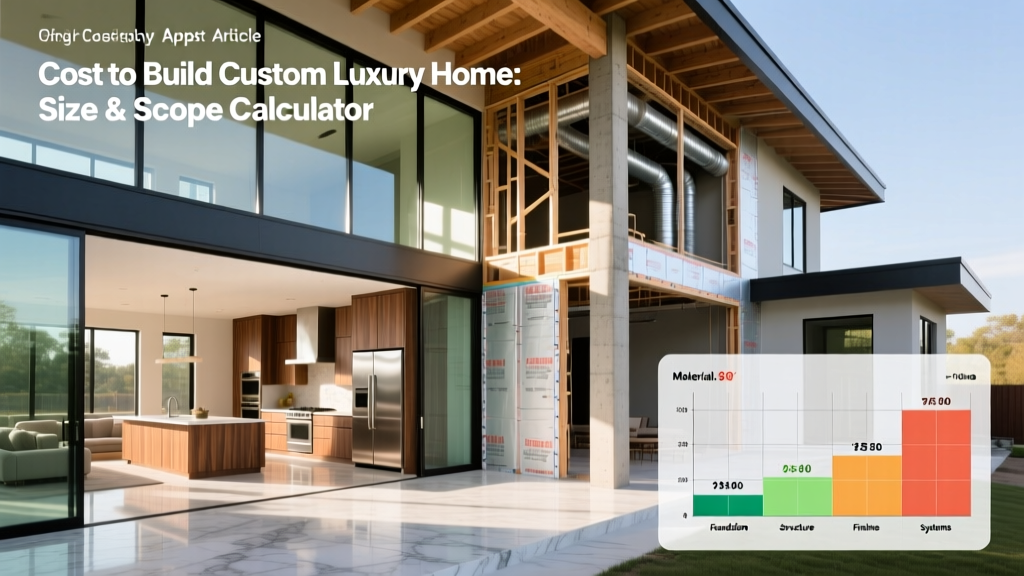
The Mathematics of High-End Residential Construction
Estimating the cost to build a custom luxury home requires abandoning standard production-builder metrics. While a standard custom home might scale linearly at $250 to $350 per square foot, luxury and ultra-luxury estates operate on a non-linear cost curve. The National Association of Home Builders (NAHB) consistently highlights that high-end architectural complexity, premium material sourcing, and advanced mechanical systems create massive fixed-cost baselines that distort simple price-per-square-foot calculators.
• Custom Home: $300 - $450 / sq. ft. (Upgraded finishes, standard architectural plans, conventional HVAC).
• Luxury Custom: $500 - $850 / sq. ft. (Architect-designed, premium appliances, smart home integration, complex rooflines).
• Ultra-Luxury Estate: $1,000 - $2,500+ / sq. ft. (Bespoke millwork, imported stone, geothermal/net-zero systems, extreme site engineering).
Core Cost Drivers: Size, Scope, and Site Complexity
When calculating the cost to build a custom luxury home, square footage is only one variable. The "Size & Scope" calculator must account for the ratio of high-cost wet spaces (kitchens, bathrooms, laundry) to low-cost dry spaces (bedrooms, hallways). A 6,000-square-foot home with six en-suite bathrooms and a commercial-grade kitchen will cost significantly more per square foot than an 8,000-square-foot home with vast, open gallery spaces and fewer plumbing stacks.
| Scope Variable | Standard Custom Impact | Luxury Multiplier Impact |
|---|---|---|
| Lot Topography (Sloped >15%) | +10% to foundation budget | +35% (Requires MSE retaining walls, stepped foundations, advanced drainage) |
| Roof Pitch & Complexity | +5% to framing budget | +25% (Standing seam copper, slate, or complex timber trusses) |
| Glazing (Window-to-Wall Ratio) | Standard vinyl/wood-clad | +40% (Thermally broken steel or Marvin Ultimate Wood Casement at $1,500+ per unit) |
| MEP Systems | Forced air gas/electric | +60% (WaterFurnace 700A11 geothermal, ERV systems, radiant floor heating) |
The Scope Multiplier Matrix: Room-by-Room Breakdown
Luxury budgets are heavily front-loaded into specific zones. To accurately estimate your build, apply these scope multipliers to your base construction costs. According to high-end architectural firms and data referenced by the American Institute of Architects (AIA), the primary suite and kitchen routinely consume 25% to 30% of the total interior build budget, regardless of the home's total square footage.
Kitchen and Culinary Spaces
A standard custom kitchen might cost $60,000 to $90,000. A luxury culinary space featuring a Sub-Zero PRO 48 refrigerator ($16,000), Wolf dual-fuel range ($14,000), custom inset cabinetry with dovetail joinery ($80,000+), and book-matched Calacatta Borghini marble island countertops ($25,000) easily pushes the scope cost past $200,000. Adding a secondary prep kitchen or butler's pantry with dedicated ventilation adds another $65,000 to $95,000.
Primary Bathroom and Spa Zones
Luxury primary bathrooms transcend basic plumbing. Scope calculations must include structural reinforcement for freestanding soaking tubs (e.g., Victoria + Albert Amiata, $6,500), waterproofing for curbless wet rooms using Schlüter Kerdi-Board, and dedicated steam generators like the Mr. Steam Aromatherapy system ($4,500 plus $3,000 for custom glass enclosures). Expect luxury primary bath scopes to range from $85,000 to $140,000.
Hidden Scope Creep: Where Luxury Budgets Fail
The most common failure mode in luxury construction estimating is under-scoping the "invisible" infrastructure. High-end homes demand commercial-grade performance hidden behind residential aesthetics.
Geotechnical and Site Prep Anomalies
Luxury estates are frequently built on challenging, scenic lots. Standard soil borings might miss subsurface bedrock or high water tables. If your site requires blasting to achieve a walk-out lower level, add $30,000 to $75,000 to the site prep budget. Furthermore, if the local municipality mandates advanced stormwater retention, you may need to install underground cisterns or permeable paver systems, adding $20,000 to $45,000.
MEP Over-Engineering and Smart Home Brains
A luxury home requires robust mechanical, electrical, and plumbing (MEP) systems. Standard 200-amp electrical panels are insufficient. Expect to install dual 400-amp services ($8,000+) to support EV charging (e.g., Tesla Wall Connector), whole-home backup generators (Generac 26kW Protector Series, $18,000 installed), and extensive AV/smart home infrastructure. A fully integrated Lutron RadioRA 3 or Crestron Home system, encompassing motorized shading, architectural lighting, and climate control, requires dedicated low-voltage wiring and rack space, adding $45,000 to $120,000 to the electrical scope.
Building a luxury home to net-zero energy standards—as promoted by the U.S. Department of Energy (DOE)—requires a highly insulated building envelope (R-40+ walls, R-60+ roofs) and triple-pane glazing. While this reduces long-term operational costs, expect an upfront scope premium of 8% to 12% on the total build cost.
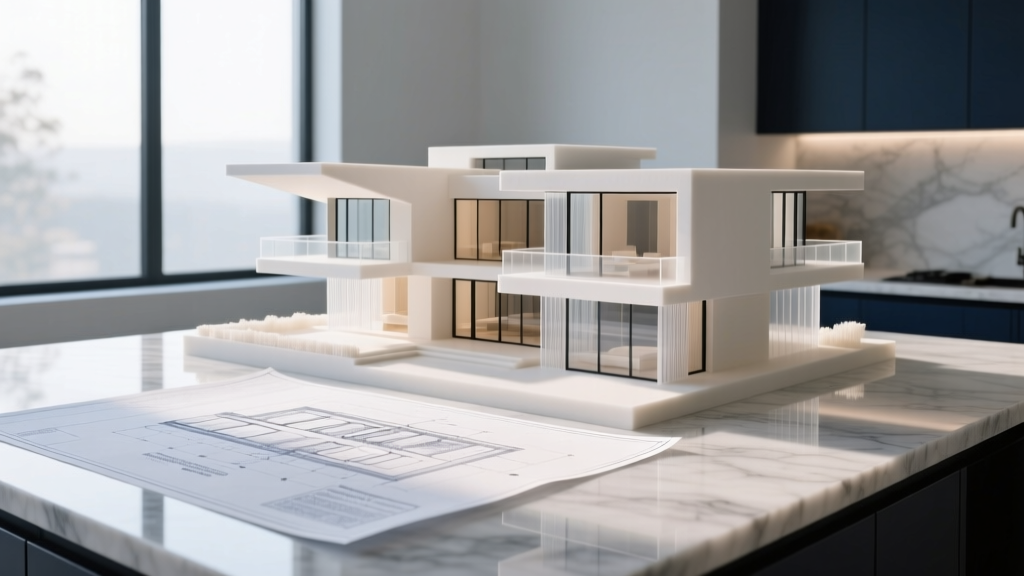
Step-by-Step: Calculating Your Custom Luxury Build
Use this sequential framework to build a reliable size and scope estimate before engaging a general contractor.
- Establish the Base Shell Cost: Multiply your target heated square footage by the regional luxury baseline (e.g., $600/sq. ft. in the Sunbelt, $850/sq. ft. in the Northeast). This covers foundation, framing, roofing, and basic exterior cladding.
- Apply the Topography Multiplier: If your lot is sloped, heavily wooded, or requires extensive grading, multiply the site work portion of your budget by 1.5x to 2.0x.
- Calculate Wet Space Premiums: Isolate the square footage of kitchens, bathrooms, and laundry. Apply a 2.5x cost multiplier to these specific zones to account for premium tile, custom millwork, and high-end fixtures.
- Add Fixed-Cost Luxury Systems: Add flat-rate estimates for non-linear scope items: Geothermal HVAC ($45,000+), Smart Home Integration ($60,000+), Home Theater ($50,000+), and Wine Cellar with active cooling like CellarPro 8000VSX ($35,000+).
- Factor in Soft Costs and Contingency: Architectural and engineering fees typically run 8% to 15% of construction costs for luxury builds. Add a 15% contingency fund specifically earmarked for material lead-time delays and supply chain substitutions.
"In luxury construction, the cost per square foot is a lagging indicator, not a leading one. You must calculate the fixed costs of the owner's non-negotiable scope items first, then divide the remaining budget by the desired square footage to see what envelope and finishes are actually achievable."
Sourcing and Supply Chain Realities for Premium Materials
Finally, the size and scope calculator must account for time as a financial metric. Sourcing imported materials for luxury estates introduces severe lead times that can stall framing or finishing crews. Hand-forged architectural hardware from European foundries, custom-milled wide-plank European white oak flooring, and bespoke bronze window frames routinely carry 16- to 24-week lead times. When calculating your construction loan interest reserves, ensure your financial scope includes a minimum 14-month timeline for homes exceeding 6,000 square feet, factoring in the inevitable material delays inherent to high-end global supply chains.
Written by
Sarah WhitfieldSarah Whitfield is a chartered quantity surveyor (MRICS) and construction cost analyst with 15 years of experience in material pricing, procurement strategy, and project budgeting. She earned her degree in Construction Management from the University of Reading (UK) and has worked on projects ranging from $2M custom homes to $180M mixed-use developments across North America and Europe. Sarah currently leads cost estimating for BuildMat Insight, maintaining a proprietary database of 4,000+ material price points updated quarterly. She is a frequent contributor to RSMeans cost data panels and has presented at the International Cost Engineering Council (ICEC) congress. Based in Denver, CO, Sarah is an avid trail runner and volunteer mentor for Women in Construction.
More from Sarah Whitfield
View all
Wood & Lumber
What Are the Different Types of Wood? A Builder's Guide
Compare structural softwoods, finish hardwoods, and engineered lumber. Analyze Janka ratings, MOE values, and 2026 pricing for construction.
Aug 4, 2026

Walls & Panels
Steel Framing vs Wood Framing: Corrosion and Moisture Defense
Compare steel framing vs wood framing for moisture resistance. Learn about galvanized coatings, condensation risks, and corrosion protection strategies.
Jul 21, 2026

Stone & Masonry
How to Cut Stone Veneer: Wet Saw vs Grinder Comparison
Compare the best tools for cutting stone veneer. We review wet saws, angle grinders, and chop saws to help you achieve clean, chip-free cuts.
Jul 21, 2026