Cost to Build an Inground Swimming Pool: Size & Scope Calculator
Calculate the exact cost to build an inground swimming pool. Break down pricing by size, material (gunite, fiberglass, vinyl), and site scope.

The True Cost to Build an Inground Swimming Pool
Estimating the cost to build an inground swimming pool requires moving beyond basic square-footage averages. A pool is a complex civil engineering project that integrates hydraulics, structural concrete, electrical engineering, and landscape architecture. In 2026, supply chain stabilization has normalized material costs, but specialized labor and site-specific variables remain the primary cost drivers.
- Vinyl Liner: $65 - $90 per sq. ft. of water surface area.
- Fiberglass Shell: $80 - $115 per sq. ft. of water surface area.
- Gunite/Concrete: $105 - $160+ per sq. ft. of water surface area.
Note: These baselines assume standard soil conditions, basic broom-finished concrete decking, and mid-tier variable-speed equipment. They do not include extensive hardscaping, retaining walls, or rock excavation.
Size Multipliers: Pricing by Pool Dimensions
The relationship between pool size and cost is not strictly linear. As dimensions increase, the perimeter-to-area ratio decreases, making larger pools slightly more cost-efficient per square foot. However, absolute costs scale significantly due to increased excavation volume, larger equipment requirements, and expanded decking footprints.
| Pool Dimensions | Surface Area | Volume (Avg Depth 5.5ft) | Vinyl Est. Cost | Fiberglass Est. Cost | Gunite Est. Cost |
|---|---|---|---|---|---|
| 10' x 20' (Small/Plunge) | 200 sq. ft. | 8,250 gal | $18,000 - $24,000 | $22,000 - $28,000 | $28,000 - $36,000 |
| 14' x 28' (Standard) | 392 sq. ft. | 16,170 gal | $32,000 - $42,000 | $40,000 - $52,000 | $52,000 - $68,000 |
| 16' x 32' (Large) | 512 sq. ft. | 21,120 gal | $40,000 - $52,000 | $52,000 - $68,000 | $68,000 - $88,000 |
| 20' x 40' (Estate) | 800 sq. ft. | 33,000 gal | $58,000 - $75,000 | N/A (Transport limits) | $95,000 - $135,000+ |
Material Scope: Vinyl vs. Fiberglass vs. Gunite
The structural shell dictates the baseline budget, maintenance trajectory, and design flexibility. Each material requires a fundamentally different construction methodology.
Gunite and Shotcrete (Custom Build)
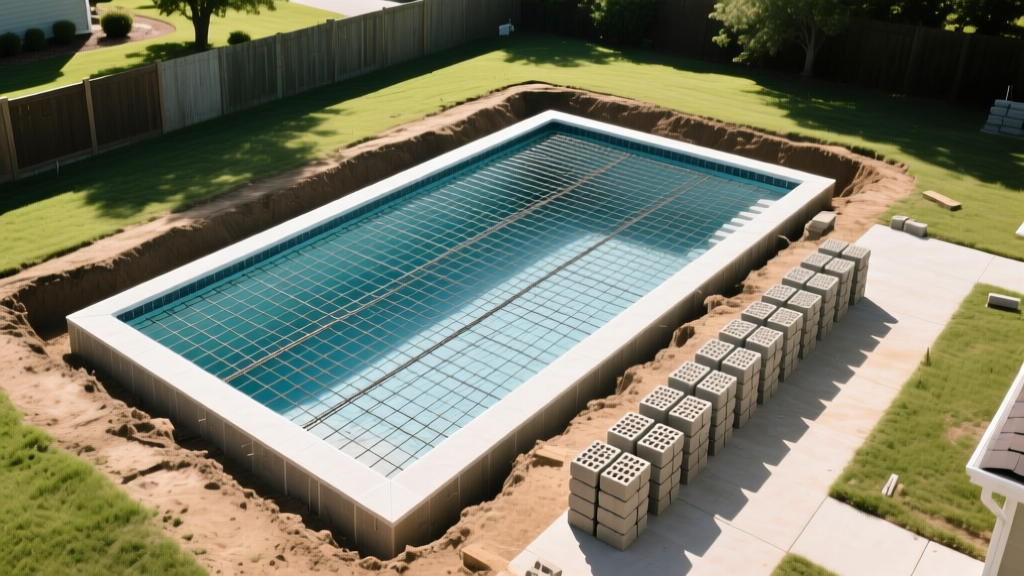
Gunite (dry-mix) and shotcrete (wet-mix) are pneumatically applied concrete mixtures sprayed over a 3/8-inch or 1/2-inch steel rebar grid tied at 10-inch to 12-inch intervals. The shell thickness must be a minimum of 8 to 10 inches to meet structural engineering standards.
- Interior Finish: Standard white Marcite lasts 7-10 years. Upgrading to an exposed aggregate finish like PebbleTec PebbleFina or QuartzScapes adds $6,000 to $12,000 but extends the lifespan to 20+ years.
- Scope Advantage: Infinite customization. You can integrate vanishing edges, tanning ledges, and integrated spas without structural seams.
Fiberglass Shells (Pre-Manufactured)
Fiberglass pools are manufactured off-site in a single piece and lowered into the excavation via a crane. The gelcoat surface is non-porous, significantly reducing algae growth and chemical usage.
- Logistical Constraints: Shells wider than 12 feet or longer than 40 feet require specialized wide-load permits and police escorts, which can add $2,000 to $5,000 to the logistics scope. Crane lifts cost $1,500 to $4,500 depending on reach and boom weight requirements.
- Backfill Requirement: Must be backfilled with clean, crushed gravel (typically 3/8-inch chip stone) rather than native dirt to prevent hydrostatic pressure from cracking the shell.
Vinyl Liner (Modular Kits)
Vinyl pools utilize modular wall panels (galvanized steel, polymer, or aluminum) braced by concrete collars, with a custom-cut 20-mil to 30-mil vinyl membrane stretched over a vermiculite or Portland cement sand-mix floor.
- Lifecycle Cost: While the initial cost to build an inground swimming pool with vinyl is lowest, the liner must be replaced every 8 to 12 years at a cost of $4,500 to $7,500 per replacement.
- Scope Limitation: Strictly limited to the manufacturer's pre-engineered wall panel shapes. Custom freeform designs are difficult and expensive to execute.
The Hidden Scope Variables: Excavation, Soil, and Access
Site conditions can inflate a pool budget by 20% to 40%. Before signing a contract, mandate a geotechnical soil analysis ($800 - $1,500) to identify subsurface risks.
- Bedrock/Limestone: If a Bobcat T770 or similar compact track loader cannot break the substrate, you will need mechanical rock hammers or blasting. Rock excavation adds $5,000 to $18,000 to the scope.
- High Water Table: Requires a permanent gravel sump pit and a hydrostatic relief valve in the pool floor to prevent the empty shell from 'floating' out of the ground during heavy rains.
- Limited Access: If a standard mini-excavator cannot fit through the side yard (requires minimum 8-foot clearance), contractors must use micro-equipment or hand-dig, tripling labor hours.
Decking, Coping, and Hardscape Integration
The pool shell is only half the project. The surrounding hardscape dictates the final aesthetic and functional budget. Coping (the cap on the pool edge) and decking must be calculated separately.
| Decking Material | Cost per Sq. Ft. (Installed) | Heat Retention | Durability & Maintenance |
|---|---|---|---|
| Broom-Finished Concrete | $8 - $12 | High | Prone to cracking; requires sealing every 2 years. |
| Stamped/Colored Concrete | $14 - $22 | High | Slippery when wet; color can fade under UV exposure. |
| Travertine Pavers | $20 - $32 | Low (Stays cool) | Excellent; naturally slip-resistant and durable. |
| Exposed Aggregate | $12 - $18 | Medium | Highly slip-resistant; rough on bare feet. |
| Porcelain Pavers | $28 - $45 | Low | Impervious to water and freeze/thaw cycles. |
Plumbing, Electrical, and Equipment Pad
Modern pool hydraulics prioritize energy efficiency and flow dynamics. According to the U.S. Department of Energy, upgrading to a variable-speed pump is the single most effective way to reduce long-term operational costs.
- Plumbing Scope: Insist on Schedule 40 PVC (or Schedule 80 for equipment pads) with a minimum 2-inch diameter for all suction and return lines. Using 1.5-inch pipe increases 'head loss' (friction), forcing the pump to work harder and consume more electricity.
- Equipment Upgrades: A standard single-speed pump costs $600, but a premium variable-speed model like the Pentair IntelliFlo3 VSF costs $1,800 - $2,400 installed. It pays for itself in energy savings within 18 to 24 months.
- Sanitation: Saltwater chlorine generators (e.g., Hayward AquaRite) cost $1,200 - $1,800 installed. For commercial-grade sanitation, UV-C or Ozone systems add $1,500 - $3,000 but drastically reduce chlorine dependency.
- Automation: Smart control systems like the Pentair IntelliCenter allow mobile management of heating, lighting, and variable-speed pump schedules, adding $3,500 - $5,500 to the electrical scope.
Regulatory Compliance and Safety Barriers
Every municipality enforces strict barrier codes to prevent unauthorized access. The U.S. Consumer Product Safety Commission (Pool Safely) mandates specific barrier heights, gate latching mechanisms, and entrapment avoidance standards. Furthermore, the Pool & Hot Tub Alliance (PHTA) provides the ANSI/APSP standards that most local building departments adopt.
Permitting & Barrier Budgeting: Allocate $500 to $1,500 for municipal building and electrical permits. For safety barriers, a 48-inch removable mesh fence (ASTM F2286 compliant) costs $15 to $25 per linear foot, while wrought iron or glass panel enclosures can exceed $100 per linear foot. Ensure all main drains are equipped with SVRS (Suction Vacuum Release Systems) or dual-drain configurations to prevent entrapment.
Step-by-Step Scope Calculation Formula
To calculate your specific project budget, use this sequential framework:
- Base Shell Cost: Multiply your desired water surface area (Length x Width) by the material multiplier (Vinyl: $75 | Fiberglass: $95 | Gunite: $130).
- Site Prep Multiplier: Add $2,500 for standard dirt excavation. Add $8,000+ if geotech reports indicate rock or if crane access is required for fiberglass.
- Decking Footprint: Calculate the total square footage of your planned deck. Multiply by your chosen material cost (e.g., 800 sq. ft. of Travertine x $25 = $20,000).
- Equipment & Upgrades: Add baseline equipment ($4,000) plus specific upgrades (Salt system: +$1,500 | Automation: +$4,500 | Heater: +$3,500).
- Soft Costs & Contingency: Add permits ($1,000), safety barriers ($2,500), and a mandatory 15% contingency fund for unforeseen subsurface conditions or design changes during construction.
By systematically isolating each variable—from the structural rebar grid to the variable-speed pump hydraulics—you can accurately forecast the cost to build an inground swimming pool and prevent the budget overruns that plague poorly scoped projects.
Written by
James ThorntonJames Thornton is a construction industry veteran with 25 years of hands-on experience in wood framing, lumber grading, and residential building codes. He started as a framing carpenter in rural Oregon, earned his ICC Residential Building Inspector certification, and eventually became a senior plan reviewer for the City of Portland Bureau of Development Services. James holds a B.S. in Wood Science & Technology from Oregon State University and is a certified lumber grader through the West Coast Lumber Inspection Bureau (WCLIB). He has inspected over 3,000 residential construction sites and authored the city's internal guide on advanced framing techniques (2x6 at 24" O.C.). James lives in Bend, OR, where he builds custom timber-frame cabins and competes in lumberjack sports.
More from James Thornton
View all
Insulation
Best Home Insulation Materials: Complete 2026 Guide
Compare top home insulation materials for 2026. Find R-values, installed costs per square foot, and best uses for fiberglass, spray foam, and mineral wool.
Aug 4, 2026

Sustainable Building
Certify Your Green Building Material for LEED and WELL
Step-by-step guide to certifying a green building material for LEED v5 and WELL v2. Master EPDs, HPDs, and VOC limits for 2026 project specifications.
Aug 4, 2026

Stone & Masonry
Veneer Stacked Stone Panels: Interior Design & Style Showcase
Discover how veneer stacked stone panels transform interiors. Explore modern design profiles, material pairings, and technical installation specs.
Aug 4, 2026