Lucas Oil Stadium Cost to Build: Original vs 2026 Estimates
Analyze the original Lucas Oil Stadium cost to build and calculate 2026 construction estimates using modern material, labor, and tech indices.

The Original $720 Million Blueprint: Where the Money Went
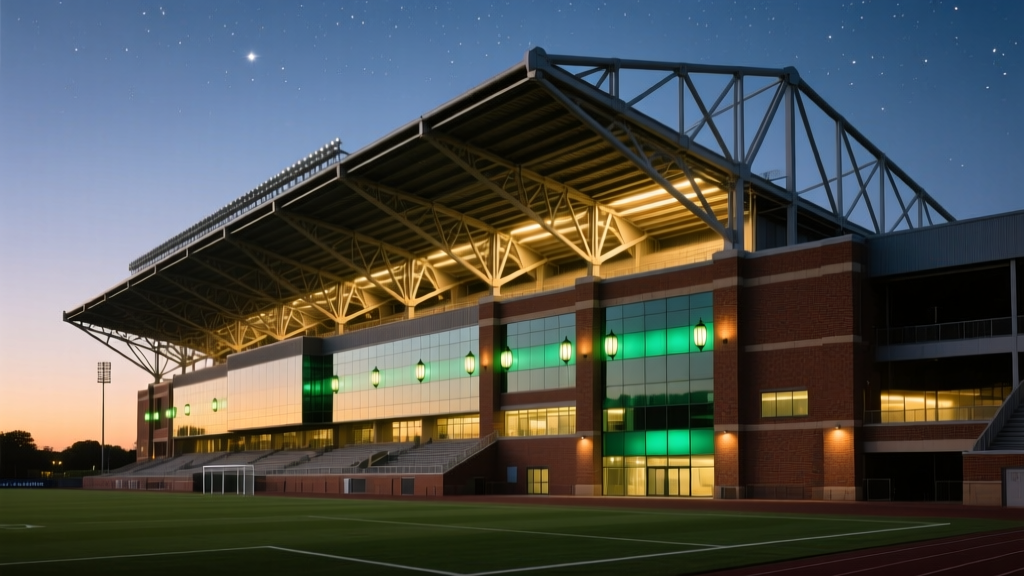
When the Indianapolis Colts broke ground on their new home in 2005, the Lucas Oil Stadium cost to build was pegged at an ambitious $720 million. Completed in 2008, the 1.8-million-square-foot venue replaced the aging RCA Dome and introduced a cable-supported retractable roof, a massive brick-and-glass facade honoring the city’s industrial heritage, and a seating capacity of 67,000 (expandable to 70,000 for Super Bowls). For construction estimators and budget planners, dissecting this historical mega-project provides a masterclass in allocating capital across complex structural, mechanical, and architectural disciplines.
The original budget was heavily weighted toward structural steel and the custom roof mechanism. Unlike rigid-truss retractable roofs (such as AT&T Stadium in Arlington), Lucas Oil Stadium utilizes a lightweight, cable-supported ETFE (ethylene tetrafluoroethylene) and glass system. This design choice saved approximately $40 million in structural steel tonnage but required highly specialized rigging labor and precision tensioning engineering.
2008 Capital Expenditure Breakdown
| Construction Category | 2008 Estimated Cost | Percentage of Total | Key Material / Scope |
|---|---|---|---|
| Site Work & Excavation | $45,000,000 | 6.2% | 1.2M cubic yards earthmoving, deep foundation piers |
| Concrete & Masonry | $112,000,000 | 15.5% | Custom brick facade, cast-in-place seating bowls |
| Structural Steel | $98,000,000 | 13.6% | 31,000 tons of structural and architectural steel |
| Roofing & Mechanisms | $85,000,000 | 11.8% | Cable-supported ETFE, glass panels, motorized tracks |
| MEP Systems | $135,000,000 | 18.7% | High-capacity HVAC, backup generators, plumbing |
| Interiors & Finishes | $105,000,000 | 14.5% | Club suites, locker rooms, concourse concessions |
| Soft Costs & Contingency | $140,000,000 | 19.4% | Architectural fees, permits, 10% risk contingency |
| Total Original Cost | $720,000,000 | 100% | Design-Build delivery method (HNTB/Barton Malow) |
Adjusting for 2026: What Would Lucas Oil Stadium Cost Today?
To understand the true Lucas Oil Stadium cost to build in today's economic climate, we must apply modern construction cost indices. According to the Engineering News-Record (ENR) Construction Cost Index, baseline construction costs have surged dramatically since 2008. However, stadium construction does not scale linearly with the ENR index; it is subject to severe premiums in specialized labor, supply chain volatility for custom steel, and advanced technology integration.
Material Cost Escalations (2008 vs. 2026)
Data from the Bureau of Labor Statistics Producer Price Index (PPI) highlights the specific material bottlenecks driving modern stadium budgets:
- Structural Steel: In 2008, fabricated structural steel averaged $1,800 per ton. In 2026, with global tariffs, decarbonization mandates for green steel, and supply chain friction, budget planners must allocate $3,400 to $3,900 per ton. For a 31,000-ton project, this single line item adds nearly $60 million to the budget.
- Custom Brick & Masonry: The stadium’s iconic exterior required millions of custom-molded bricks. Masonry labor shortages in 2026 dictate a 45% premium on labor rates compared to 2008, pushing the facade budget from $35 million to over $65 million.
- ETFE Foil & Cable Systems: ETFE remains highly specialized. With fewer than a dozen global manufacturers capable of producing stadium-grade, UV-resistant, multi-layer ETFE cushions, lead times have stretched to 14 months, requiring heavy early-procurement capital and storage costs.
Modern Upgrades Driving 2026 Budget Expansions
A 2026 budget cannot simply replicate 2008 specifications. Modern sports venues are essentially massive, high-density smart cities. Budget planners must account for technological and sustainability mandates that were either in their infancy or non-existent during the original Lucas Oil Stadium build.
1. Digital Infrastructure and Connectivity
In 2008, stadium Wi-Fi was a novelty. Today, a venue hosting 70,000 fans requires a dense, high-bandwidth network to support mobile ticketing, instant replay streaming, and point-of-sale systems. A 2026 budget must include:
- Wi-Fi 7 and 5G DAS (Distributed Antenna Systems): Installing under-seat antennas and neutral-host 5G nodes requires $45 million to $60 million in specialized low-voltage cabling and hardware.
- Fiber-Optic Backbone: Replacing legacy copper with single-mode fiber throughout the 1.8 million square feet adds $12 million in material and specialized splicing labor.
2. Sustainability and MEP Complexities
Modern venues are expected to achieve LEED v4.1 Gold or Platinum certification. This impacts the mechanical, electrical, and plumbing (MEP) budget significantly:
- Electrification & HVAC: Moving away from natural gas boilers to industrial-scale electric heat pumps and chilled-beam systems to reduce Scope 1 emissions. This adds approximately $25 million to the MEP baseline.
- Water Reclamation: Greywater recycling systems for concourse restrooms and field irrigation, requiring dual-plumbing infrastructure during the concrete pouring phase.
Budget Planning Framework for Mega-Scale Sports Venues
For estimators and capital planners analyzing the Lucas Oil Stadium cost to build as a benchmark for future projects, historical data must be filtered through a modern risk-assessment matrix. Mega-projects (>$1B) suffer from unique failure modes that standard commercial contingency models fail to capture.
The 2026 Contingency Allocation Matrix
| Risk Category | Standard Commercial Contingency | 2026 Stadium Contingency Requirement | Primary Trigger / Failure Mode |
|---|---|---|---|
| Design & Engineering | 5% | 12% | Clash detection failures in dense MEP/Structural zones |
| Supply Chain & Procurement | 3% | 10% | Custom ETFE/Steel delays, port congestion, tariff shifts |
| Labor Availability | 4% | 15% | Shortage of certified welders, heavy-lift crane operators |
| Regulatory & Permitting | 2% | 5% | Evolving FAA airspace restrictions for retractable roofs |
| Total Recommended Contingency | 14% | 42% (Phased release) | Must be held in an escrowed project risk fund |
Financing and Public-Private Cost Sharing Models
Understanding the Lucas Oil Stadium cost to build also requires examining the capital stack. The original $720 million was funded through a public-private partnership (P3). The State of Indiana and the City of Indianapolis covered roughly $620 million via a capital improvement fund backed by a 1% food and beverage tax, a 1% car rental tax, and a $1 ticket surcharge. The Colts organization contributed $100 million.
In 2026, municipal appetites for direct tax-funded stadium subsidies have contracted. Modern budget planners must structure deals that leverage private capital, stadium naming rights (which now command $20M+ annually for 20-year terms), and localized real estate development rights. A 2026 feasibility study must include the cost of adjacent mixed-use entertainment districts, as the stadium alone rarely achieves a standalone positive ROI without the surrounding year-round revenue ecosystem.
Ultimately, whether analyzing the Indianapolis Colts' official stadium history or projecting costs for a new franchise venue, the core lesson remains: the physical structure is only half the battle. The integration of digital infrastructure, sustainable MEP systems, and rigorous, phase-gated contingency planning will define the financial success of any 2026 mega-venue development.
Written by
David NakamuraDavid Nakamura is a licensed architect (AIA) and construction technology writer focused on sustainable building methods, mass timber engineering, and high-performance building envelopes. He holds a Master of Architecture from the University of Washington and is a certified Passive House Consultant (CPHC). David spent eight years at the Seattle firm Mithun, where he led the design of three LEED Platinum projects, before founding his own practice specializing in net-zero residential design. He serves on the editorial advisory board of GreenBuilder Magazine and has authored peer-reviewed papers on cross-laminated timber (CLT) connections for the Journal of Structural Engineering. In his spare time, David teaches woodworking at Pratt Fine Arts Center and kayaks the Puget Sound.
More from David Nakamura
View all
Construction Cost
Labor Cost to Build a Deck Per Sq Ft: 2026 Installation Guide
Discover the exact labor cost to build a deck per sq ft in 2026. This installation guide breaks down contractor rates, complexity factors, and hidden fees.
Aug 4, 2026

Construction Cost
How Much Does It Cost to Build a 3 Bedroom House? Financing Guide
Learn exactly how much it costs to build a 3 bedroom house and explore 2026 financing options, construction loan types, and budget frameworks for your build.
Aug 4, 2026

Construction Cost
Cost to Build a Tennis Court: 2026 Guide
How much does it cost to build a tennis court in 2026? Breakdowns for asphalt, concrete, and synthetic surfaces plus fencing and lighting.
Jul 30, 2026