The Real Cost to Build a Luxury Home: 2026 Budget Guide
Discover the true cost to build a luxury home in 2026. Explore hard and soft cost breakdowns, material multipliers, and expert budget planning frameworks.
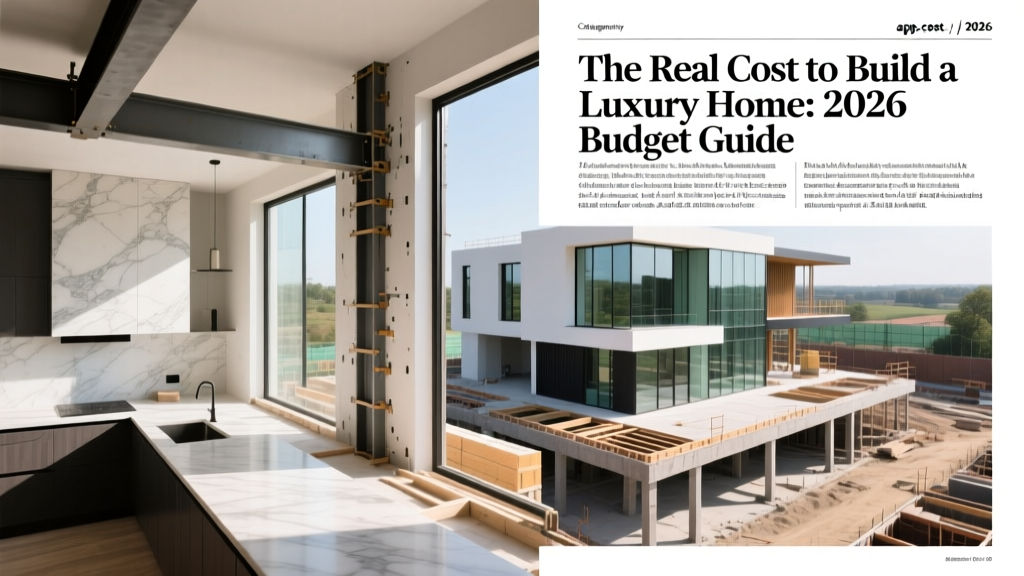
The 2026 Luxury Home Cost Baseline
Defining the cost to build a luxury home requires moving beyond standard production-home metrics. In 2026, a true custom luxury residence—characterized by architectural originality, high-performance building envelopes, and bespoke interior finishes—commands a baseline of $450 to $850 per square foot for hard construction costs. Ultra-luxury estates featuring complex structural engineering, imported materials, and comprehensive smart-home automation routinely exceed $1,200 per square foot.
Hard Cost Breakdown: Where the Budget Goes
Hard costs represent the physical construction of the asset. Luxury builds diverge significantly from standard residential construction in the framing, mechanical, and interior finish phases. The following matrix illustrates the percentage allocation of hard costs for a $5 million luxury build in a temperate climate zone.
| Construction Phase | Standard Home % | Luxury Home % | Luxury Cost Drivers |
|---|---|---|---|
| Site Work & Foundation | 11% | 9% | Deep helical piers, insulated concrete forms (ICF) like Fox Blocks for basement soundproofing. |
| Framing & Exterior | 21% | 18% | Engineered lumber (LVL/PSL) for 40-foot clear spans, Accoya modified wood siding, standing seam zinc roofs. |
| Major Systems (MEP) | 14% | 19% | WaterFurnace 700A geothermal HVAC, Zehnder ERV systems, Lutron HomeWorks QSX lighting infrastructure. |
| Interior Finishes | 28% | 34% | Book-matched Statuario marble, 10-inch European white oak flooring, custom CNC-milled walnut cabinetry. |
| Landscaping & Outdoor | 6% | 12% | Infinity edge pools, outdoor kitchens with Gaggenau appliances, mature tree transplantation. |
| General Conditions | 10% | 8% | Extended project management timelines, specialized site security, climate-controlled material storage. |
The Soft Cost Premium in Custom Architecture
Soft costs in luxury construction extend far beyond basic permitting and architectural drafting. High-end projects require specialized consultants to achieve the acoustic, thermal, and technological performance expected by affluent buyers. Budgeting 18% to 25% of total project costs for soft expenses is standard practice.
Standard vs. Luxury Soft Cost Allocation
- Architectural & Design Fees: Standard homes utilize draftspersons or stock plans (2-4% of build cost). Luxury homes employ licensed architects and interior designers charging 10-15% of construction costs for bespoke schematic design and construction administration.
- Specialized Engineering: Beyond structural engineering, luxury builds require geotechnical engineers for complex site grading, acoustic consultants for home theaters and mechanical room isolation, and lighting designers for circadian-rhythm-aligned LED layouts.
- Smart Home Integration: A dedicated AV and automation programmer is required to integrate Crestron or Control4 systems, ensuring seamless operation of motorized shading, HVAC, security, and audio zones.
- Expediting & Permitting: In strict municipal jurisdictions, luxury projects often hire permit expediters ($15,000–$30,000) to navigate design review boards and environmental impact assessments.
Material Multipliers: Standard vs. Ultra-Luxury
The cost to build a luxury home is heavily influenced by material selection. The multiplier effect occurs not just in the raw material cost, but in the specialized labor required for installation. A master tile setter charging $120/hour is required for large-format, book-matched porcelain or natural stone, compared to $65/hour for standard ceramic tile.
Exterior Envelope
Standard: Vinyl or fiber cement siding ($6–$10/sq ft installed). Asphalt architectural shingles ($4/sq ft).
Luxury: Accoya radiata pine cladding with factory-applied Teknos coatings ($28–$35/sq ft). Rheinzink pre-weathered standing seam roofing ($22–$30/sq ft).
Glazing and Fenestration
Standard: Vinyl-framed double-pane Low-E windows ($400–$700 per unit).
Luxury: Alpen High Performance Products or Schüco triple-pane, fiberglass or thermally broken aluminum systems with motorized exterior shades ($2,500–$5,000+ per unit).
Interior Flooring
Standard: 5-inch engineered oak or luxury vinyl plank ($8–$14/sq ft installed).
Luxury: 10-inch to 14-inch wide plank European white oak, wire-brushed, hardwax oil finished ($22–$32/sq ft installed).
Hidden Budget Traps in High-End Construction
Luxury home budgets frequently collapse due to underestimated lead times and site-specific anomalies. According to the National Association of Home Builders (NAHB) construction cost surveys, supply chain volatility for imported finishes remains a primary risk factor.
Expert Insight: 'The most common budget failure in ultra-luxury builds is the misalignment of long-lead items with the critical path. If your custom Italian cabinetry or specialized European glazing is delayed by 14 weeks, you are paying for an idle site crew, extended scaffolding rentals, and compounded general conditions costs that can easily exceed $100,000.' — Senior Custom Home Project Manager
Geotechnical Surprises: Standard soil borings might miss localized bedrock or high-water tables. Excavating a walk-out luxury basement in uncharted bedrock can add $80,000 to $150,000 in rock-blasting and heavy equipment fees. Always mandate a dense-grid geotechnical survey before finalizing the foundation budget.
Net-Zero Energy Upgrades: Many luxury buyers now demand net-zero capabilities. The U.S. Department of Energy notes that achieving net-zero requires a holistic approach. Adding a 20kW solar array with Tesla Powerwall 3 battery backup and a fully electrified mechanical system (heat pump water heaters, induction cooking) adds roughly $85,000 to $120,000 to the MEP budget, but drastically reduces long-term operational costs.
The Luxury Budget Allocation Framework
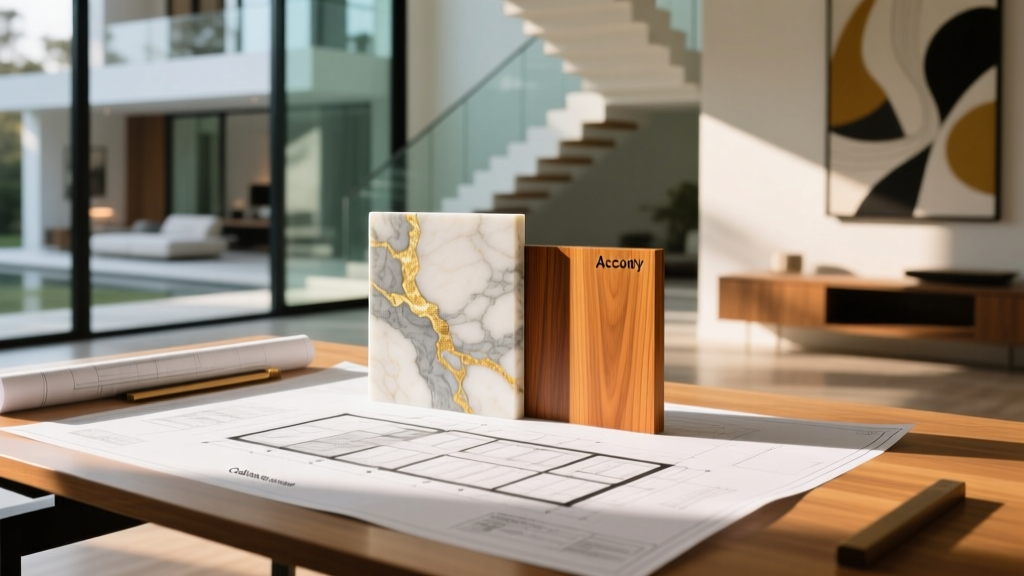
To maintain financial control over a $5 million luxury build, utilize this sequential budgeting framework:
- Land & Site Prep (15-20%): Secure the lot, conduct topographical and geotechnical surveys, and budget for utility extensions and driveway engineering.
- Soft Costs (18-22%): Lock in architectural, engineering, interior design, and permitting fees. Pay for 3D rendering and VR walkthroughs to finalize design before breaking ground.
- Core & Shell (30-35%): Fund the foundation, framing, roofing, and exterior envelope. Do not value-engineer the building envelope; air-tightness and thermal mass are critical for luxury comfort.
- MEP & Automation (15-18%): Install geothermal HVAC, ERV systems, whole-house water filtration, and low-voltage smart home infrastructure.
- Interior Finishes (15-20%): Execute millwork, stone installation, flooring, and painting. Allocate funds for specialized artisans (e.g., plasterers for Venetian finish walls).
- Contingency Reserve (10%): Hold a strict 10% cash reserve ($500,000 on a $5M build) exclusively for unforeseen site conditions, design changes, and material price escalations.
Frequently Asked Questions
How does the location affect the cost to build a luxury home?
Location dictates labor rates, material transport costs, and seismic or hurricane code requirements. Building a luxury home in Aspen or Manhattan can push costs past $1,500 per square foot due to extreme logistical challenges, union labor rates, and strict municipal codes, whereas building in the Midwest or Southeast might keep costs closer to $450 per square foot for the exact same architectural design.
Is it cheaper to renovate an existing mansion or build a new luxury home?
Ground-up construction is generally more predictable in cost. Luxury renovations frequently encounter hidden structural deficiencies, asbestos abatement, and the challenge of integrating modern smart-home wiring into historic framing. While a high-end gut renovation might start at $300 per square foot, change orders often push the final cost to $550+ per square foot, rivaling new construction without the benefit of a modern, optimized floor plan.
What is the ROI on luxury smart home automation?
While comprehensive systems like Crestron or Savant cost $150,000 to $400,000 for a 6,000-square-foot home, they do not yield a 1:1 dollar-for-dollar return on investment at resale. However, in the ultra-luxury tier, a fully integrated, enterprise-grade automation system is considered a baseline expectation by buyers; lacking it will severely limit the pool of qualified purchasers and extend time on market.
Written by
Marcus ChenMarcus Chen is a licensed structural engineer (PE) and building materials analyst with over 12 years of experience across residential, commercial, and industrial construction. He holds a Master of Science in Civil Engineering from UC Berkeley and spent six years at Thornton Tomasetti before transitioning to independent consulting and technical writing. Marcus specializes in material selection for seismic-prone regions, concrete reinforcement strategies, and lifecycle cost analysis. His work has been cited by the American Concrete Institute (ACI) and the Structural Engineers Association of California (SEAOC). When he is not on a job site or at his desk, you will find him hiking the Sierra Nevada or restoring a 1920s craftsman bungalow in Oakland, CA.
More from Marcus Chen
View all
Construction Cost
How Much Did the Eiffel Tower Cost to Build?
How much did the Eiffel Tower cost to build in 1889? We adjust for inflation and compare its budget to modern skyscraper construction.
Aug 4, 2026

Fire Resistance
What Is a Fire Resistant Material? Testing & Certification Guide
Discover what is a fire resistant material through ASTM and UL testing. Learn how fire ratings, certifications, and assemblies work in construction.
Aug 4, 2026

Construction Cost
How Much Did the Burj Khalifa Cost to Build?
How much did the Burj Khalifa cost to build? We break down the $1.5B project and extract 5 money-saving strategies for your next build.
Jul 30, 2026