Cost to Build a Mini Golf Course: Complete Budget Guide
Plan your budget with our comprehensive guide to the cost to build a mini golf course, covering materials, labor, and commercial pricing.

Project Scale and Baseline Budget Tiers
Estimating the cost to build a mini golf course requires defining the project scope before evaluating material quotes. A backyard 9-hole setup operates on entirely different structural and financial parameters than a 36-hole commercial Family Entertainment Center (FEC). Commercial courses demand heavy-duty sub-bases, commercial-grade synthetic turf, and compliance with public accessibility codes, all of which drive up the capital expenditure.
The following matrix outlines the baseline construction costs across three primary project scales. These figures encompass site preparation, base construction, surface materials, standard obstacles, and basic landscaping, but exclude land acquisition and indoor building construction.
| Project Scale | Holes | Estimated Cost Range | Average Cost Per Hole |
|---|---|---|---|
| High-End Backyard | 9 | $18,000 – $45,000 | $2,000 – $5,000 |
| Boutique Commercial (Rooftop/Urban) | 9 - 12 | $90,000 – $180,000 | $10,000 – $15,000 |
| Large Themed FEC (Outdoor) | 18 - 36 | $250,000 – $600,000+ | $13,800 – $16,600+ |
The Anatomy of a Mini Golf Hole: Base Construction
The most common point of structural failure in miniature golf is base settlement, which causes the putting surface to ripple and alters ball roll. Proper base construction accounts for roughly 35% to 45% of the total hardscape budget.
Excavation and Sub-Base
Excavation must reach 8 to 12 inches below the finished grade. The sub-base requires 4 to 6 inches of Class II road base (crushed aggregate). This layer must be mechanically compacted to a minimum of 95% Standard Proctor Density. Skipping mechanical compaction and relying on water settling will inevitably lead to sinkholes around obstacle footings.
Structural Slab: Asphalt vs. Concrete
- Asphalt Base: A 2 to 3-inch layer of hot-mix asphalt costs between $3.50 and $5.00 per square foot. While cheaper upfront, asphalt is susceptible to thermal expansion and freeze-thaw heaving. It requires a 14-to-21-day curing period before synthetic turf can be adhered, otherwise off-gassing will cause the turf adhesive to fail.
- Concrete Base: A 4-inch pour of 3,000 PSI concrete reinforced with a #3 rebar grid on 2-foot centers costs $7.00 to $11.00 per square foot. Concrete is the mandatory standard for commercial FECs and indoor courses due to its dimensional stability and resistance to moisture vapor transmission.
Putting Surface Materials: Turf vs. Concrete
While early miniature golf courses utilized painted concrete or carpet, modern commercial facilities rely almost exclusively on specialized synthetic turf. According to TourGreens synthetic turf specifications, the face weight and yarn type dictate the stimp rating (ball speed) and longevity.
| Material Type | Durability & Lifespan | Stimp Rating (Ball Speed) | Installed Cost (Per Sq Ft) |
|---|---|---|---|
| Nylon (Texturized) | 10-15 years; highly resilient | 9.0 – 11.0 (Tournament speed) | $8.00 – $12.00 |
| Polypropylene | 5-8 years; prone to matting | 7.0 – 9.0 (Slower, casual) | $5.00 – $8.00 |
| Poured/Coated Concrete | 20+ years; requires resurfacing | 8.0 – 10.0 (Depends on coating) | $9.00 – $14.00 |
Crucial Installation Detail: Synthetic turf requires infill to weigh down the backing and keep the yarn blades upright. Budget for 2 to 4 pounds of 20-30 mesh silica sand per square foot. Using unwashed masonry sand will introduce dust and clay that clogs the turf drainage pores and stains the fibers.
Obstacles and Theming: Modular vs. Custom Fabrication
Obstacles represent the highest variance in a mini golf construction budget. The choice between modular fiberglass and custom-built animatronics will swing the budget by tens of thousands of dollars.
Modular Fiberglass (Budget-Friendly)
Pre-manufactured fiberglass obstacles (e.g., standard windmills, lighthouses, volcanoes) are mass-produced and shipped in sections. A standard 8-foot fiberglass windmill costs between $3,500 and $5,500. Installation requires pouring isolated concrete footings and anchoring the base flange with 1/2-inch wedge anchors. These are ideal for boutique courses or secondary 9-hole loops.
Custom Fabrication and Animatronics (Premium)
Large-scale FECs utilize custom thematic elements built from structural steel armatures, carved EPS foam, and polyurea hard-coats. A custom 20-foot animatronic pirate ship with pneumatic movements and integrated audio will cost between $35,000 and $65,000. These structures require engineered foundation plans and dedicated 220V electrical circuits for the air compressors and control logic boards.
Hidden Budget Killers: Drainage, ADA, and Permitting
When calculating the cost to build a mini golf course, developers frequently underestimate site compliance and water management. The International Association of Amusement Parks and Attractions (IAAPA) frequently highlights operational downtime caused by poor drainage and code violations as primary profit killers in the FEC sector.
⚠️ Warning: ADA Compliance is Non-Negotiable
Under the ADA Standards for Accessible Design, amusement and recreation facilities must provide an accessible route. For mini golf, this mandates a minimum 36-inch clear width on the playing surface, a 60-inch turning radius at tee boxes, a maximum running slope of 5% (1:20), and a maximum cross slope of 2% (1:50). Failing to engineer the concrete sub-base to these exact tolerances will result in failed municipal inspections and costly concrete demolition.
Water Hazards and Drainage
If your course design includes waterfalls or streams, you must budget for commercial-grade water management. Do not use standard PVC pond liners; they will puncture under the weight of rock features. Specify 45-mil EPDM rubber pond liners. Furthermore, budget for a 1/2 HP submersible pump with a built-in UV clarifier (approx. $800 - $1,200) to prevent algae blooms in stagnant water hazards, which otherwise require weekly chemical treatments.
Lighting and Electrical Infrastructure
Nighttime operations can account for up to 40% of a commercial mini golf course's revenue. Lighting must be designed to eliminate shadows across the putting surface while preventing glare into players' eyes.
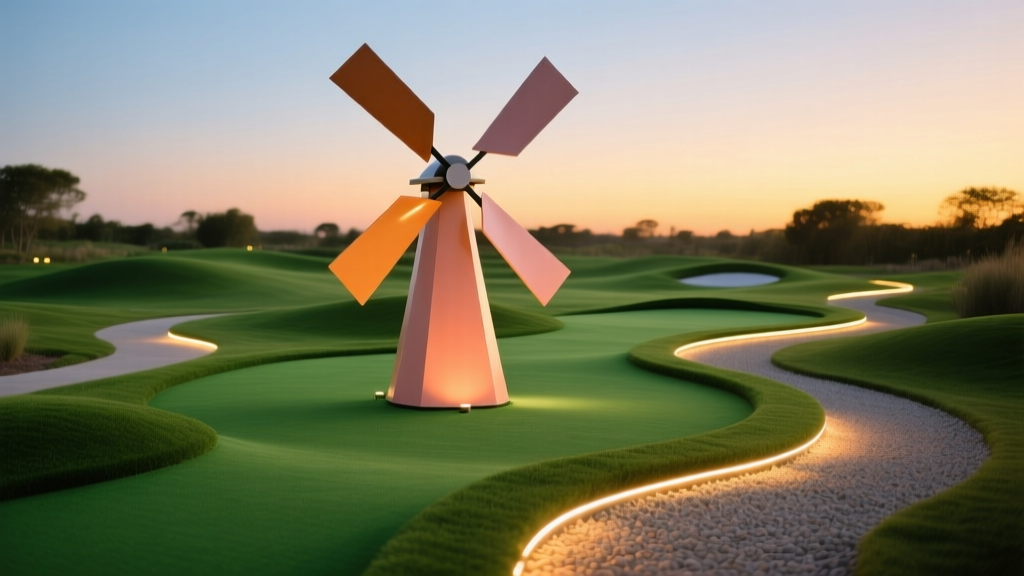
- Hardscape Lighting: Recessed LED strip lights hidden beneath the turf edges or obstacle overhangs. Budget $120 to $180 per linear foot for marine-grade, 3000K warm white fixtures.
- Bollard and Pathway Lighting: Used for walking paths between holes. Specify fixtures with a Type II or Type III photometric distribution to cast light laterally across the path rather than pooling it at the base.
- Electrical Rough-In: Trenching and running conduit to 18 separate hole locations requires a dedicated 20-amp GFCI circuit for every 4 to 6 holes. Budget $45 to $65 per linear foot for underground electrical trenching and conduit installation.
Vendor Selection and Procurement Framework
When soliciting bids for your miniature golf construction, avoid general landscaping contractors unless they possess specific portfolio evidence of putting green installation. The tolerances for a miniature golf course (sub-grade variations of less than 1/4 inch over 10 feet) are vastly stricter than standard landscape grading.
Issue a Request for Proposal (RFP) that explicitly requires the contractor to provide a core sample of their proposed sub-base compaction and a stimp-meter reading of their proposed turf system. Require vendors to itemize the cost of the structural base separately from the surface materials and obstacles. This transparency allows you to value-engineer the theming and obstacles without compromising the structural integrity of the concrete or asphalt base, ensuring your capital investment yields a playable, low-maintenance asset for the next decade.
Written by
David NakamuraDavid Nakamura is a licensed architect (AIA) and construction technology writer focused on sustainable building methods, mass timber engineering, and high-performance building envelopes. He holds a Master of Architecture from the University of Washington and is a certified Passive House Consultant (CPHC). David spent eight years at the Seattle firm Mithun, where he led the design of three LEED Platinum projects, before founding his own practice specializing in net-zero residential design. He serves on the editorial advisory board of GreenBuilder Magazine and has authored peer-reviewed papers on cross-laminated timber (CLT) connections for the Journal of Structural Engineering. In his spare time, David teaches woodworking at Pratt Fine Arts Center and kayaks the Puget Sound.
More from David Nakamura
View all
Construction Cost
Labor Cost to Build a Deck Per Sq Ft: 2026 Installation Guide
Discover the exact labor cost to build a deck per sq ft in 2026. This installation guide breaks down contractor rates, complexity factors, and hidden fees.
Aug 4, 2026

Construction Cost
How Much Does It Cost to Build a 3 Bedroom House? Financing Guide
Learn exactly how much it costs to build a 3 bedroom house and explore 2026 financing options, construction loan types, and budget frameworks for your build.
Aug 4, 2026

Construction Cost
Cost to Build a Tennis Court: 2026 Guide
How much does it cost to build a tennis court in 2026? Breakdowns for asphalt, concrete, and synthetic surfaces plus fencing and lighting.
Jul 30, 2026