Financing the Average Cost to Build an Apartment Complex in 2026
Learn how to finance the average cost to build an apartment complex. Explore HUD loans, capital stacks, draw schedules, and 2026 per-unit pricing.
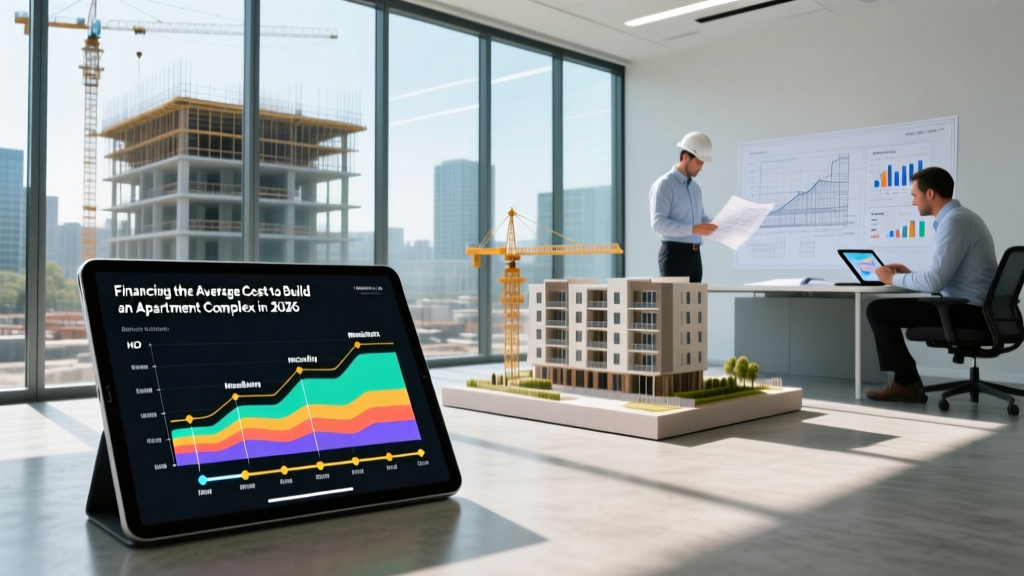
The True Average Cost to Build an Apartment Complex
Securing financing begins with an accurate baseline. In 2026, the average cost to build an apartment complex ranges from $175,000 to $260,000 per unit, translating to roughly $190 to $310 per square foot. However, this average masks severe variances based on structural typology and regional labor markets.
2026 Hard Cost Benchmarks by Typology
- Garden-Style (1-3 stories, Type V-B wood frame): $160,000 - $195,000 per unit.
- Mid-Rise Podium (4-5 stories, Type V-A over concrete): $210,000 - $255,000 per unit.
- High-Rise (6+ stories, Type I concrete/steel): $320,000 - $450,000+ per unit.
Lenders will scrutinize your cost-per-unit against local market comps. If your budget falls below the regional baseline, underwriters will flag it as a high-risk value-engineering attempt, potentially stalling your loan commitment. According to the National Multifamily Housing Council (NMHC), material volatility and localized trade shortages continue to push baseline hard costs upward, making contingency reserves non-negotiable.
Structuring the Capital Stack for Multifamily Development
Rarely does a single lender cover the total average cost to build an apartment complex. Developers must assemble a capital stack, typically targeting a 60% to 65% Loan-to-Cost (LTC) ratio for conventional debt, though government-backed programs can push this higher.
Senior Construction Debt
This is your primary loan, secured by a first-position lien. Senior lenders require a minimum Debt Service Coverage Ratio (DSCR) of 1.25x upon stabilization and will demand a personal recourse carve-out (the "bad boy" guaranty) unless you utilize non-recourse government financing.
Preferred Equity and Mezzanine Debt
When senior debt and general partner (GP) equity fall short, developers inject mezzanine debt (secured by a pledge of ownership interests) or preferred equity. Mezzanine rates in 2026 hover between 11% and 14%, significantly higher than senior debt, but they prevent excessive GP dilution.
LP Equity and the Promote Structure
Limited Partners (LPs) provide the bulk of the cash equity. To align incentives, GPs structure a "promote"—a disproportionate share of profits (often 20% to 30%) awarded to the GP after LPs achieve a preferred return hurdle, typically set at 7% to 9% IRR.
HUD 221(d)(4) vs. Conventional Construction Loans
Choosing the right senior debt instrument fundamentally alters your risk profile. The HUD 221(d)(4) program remains the gold standard for large-scale multifamily development, but it carries strict bureaucratic hurdles compared to conventional bank loans.
| Feature | HUD 221(d)(4) Loan | Conventional Bank Construction Loan |
|---|---|---|
| Term Length | 3-year construction + 40-year fixed permanent | 12 to 24 months (floating rate), requires refinance |
| Interest Rate | Fixed for the entire 43-year term | Floating (SOFR + spread), subject to rate cap costs |
| Recourse | Non-recourse (no personal guaranty required) | Full recourse during construction, partial post-stabilization |
| LTC / LTV Limits | Up to 85% LTC for affordable/LIHTC; 80% for market | Typically capped at 60% - 65% LTC |
| Labor Requirements | Davis-Bacon prevailing wages mandatory | Standard market labor rates apply |
Soft Costs and Impact Fees: The Budget Killers
When calculating the average cost to build an apartment complex, amateur developers often over-index on hard costs (lumber, concrete, MEP systems) while underestimating soft costs. Soft costs typically consume 20% to 30% of the total project budget.
- Architectural & Engineering (A&E): 6% to 9% of hard costs. Includes civil, structural, MEP, and landscape design.
- Municipal Impact Fees: These are the most volatile line items. In high-growth Sunbelt markets or strict California jurisdictions, water, sewer, and school impact fees can exceed $25,000 per unit. These fees are usually due at permit issuance, requiring massive upfront cash liquidity before the first draw is funded.
- Legal & Syndication Costs: $75,000 to $150,000 for partnership agreements, SEC compliance, and loan document review.
- Interest Reserve: Lenders require you to budget for interest payments during construction. Calculate this as: (Total Loan Amount × Interest Rate ÷ 12) × (Construction Months × 0.5). The 0.5 multiplier accounts for the average outstanding balance as draws are progressively funded.
Managing the Draw Schedule and Retainage
Once Fannie Mae, Freddie Mac, or a private lender closes your loan, funds are not disbursed in a lump sum. They are released via a monthly draw schedule tied to the AIA G702 (Application and Certificate for Payment) and G703 (Continuation Sheet) forms.
The Monthly Draw Workflow
- Day 20-25: General Contractor submits the AIA G702/G703 detailing the percentage of work completed for each CSI MasterFormat division.
- Day 26-28: The Architect of Record reviews the application to verify that billed work matches physical progress and that stored materials are properly secured on-site.
- Day 29-30: The bank’s third-party inspector conducts a site walk to validate the architect’s approval.
- Day 1-5 (Next Month): The lender funds the draw, withholding 5% to 10% as retainage.
Frequently Asked Questions
Can I use an SBA 504 loan to build an apartment complex?
No. The SBA 504 program is strictly for owner-occupied commercial real estate (where the business occupies at least 51% of the space). Multifamily apartment complexes are considered passive investment properties and are ineligible for SBA financing. You must use conventional construction loans, HUD programs, or private debt funds.
How does the Low-Income Housing Tax Credit (LIHTC) affect construction financing?
If your project includes affordable units qualifying for 4% or 9% LIHTC, you can sell these tax credits to institutional investors to generate equity. This "tax credit equity" can cover 30% to 70% of the average cost to build an apartment complex, drastically reducing the amount of senior debt required and improving your cash-on-cash returns.
What happens if construction costs exceed the original loan commitment?
You will face a capital call. Lenders will not increase the senior loan amount without a complete re-underwriting, which takes months. Developers must maintain a "contingency reserve" (typically 5% to 10% of hard costs) within the original budget. If the contingency is exhausted, the GP must inject out-of-pocket capital or secure expensive emergency mezzanine debt to prevent the lender from halting draws and foreclosing on the partially built asset.
Written by
Elena RodriguezElena Rodriguez is a civil engineer and technical writer specializing in concrete technology, masonry systems, and ASTM/ACI compliance. She earned her B.S. in Civil Engineering from Texas A&M University and spent a decade at a materials testing laboratory, performing over 2,000 concrete compressive strength tests and masonry prism evaluations. Elena is an ACI-certified Field Testing Technician (Grade I) and a member of ASTM Committee C12 on Natural Building Stone. She currently consults on forensic engineering cases involving concrete failures and moisture intrusion. Based in San Antonio, TX, Elena is a proud member of the Society of Women Engineers (SWE) and coaches her daughter's FIRST Robotics team.
More from Elena Rodriguez
View all
Walls & Panels
Cost Analysis: Light Gauge Steel Framing Advantages and Disadvantages
Evaluate light gauge steel framing advantages and disadvantages through a strict cost analysis lens, comparing material, labor, and lifecycle expenses.
Aug 4, 2026

Walls & Panels
Gypsum Board Types: Exact Specifications, Thickness & Dimensions
Compare standard, Type X, and moisture-resistant gypsum board types. Get exact specifications, thicknesses, dimensions, and ASTM standards for your project.
Aug 4, 2026

Fire Resistance
Best Fire-Resistant Outdoor Decking Materials: 2026 Buyer Guide
Discover the best fire-resistant outdoor decking materials for 2026. Compare Class A PVC, aluminum, and hardwood options for WUI compliance and safety.
Aug 4, 2026