How Much Does a Nuclear Power Plant Cost to Build? SMR Cost Savings
Discover how much a nuclear power plant costs to build. Explore SMR savings, brownfield strategies, and modular construction cost reductions.

The Baseline: How Much Does a Nuclear Power Plant Cost to Build?
When utility developers and energy syndicates ask, "how much does nuclear power plant cost to build," the answer requires separating Overnight Capital Cost (OCC) from All-In Cost (AIC), which includes financing, inflation, and regulatory delays. As of current industry benchmarks, a traditional 1,000 to 1,200 MWe large light water reactor (LWR) carries an OCC ranging from $9,000 to $14,000 per kilowatt (kW) in Western markets. This translates to a staggering $9 billion to $16.8 billion per reactor unit before a single drop of concrete is poured.
However, these figures are heavily skewed by First-of-a-Kind (FOAK) penalties and localized supply chain atrophy. For context, the Vogtle Units 3 and 4 project in Georgia (utilizing the Westinghouse AP1000 design) ballooned to over $30 billion for 2,200 MW of capacity—roughly $13,600/kW. Conversely, standardized fleet deployments, such as the APR-1400 reactors built in the UAE and South Korea, consistently achieve costs closer to $4,000 to $5,000/kW. The path to cost reduction in modern nuclear construction does not lie in cheaper concrete; it lies in radical design standardization, modularization, and site repurposing.
The FOAK vs. NOAK Cost Multiplier
The most significant financial trap in nuclear mega-projects is the FOAK (First-of-a-Kind) premium. When a utility builds a reactor design for the first time in a specific regulatory jurisdiction, they absorb the costs of unoptimized supply chains, iterative engineering changes, and steep learning curves for specialized welders and nuclear-grade concrete crews. According to the MIT Energy Initiative, transitioning from a FOAK to an Nth-of-a-Kind (NOAK) standardized deployment can reduce capital costs by 30% to 40%.
| Deployment Phase | Estimated OCC ($/kW) | Primary Cost Drivers | Risk Profile |
|---|---|---|---|
| First-of-a-Kind (FOAK) | $11,000 - $15,000+ | Engineering rework, supply chain setup, regulatory learning curve | Extreme (High overrun probability) |
| Second/Third Unit | $8,000 - $10,000 | Workforce optimization, localized fabrication | Moderate |
| Nth-of-a-Kind (NOAK) | $4,500 - $6,500 | Standardized licensing, factory-fabricated modules | Low (Predictable cash flows) |
4 Strategic Pillars to Reduce Nuclear Build Costs
To bring nuclear capital expenditures in line with renewable-plus-storage alternatives, developers are abandoning the "bigger is better" paradigm in favor of agile, modular, and digitally managed construction methodologies.
1. Transitioning to Small Modular Reactors (SMRs)
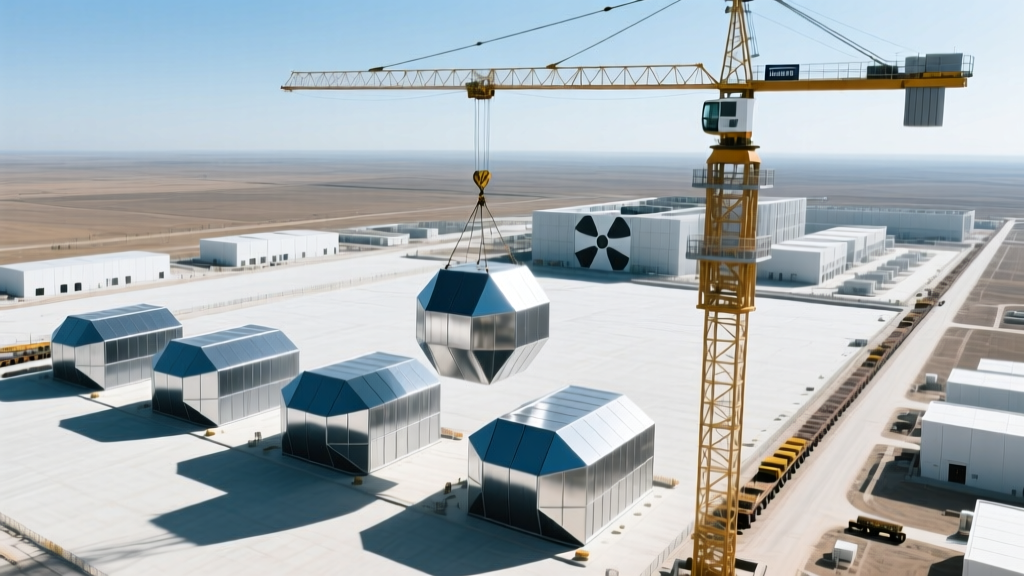
SMRs (typically defined as reactors under 300 MWe) fundamentally alter the cost architecture of nuclear builds. Designs like GE Hitachi’s BWRX-300 and TerraPower’s Natrium shift up to 70% of the construction effort from the muddy, weather-delayed job site into controlled factory environments. By fabricating the Nuclear Steam Supply System (NSSS) and primary containment vessels in modular skids, developers drastically reduce the volume of nuclear-grade civil works. The U.S. Department of Energy notes that factory fabrication can compress on-site construction timelines from 7-10 years down to 3-4 years, slashing financing costs (interest during construction), which often account for 20% of a traditional plant's total price tag.
2. Brownfield Repurposing (Coal-to-Nuclear)
Greenfield nuclear sites require billions in new transmission interconnects, cooling water infrastructure, and rail spurs. The most aggressive money-saving strategy in the 2020s is brownfield repurposing—specifically, retiring coal plants and replacing them with advanced nuclear. A coal-to-nuclear transition leverages existing high-voltage switchyards, turbine halls, and cooling water access. Feasibility studies indicate that reusing this Balance of Plant (BOP) infrastructure can reduce overall project capital costs by 15% to 35%, while simultaneously preserving local grid stability and tax bases.
3. Digital Twin and 5D BIM Integration
Rework due to spatial clashes (e.g., HVAC ducting intersecting with seismic piping supports) historically accounts for 10% to 15% of cost overruns in nuclear mega-projects. Modern developers mandate 5D Building Information Modeling (BIM) integrated with digital twins before ground is broken. By utilizing laser-scanned point clouds of existing brownfield sites and running automated clash detection algorithms, engineering firms achieve a "zero-clash" design freeze. This prevents the catastrophic cost of ripping out and re-welding nuclear-grade stainless steel piping in the field.
4. Standardized Regulatory Licensing (Part 52)
In the U.S., utilizing the 10 CFR Part 52 Combined Construction and Operating License (COL) process for a standardized design means the NRC (Nuclear Regulatory Commission) has already approved the generic reactor design. Developers only need to litigate site-specific parameters (seismicity, hydrology). Attempting to build a customized or heavily modified reactor design triggers endless regulatory holds, which bleed millions in idle labor and equipment rental costs.
Cost Breakdown: Where Does the Capital Actually Go?
Understanding the anatomy of nuclear capital costs allows project managers to target specific sectors for value engineering. According to data synthesized by the World Nuclear Association, the capital distribution for a traditional LWR differs vastly from a modular SMR.
| Cost Center | Traditional LWR (1000+ MWe) | Factory-Fabricated SMR (300 MWe) | Money-Saving Opportunity |
|---|---|---|---|
| Civil/Structural/Architectural (CSA) | 35% - 45% | 15% - 20% | Shift to modular steel skids; eliminate massive seismic concrete basemats. |
| Nuclear Steam Supply System (NSSS) | 15% - 20% | 35% - 45% | Factory assembly line economies of scale (NOAK production). |
| Turbine Island & BOP | 20% - 25% | 20% - 25% | Utilize standard industrial-grade turbines where non-nuclear safety permits. |
| Indirect Costs & Owner's Costs | 15% - 20% | 10% - 15% | Shorten construction timeline to reduce interest during construction (IDC). |
Actionable Decision Matrix for Utility Developers
Choosing the right nuclear deployment strategy requires matching your capital constraints, grid requirements, and risk tolerance. Use this framework to determine the optimal path for minimizing levelized cost of energy (LCOE).
- Scenario A: Baseload Replacement on a Tight Budget. Strategy: Brownfield Coal-to-Nuclear using a 300 MWe SMR. Why: Maximizes reuse of transmission and cooling infrastructure; factory fabrication limits upfront capital exposure. Target OCC: $5,500/kW.
- Scenario B: Massive Industrial/Grid Decarbonization. Strategy: Twin-unit AP1000 or APR-1400 on a Greenfield site, but only if executing as the 3rd or 4th unit in a fleet (NOAK). Why: Achieves economies of scale in operations and maintenance (O&M), though upfront capital will exceed $12B. Target OCC: $6,500/kW.
- Scenario C: Remote Mining or Off-Grid Industrial. Strategy: Microreactor (1-5 MWe) like the Westinghouse eVinci. Why: Arrives fully fueled and assembled on standard railcars. Eliminates the need for on-site nuclear construction labor entirely. Target OCC: $10,000/kW (offset by zero transmission line costs).
Ultimately, the question of how much a nuclear power plant costs to build is no longer a static number tied to mid-century concrete monoliths. By leveraging factory modularity, brownfield infrastructure, and digital delivery, developers can transform nuclear energy from a high-risk financial gamble into a predictable, cost-competitive baseload asset.
Written by
David NakamuraDavid Nakamura is a licensed architect (AIA) and construction technology writer focused on sustainable building methods, mass timber engineering, and high-performance building envelopes. He holds a Master of Architecture from the University of Washington and is a certified Passive House Consultant (CPHC). David spent eight years at the Seattle firm Mithun, where he led the design of three LEED Platinum projects, before founding his own practice specializing in net-zero residential design. He serves on the editorial advisory board of GreenBuilder Magazine and has authored peer-reviewed papers on cross-laminated timber (CLT) connections for the Journal of Structural Engineering. In his spare time, David teaches woodworking at Pratt Fine Arts Center and kayaks the Puget Sound.
More from David Nakamura
View all
Construction Cost
Labor Cost to Build a Deck Per Sq Ft: 2026 Installation Guide
Discover the exact labor cost to build a deck per sq ft in 2026. This installation guide breaks down contractor rates, complexity factors, and hidden fees.
Aug 4, 2026

Construction Cost
How Much Does It Cost to Build a 3 Bedroom House? Financing Guide
Learn exactly how much it costs to build a 3 bedroom house and explore 2026 financing options, construction loan types, and budget frameworks for your build.
Aug 4, 2026

Construction Cost
Cost to Build a Tennis Court: 2026 Guide
How much does it cost to build a tennis court in 2026? Breakdowns for asphalt, concrete, and synthetic surfaces plus fencing and lighting.
Jul 30, 2026