How Much It Costs to Build a Pool: A 2026 Budget Planning Guide
Discover exactly how much it costs to build a pool in 2026. This budget planning guide breaks down shell, excavation, equipment, and decking expenses.

The True Cost Breakdown: Shell Types and Base Pricing
When calculating how much it costs to build a pool, the shell type dictates roughly 40% to 50% of your total budget. In 2026, material and labor fluctuations have stabilized, but regional variations remain significant. The three primary shell materials each carry distinct structural profiles, maintenance requirements, and upfront costs.
Gunite (Dry-Mix Shotcrete)
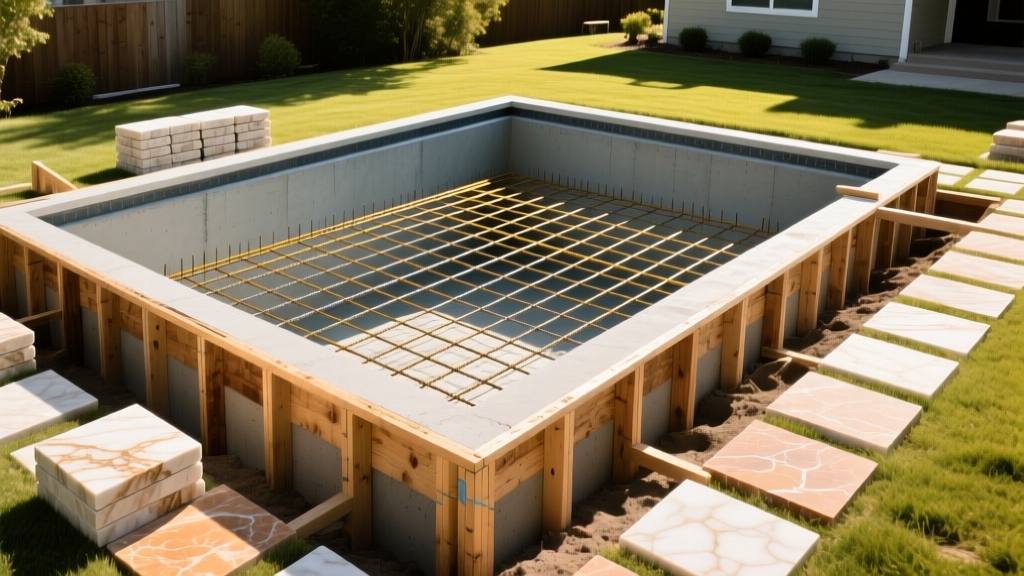
Gunite remains the gold standard for custom, high-end pools. A properly engineered gunite shell requires a minimum 4,000 PSI concrete mix, sprayed to a 6-inch thickness over a grid of #3 and #4 steel rebar spaced at 12-inch on-center intervals. Because it is built on-site, it allows for infinite customization regarding shape, depth profiles, and integrated features like tanning ledges or infinity edges. Expect base pricing for a standard 14x28 foot gunite pool to range from $85,000 to $130,000, excluding decking and premium automation.
Fiberglass
Fiberglass pools are manufactured off-site as single-piece gelcoat shells and craned into the excavated hole. They offer a non-porous surface that resists algae growth and requires fewer chemicals. The primary budget variable here is site access. If a 16-foot-wide shell cannot be driven directly to the backyard, you will need to hire a specialized crane, which adds $1,500 to $4,500 to the project. Base costs for a mid-sized fiberglass installation typically range from $60,000 to $95,000.
Vinyl Liner
Vinyl pools utilize pre-fabricated polymer or galvanized steel wall panels supported by a vermiculite or grout bottom. The liner itself is a custom-cut sheet of PVC, typically 27-mil to 30-mil thick. While the initial investment is the lowest—ranging from $50,000 to $80,000—budget planners must account for a mandatory liner replacement every 7 to 12 years, which costs between $4,500 and $7,000 in 2026.
Site Preparation, Excavation, and Hidden Dirt Costs
Excavation is rarely a flat fee. The quoted price usually assumes 'clean sand' or easily diggable topsoil. However, subsurface conditions can rapidly inflate your budget. Standard excavation and spoil removal for an average-sized pool costs between $3,000 and $8,000. This includes hauling away the displaced dirt, which typically costs $150 to $250 per 10-yard dump truck load.
If your soil test reveals expansive clay, caliche rock, or a high water table, your excavation costs will spike. Rock excavation requires hydraulic breakers or blasting, adding $8,000 to $15,000. Expansive clay requires over-excavation (digging 12 inches deeper) and backfilling with engineered gravel to prevent the pool shell from heaving and cracking during freeze-thaw cycles.
Furthermore, site access restrictions heavily influence labor costs. If a standard Bobcat skid-steer cannot fit through your side yard (requiring a minimum 8-foot clearance), contractors must use mini-excavators or manual labor, which can increase the excavation line item by 30% to 50%.
Mechanical, Electrical, and Plumbing (MEP) Specifications
The equipment pad is the heart of your pool. Upgrading from builder-grade equipment to high-efficiency, automated systems increases upfront costs but drastically reduces long-term operational expenses. According to the U.S. Department of Energy, upgrading to a variable-speed pump can reduce pool pumping energy costs by up to 90% compared to single-speed models.
| Equipment Category | Standard Builder-Grade | Premium High-Efficiency |
|---|---|---|
| Primary Pump | Single-Speed 1.5 HP ($800) | Pentair IntelliFlo3 VSF ($2,400) |
| Sanitation System | Standard Chlorine Feeder ($250) | Hayward AquaRite Salt + UV ($3,200) |
| Heater | 250k BTU Gas Heater ($3,500) | Electric Heat Pump ($6,500) |
| Automation | Basic Time Clock ($150) | OmniLogic Smart Automation ($4,500) |
For plumbing, insist on Schedule 40 PVC for standard runs, but upgrade to Schedule 80 or flexible PVC in areas with heavy soil movement to prevent shear cracking at the glued joints. Ensure your builder uses 2-inch or 2.5-inch diameter plumbing rather than 1.5-inch to reduce friction loss and maximize the efficiency of your variable-speed pump.
Hardscaping: Coping and Decking Materials
The pool coping (the capstone that borders the pool edge) and the surrounding decking represent the final major capital expenditure. The Pool & Hot Tub Alliance (PHTA) recommends specific installation standards to ensure proper drainage away from the shell.
- Stamped Concrete: The most economical hardscaping option at $18 to $24 per square foot. Ensure the contractor uses a 3000 PSI mix with fiber mesh reinforcement and applies a UV-resistant acrylic sealer to prevent color fading and efflorescence.
- Travertine Pavers: Priced at $28 to $38 per square foot. Travertine remains cool to the touch in direct sunlight, making it ideal for bare feet. For longevity, specify a dry-set installation over a 4-inch compacted aggregate base and a 1-inch sand setting bed, rather than mud-setting them directly to a concrete slab, which can lead to cracking in freeze-thaw climates.
- Bullnose Coping: Poured-in-place cantilevered concrete coping is cost-effective ($15 to $20 per linear foot), but pre-cast bullnose travertine or limestone coping ($35 to $50 per linear foot) provides a superior, chip-resistant finish that hides the concrete bond beam.
The 60/20/20 Budget Allocation Framework
To maintain financial control and avoid change-order fatigue, structure your budget using the 60/20/20 framework. This ensures you do not overspend on the shell while neglecting the equipment and hardscaping that dictate the daily user experience.
- 60% Shell, Plumbing, and Excavation: The structural core, steel, concrete, and underground piping.
- 20% Equipment and Automation: Pumps, heaters, sanitation, lighting, and smart-home integration.
- 20% Decking, Coping, and Landscaping: The visible hardscape, perimeter drainage, and immediate soil grading.
By adhering to this ratio, a homeowner with a $120,000 total budget should allocate $72,000 to the shell and dirt work, $24,000 to premium mechanical equipment, and $24,000 to the surrounding travertine deck and coping. If your desired shell costs $90,000, you must either increase your total budget to $150,000 or scale back the shell size to maintain the integrity of the equipment and decking phases.
Permitting, Impact Fees, and Utility Locates
Before breaking ground, budget $1,500 to $3,500 for municipal building permits, electrical permits, and potential impact fees. Some municipalities charge additional fees for water and sewer capacity if the pool is connected to the municipal supply for auto-fill systems. Always mandate that your contractor submits an 811 utility locate request at least two weeks prior to excavation to identify buried gas, water, or fiber-optic lines, avoiding catastrophic and expensive utility strikes.
Written by
James ThorntonJames Thornton is a construction industry veteran with 25 years of hands-on experience in wood framing, lumber grading, and residential building codes. He started as a framing carpenter in rural Oregon, earned his ICC Residential Building Inspector certification, and eventually became a senior plan reviewer for the City of Portland Bureau of Development Services. James holds a B.S. in Wood Science & Technology from Oregon State University and is a certified lumber grader through the West Coast Lumber Inspection Bureau (WCLIB). He has inspected over 3,000 residential construction sites and authored the city's internal guide on advanced framing techniques (2x6 at 24" O.C.). James lives in Bend, OR, where he builds custom timber-frame cabins and competes in lumberjack sports.
More from James Thornton
View all
Insulation
Best Home Insulation Materials: Complete 2026 Guide
Compare top home insulation materials for 2026. Find R-values, installed costs per square foot, and best uses for fiberglass, spray foam, and mineral wool.
Aug 4, 2026

Sustainable Building
Certify Your Green Building Material for LEED and WELL
Step-by-step guide to certifying a green building material for LEED v5 and WELL v2. Master EPDs, HPDs, and VOC limits for 2026 project specifications.
Aug 4, 2026

Stone & Masonry
Veneer Stacked Stone Panels: Interior Design & Style Showcase
Discover how veneer stacked stone panels transform interiors. Explore modern design profiles, material pairings, and technical installation specs.
Aug 4, 2026