How Much Does a Tesla Charging Station Cost to Build? Full Breakdown
Discover the exact costs to build a Tesla charging station in 2026. Detailed breakdown of residential Level 2, commercial, and DC fast charger construction.

The Core Question: Residential vs. Commercial Infrastructure
When property owners and developers ask how much it costs to build a Tesla charging station, the answer depends entirely on the scale of the electrical infrastructure required. A residential Level 2 home charging hub operates on fundamentally different civil and electrical parameters than a commercial DC Fast Charging (DCFC) Supercharger-scale site. In 2026, the widespread adoption of the North American Charging Standard (NACS) has streamlined hardware compatibility, but the physical construction, utility interconnection, and load-management requirements remain the primary cost drivers.
Quick Cost Summary Matrix
- Residential Level 2 (Hardwired): $800 – $4,500+
- Commercial Level 2 (Destination/Fleet): $4,000 – $12,000 per port
- DC Fast Charging (Supercharger-Scale): $150,000 – $600,000+ per site
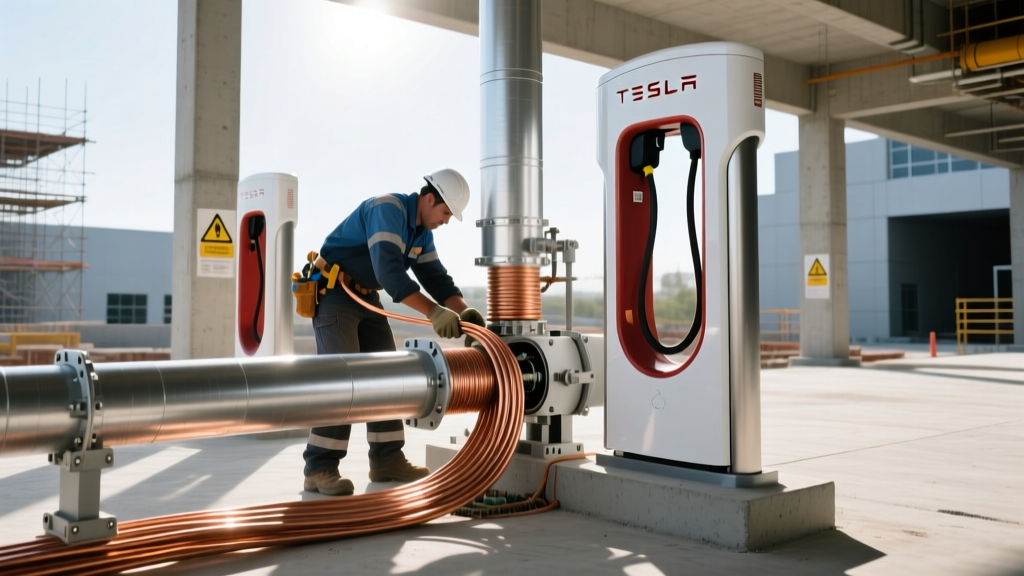
Residential Level 2 Build-Out: The Home Charging Hub
Building a dedicated Tesla charging station at home involves more than simply plugging in a device. It requires calculating continuous electrical loads, routing conduit, and potentially upgrading your main service panel.
Hardware: Tesla Wall Connector vs. Universal Wall Connector
The standard Tesla Wall Connector (Gen 3) retails for approximately $475 and features a native NACS connector. For properties that need to service both Tesla and legacy J1772 EVs, the Tesla Universal Wall Connector ($599) includes a built-in J1772 adapter. Both units support up to 48 amps of continuous charging, which dictates the electrical build-out requirements.
Electrical Upgrades & Panel Capacity (The Hidden Cost Driver)
Under National Electrical Code (NEC) Article 625, EV chargers are classified as continuous loads. This means the circuit breaker must be rated for 125% of the charger's maximum amperage. A 48-amp Tesla Wall Connector requires a dedicated 60-amp breaker and 4 AWG copper wire (or 3 AWG aluminum).
If your home has a standard 200-amp electrical panel, adding a 60-amp continuous load may fail the utility's mandatory load calculation, especially if you have electric HVAC, water heating, or a pool. Upgrading to a 400-amp service typically costs between $2,500 and $4,500. Alternatively, installing an automated energy management system (like a Span smart panel or a DCC-10 load shedder) can bypass the need for a full utility service upgrade, costing roughly $1,500 to $3,000 installed.
Trenching, Conduit, and Civil Work
If your electrical panel is in the basement and the charger is mounted on an exterior detached garage, you will need to trench. Residential trenching through soil and grass averages $15 to $30 per linear foot. This includes digging an 18-inch deep trench, laying Schedule 80 PVC conduit, pulling the wire, and backfilling. If the trench must cross a concrete driveway, expect to pay $75 to $125 per linear foot for saw-cutting, trenching, and concrete restoration.
Commercial & Fleet Charging: Destination and Level 2 Networks
Building a commercial Tesla charging station for a hotel, workplace, or multi-family dwelling introduces complex civil engineering, ADA compliance, and networking requirements. Commercial sites typically utilize pedestal-mounted Level 2 chargers or networked Tesla Universal Wall Connectors.
| Cost Component | Estimated Range (Per Port) | Details & Variables |
|---|---|---|
| Hardware (Level 2) | $600 - $1,200 | Networked commercial chargers with OCPP compliance. |
| Pedestal & Mounting | $800 - $1,500 | Steel pedestals, concrete footings, and bollards. |
| Commercial Trenching | $75 - $150 / ft | Asphalt cutting, heavy-duty conduit, and repaving. |
| Electrical Switchgear | $3,000 - $8,000 | Sub-panels, transformers, and commercial metering. |
| ADA Compliance | $1,500 - $4,000 | Wider stalls, accessible routing, and compliant signage. |
The Impact of ADA Compliance on Construction Costs
A frequently overlooked expense in commercial EV infrastructure is ADA compliance. The U.S. Access Board requires that a percentage of EV charging stalls be accessible. This means building wider parking spaces (minimum 11 feet wide with an 8-foot access aisle), ensuring the charging interface is mounted between 15 and 48 inches above the ground, and providing an accessible, paved route to the facility entrance. Retrofitting an existing parking lot to meet these grading and paving requirements can easily add $3,000 to $5,000 per accessible stall to the overall construction budget.
DC Fast Charging (Supercharger-Scale) Construction Costs
Building a DC Fast Charging (DCFC) station capable of delivering 150kW to 350kW per vehicle is a major civil and electrical construction project. While Tesla's proprietary Supercharger network is built and managed by Tesla, third-party developers building NACS-compatible DCFC sites face similar infrastructure costs.
Utility Infrastructure and Transformer Upgrades
A four-stall DCFC site requires roughly 1.5 Megawatts of electrical capacity—equivalent to the power draw of a large supermarket or a small manufacturing plant. Most utility distribution lines on standard commercial streets do not have this spare capacity. Developers must fund utility-side upgrades, which include installing a new pad-mounted transformer ($25,000 to $60,000), upgrading medium-voltage distribution lines ($150 to $300 per linear foot), and installing heavy-duty commercial switchgear ($30,000 to $50,000). Utility interconnection studies and impact fees alone can cost $10,000 to $25,000 before a single shovel hits the dirt.
Civil Engineering: Concrete Pads and Directional Boring
DCFC cabinets and dispensers are incredibly heavy and generate significant heat. They require reinforced, 4000-PSI concrete pads engineered to resist frost heave and support the equipment's footprint. Furthermore, routing the massive 1000 MCM copper cables from the transformer to the dispensers often requires directional boring beneath existing landscaping or drive lanes, costing $100 to $250 per foot. Total civil and site-preparation costs for a standard 4-to-8 stall DCFC site routinely range from $80,000 to $150,000.
Expert Insight on Utility Demand Charges: When budgeting a commercial DCFC build, construction costs are only half the equation. Commercial sites are subject to utility 'demand charges' based on the highest 15-minute peak power draw in a billing cycle. A single DCFC cabinet pulling 350kW can trigger demand charges of $15 to $30 per kW, adding $5,000 to $10,000 in monthly fees. Smart developers are now factoring in the cost of on-site Battery Energy Storage Systems (BESS) to peak-shave and mitigate these operational costs.
Navigating the 30C Tax Credit and Local Rebates
The financial viability of building EV infrastructure in 2026 is heavily influenced by the IRS 30C Alternative Fuel Infrastructure Tax Credit. According to the IRS 30C Tax Credit guidelines, residential installations can claim up to 30% of the hardware and installation costs, capped at $1,000.
For commercial and fleet projects, the credit covers up to 30% of the total project cost with a maximum limit of $100,000 per single item of property (e.g., per charger or per site, depending on interpretation and placement). However, commercial projects must meet strict prevailing wage and apprenticeship requirements to claim the full 30% rate; otherwise, the credit drops to 6%. Additionally, the equipment must be placed in service within a designated low-income or rural census tract. Developers must utilize precise GIS mapping tools during the site-selection phase to ensure their build qualifies for these federal incentives.
Common Construction Pitfalls and Edge Cases
- Ignoring the Make-Ready Costs: Many site hosts assume the charger hardware is the main expense. In reality, 'make-ready' costs (the wiring, conduit, and panel upgrades required to deliver power to the parking space) account for 60% to 80% of the total project budget. Always commission a professional electrical load study before purchasing hardware.
- Under-Sizing Conduit for Future Expansion: When trenching for a two-port Level 2 commercial site, always install conduit sized for four ports. The marginal cost of laying a wider 3-inch PVC conduit during the initial civil work is negligible compared to the $10,000+ it will cost to saw-cut and re-trench the asphalt three years later when fleet demand increases.
- Wi-Fi and Cellular Dead Zones: Networked commercial chargers require constant connectivity for payment processing and load balancing. Building a station in an underground parking garage or a remote highway corridor often requires the installation of dedicated cellular repeaters or hardwired ethernet drops, adding $1,500 to $3,000 to the build.
Understanding the granular costs of electrical capacity, civil engineering, and regulatory compliance is essential for accurately budgeting a Tesla-compatible charging station. Whether wiring a single 60-amp circuit in a residential garage or engineering a multi-megawatt commercial plaza, the physical infrastructure dictates the true price of EV adoption.
Written by
Sarah WhitfieldSarah Whitfield is a chartered quantity surveyor (MRICS) and construction cost analyst with 15 years of experience in material pricing, procurement strategy, and project budgeting. She earned her degree in Construction Management from the University of Reading (UK) and has worked on projects ranging from $2M custom homes to $180M mixed-use developments across North America and Europe. Sarah currently leads cost estimating for BuildMat Insight, maintaining a proprietary database of 4,000+ material price points updated quarterly. She is a frequent contributor to RSMeans cost data panels and has presented at the International Cost Engineering Council (ICEC) congress. Based in Denver, CO, Sarah is an avid trail runner and volunteer mentor for Women in Construction.
More from Sarah Whitfield
View all
Wood & Lumber
What Are the Different Types of Wood? A Builder's Guide
Compare structural softwoods, finish hardwoods, and engineered lumber. Analyze Janka ratings, MOE values, and 2026 pricing for construction.
Aug 4, 2026

Walls & Panels
Steel Framing vs Wood Framing: Corrosion and Moisture Defense
Compare steel framing vs wood framing for moisture resistance. Learn about galvanized coatings, condensation risks, and corrosion protection strategies.
Jul 21, 2026

Stone & Masonry
How to Cut Stone Veneer: Wet Saw vs Grinder Comparison
Compare the best tools for cutting stone veneer. We review wet saws, angle grinders, and chop saws to help you achieve clean, chip-free cuts.
Jul 21, 2026