Cost to Build a Putt Putt Course: 2026 Budget Guide
Plan your 2026 mini golf project with our detailed cost to build a putt putt course guide. Breakdowns for commercial 18-hole and backyard setups.

The True Cost to Build a Putt Putt Course in 2026
Estimating the cost to build a putt putt course requires moving beyond generic per-hole averages. Whether you are developing a high-throughput commercial family entertainment center (FEC) or installing a high-end residential backyard course, the budget hinges on sub-grade engineering, synthetic turf durability, and obstacle fabrication materials. In 2026, material volatility has stabilized, but labor costs for specialized hardscape installation continue to dictate the baseline. A standard commercial 18-hole outdoor course ranges from $180,000 to $350,000, while a luxury residential setup typically falls between $8,000 and $25,000.
Quick Budget Baseline (2026 Estimates)
- Commercial 18-Hole Outdoor: $180,000 – $350,000 ($10,000 – $19,500 per hole)
- Commercial 9-Hole Indoor: $90,000 – $160,000 ($10,000 – $17,700 per hole)
- High-End Residential Backyard: $8,000 – $25,000 ($1,500 – $4,000 per hole)
Commercial vs. Residential: Where Does Your Budget Fit?
The divergence in cost is driven by load-bearing requirements, UV-stabilized materials, and automated infrastructure. Below is a direct comparison of the material specifications required for each tier.
| Feature | Commercial 18-Hole | High-End Residential |
|---|---|---|
| Avg Total Cost | $180k - $350k | $8k - $25k |
| Base Material | 4-inch 4,000 PSI Concrete | 2-inch Poured Concrete or Paver Base |
| Turf Type | 60oz+ Nylon (Polyamide 6,6) | 40-50oz Polypropylene |
| Obstacles | Custom GFRC / Fiberglass | Pre-fab Wood / Resin / Stone Veneer |
| Drainage | Engineered French Drains & Trench Drains | Surface Grading & Swales |
Line-Item Breakdown: Hardscape, Turf, and Obstacles
1. Concrete Base and Sub-Grade Preparation
The longevity of a putting surface is entirely dependent on the rigidity of its base. For commercial applications, the American Concrete Institute recommends a minimum 4,000 PSI air-entrained concrete mix for exterior flatwork subject to freeze-thaw cycles. The slab must be a minimum of 4 inches thick, reinforced with #4 rebar placed at 18 inches on center (O.C.).
Before the pour, the sub-grade requires 4 to 6 inches of Class II Road Base (compacted aggregate base), mechanically compacted to 95% Proctor density. Skimping on sub-base compaction leads to differential settling, which creates pooling water and unpredictable ball rolls. Budget $6.50 to $9.00 per square foot for professional hardscape prep and pouring.
2. Synthetic Turf Selection and Infill
Not all artificial grass is engineered for the high-traffic, low-roll-resistance demands of mini golf. According to guidelines from the Synthetic Turf Council, commercial courses must utilize Nylon (Polyamide 6,6) fibers with a face weight of 60 to 80 ounces. Nylon possesses superior memory and resilience compared to polypropylene, preventing the fibers from matting down in the high-traffic "sweet spots" around the cup.
Infill is equally critical. You must budget for 1.5 to 2.0 pounds of rounded silica sand per square foot. Avoid angular sand, which will slice the turf fibers over time. The sand infill keeps the blades upright, adds ballast to prevent wind uplift, and regulates the ball roll speed to a consistent 8 to 10 on the Stimpmeter.
3. Obstacles, Theming, and Bottleneck Engineering
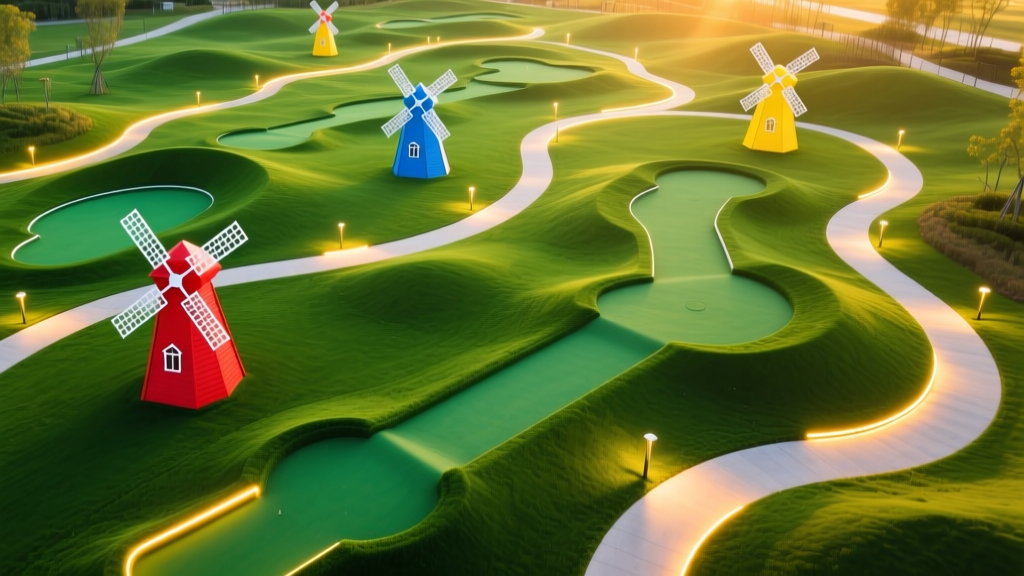
Obstacles represent the most variable line item in your budget. Standard fiberglass obstacles (windmills, lighthouses, looping pipes) coated in UV-stabilized gel coat range from $4,000 to $12,000 each. For premium, vandal-resistant installations, Glass Fiber Reinforced Concrete (GFRC) obstacles are the industry standard. GFRC structures, such as multi-tier volcanoes or castle ruins, cost between $15,000 and $30,000 per unit but offer a lifespan exceeding 30 years with minimal maintenance.
Do not sequence two highly complex, multi-stroke obstacles back-to-back. A 45-second hole followed by a 3-minute water-feature hole will create 15-minute backups, destroying customer throughput and revenue. Budget for professional course routing to ensure a mix of rapid-play and technical holes.
Hidden Costs and Failure Modes That Destroy Margins
When planning the cost to build a putt putt course, developers frequently overlook secondary infrastructure. Failing to budget for these elements results in catastrophic failure modes within the first 24 months.
- Drainage Failure: A minimum 1% to 2% slope is mandatory. If water pools on the concrete base, it will cause spalling and eventually delaminate the turf backing. Budget $12 to $18 per linear foot for 4-inch corrugated French drains wrapped in geotextile fabric, tying into municipal storm sewers or dry wells. The USGA Green Section emphasizes that subsurface drainage is the single most critical factor in any putting surface longevity.
- Turf Delamination at Seams: Commercial courses require specialized 12-inch wide seam tape and dual-component polyurethane adhesives. Using standard landscape glue will result in seams peeling up under the stress of foot traffic and thermal expansion.
- Lighting Glare and Shadows: High-mast floodlights create deep shadows across the turf, making it difficult for players to read the break. Budget for low-voltage (12V) LED hardscape fixtures ($80 to $150 per fixture installed) mounted at knee-height to provide even, 2700K warm-white illumination without glare.
- Automated Ticketing and POS: Modern FECs require RFID wristband systems and automated ticketing kiosks to reduce labor costs. Budget $15,000 to $28,000 for a robust, weatherproof POS and access control system.
Step-by-Step Budget Allocation Framework
To ensure your capital is distributed correctly across the project lifecycle, use this percentage-based allocation model for a standard $250,000 commercial 18-hole build:
- Site Prep, Earthwork & Permitting (12% | $30,000): Clearing, grading, soil testing, and municipal zoning fees.
- Concrete Hardscape & Drainage (28% | $70,000): Sub-base compaction, forming, rebar, pouring, and trench drains.
- Synthetic Turf, Adhesives & Infill (18% | $45,000): Premium nylon turf, seam tape, polyurethane glue, and silica sand.
- Obstacles & Architectural Theming (22% | $55,000): Fiberglass/GFRC structures, water features, and custom signage.
- Lighting, POS, & Landscaping (14% | $35,000): LED pathway lighting, kiosk hardware, and perimeter landscaping/berms.
- Design, Engineering & Contingency (6% | $15,000): Professional course routing and a buffer for material price fluctuations.
Permitting, Zoning, and Site Prep Variables
Before breaking ground, verify your local zoning ordinances regarding noise, light pollution, and commercial recreation. Many municipalities classify putt putt courses under "Amusement and Recreation" zoning, which may require conditional use permits if located near residential boundaries. Furthermore, if your site features mature trees, budget for root mapping and specialized aeration systems to ensure your concrete pouring and trenching do not destabilize the local canopy. Proper budget planning demands that you secure geotechnical soil reports early; discovering expansive clay or high water tables after signing a lease can add $20,000 to $40,000 in unexpected soil stabilization and deep-foundation drainage costs.
Written by
Priya KapoorPriya Kapoor is a real estate market analyst and construction economics researcher with expertise in housing affordability, development feasibility, and infrastructure investment. She holds a Master of Regional Planning from Cornell University and previously worked as a senior analyst at CBRE's Investment Properties group, where she modeled returns for $4B in mixed-use development pipelines. Priya now runs an independent research practice advising developers, municipalities, and REITs on construction cost forecasting and market timing. She publishes the quarterly "BuildMat Market Pulse" report tracking material price indices across 12 commodity categories. Based in Austin, TX, Priya serves on the board of Habitat for Humanity Austin and is a marathon runner.
More from Priya Kapoor
View all
Construction Cost
Cost to Build a 1600 Sq Ft Home in 2026: Full Breakdown
Accurate 2026 cost to build a 1600 sq ft home—material, labor, and regional pricing breakdowns included. Plan your budget with real-time estimates.
Aug 11, 2026

Wood & Lumber
Name the Types of Wood for Pressure Treatment and Preservation
Learn how to name the types of wood best suited for pressure treatment. Compare species treatability, chemical retention levels, and 2026 preservation costs.
Aug 4, 2026

Stone & Masonry
Stone Veneer Suppliers Lindenhurst: 2026 Cost Analysis
Analyze 2026 stone veneer costs in Lindenhurst, NY. Compare local supplier pricing, delivery fees, and Suffolk County installation labor rates.
Aug 4, 2026