How Much It Costs to Build a Swimming Pool: 2026 Regional Guide
Discover how much it costs to build a swimming pool in 2026. We break down regional pricing, soil challenges, and local code impacts across the US.

The True Cost to Build a Swimming Pool: Beyond the National Average
When homeowners begin researching how much it costs to build a swimming pool, they are frequently met with a frustratingly broad national average. In 2026, the baseline cost for a standard 14-by-28-foot gunite pool hovers between $55,000 and $75,000. However, this national median is practically useless for precise budgeting. The reality of pool construction is that geography dictates your final invoice far more than the size of the water feature itself.
To accurately estimate your project, you must analyze the intersection of local soil mechanics, municipal building codes, and regional labor rates. According to the Pool & Hot Tub Alliance (PHTA), regional variance can swing the final price of identical pool designs by over 60% from one state to the next.
Regional Cost Matrix: How Geography Dictates Your Pool Price
The table below illustrates the baseline cost ranges for a standard 14x28 foot gunite (dry-mix shotcrete) pool with a basic brushed concrete deck across four distinct US regions.
| Region | 2026 Cost Range | Primary Cost Driver | Soil / Code Factor |
|---|---|---|---|
| Florida / Southeast | $45,000 - $65,000 | Dewatering & Engineering | High Water Table / Sandy Soil |
| Texas / Southwest | $65,000 - $90,000 | Rock Excavation | Caliche Rock / Expansive Clay |
| California / West Coast | $85,000 - $120,000+ | Permitting & Energy Codes | Seismic Engineering / Title 24 |
| Northeast / Midwest | $70,000 - $100,000 | Frost Line Footings & Labor | Deep Frost Lines / Freeze-Thaw |
Florida & The Southeast: The High Water Table Premium
While sandy soil makes the physical digging process faster and cheaper, Florida builders face a massive hidden cost: water management. In coastal or low-lying areas, excavators frequently hit the water table just a few feet down. To prevent the pool shell from literally floating out of the ground during heavy rains or when drained for maintenance, engineers must design hydrostatic relief valves and heavily over-engineer the steel reinforcement grid.
Furthermore, builders often have to install temporary wellpoint dewatering systems during construction, which can add $2,500 to $4,500 to the excavation phase alone. The gunite shell must also be mixed with specific waterproofing admixtures to resist hydrostatic pressure and chloride intrusion from the surrounding damp sand.
Texas & The Southwest: Rock Excavation and Expansive Clay
If you are building in the Hill Country or suburban Austin, your biggest adversary is caliche and solid limestone. Standard excavation with a backhoe is impossible. Contractors must bring in heavy-duty rock hammers or even utilize controlled blasting, which can increase the $3,000 baseline excavation cost to upwards of $12,000. According to regional labor data tracked by the US Bureau of Labor Statistics, the demand for specialized heavy equipment operators in these zones commands a significant premium.
Additionally, the expansive clay soils prevalent in North Texas require deeper grade beams and over-excavation. Builders must dig wider and deeper, then backfill with select, non-expansive material to prevent the soil from swelling and cracking the 3,000 PSI gunite shell during heavy spring rains.
California & The West Coast: Seismic Codes and Title 24 Energy Mandates
California consistently posts the highest pool construction costs in the nation. Beyond the high cost of union and prevailing-wage labor, the regulatory environment is stringent. All new pools must comply with Title 24 Building Energy Efficiency Standards. This means single-speed pumps are entirely banned. Builders must install high-end variable speed pumps, such as the Pentair IntelliFlo3 VSF (retailing around $1,800 to $2,200 for the unit alone), alongside mandatory solar-ready plumbing pathways and automated pool covers to reduce evaporation and heat loss.
Furthermore, seismic zones require structural engineers to stamp the pool plans, mandating thicker shotcrete application (often 12 inches instead of the standard 8 to 10 inches) and a denser #4 rebar grid tied at 10-inch centers rather than the standard 12-inch centers. The California Energy Commission strictly enforces these efficiency mandates, and failing an inspection can halt a project for weeks, inflating carrying costs.
The Northeast & Midwest: Frost Lines and Seasonal Labor Surcharges
In states like New York, Pennsylvania, or Illinois, the primary structural enemy is frost heave. The pool shell and surrounding concrete deck must be engineered to withstand the violent freeze-thaw cycles of northern winters. This requires digging deep structural footings—often 48 inches or more below grade—to sit below the local frost line.
Plumbing configurations also differ drastically. While southern builders might use flexible corrugated PVC to save time, northern builders must use rigid Schedule 40 PVC with specific sweep elbows and install comprehensive auto-drain winterization lines. Because the construction window is compressed into roughly six to seven months of favorable weather, contractors price in a seasonal labor surge, effectively charging a premium for the urgency of the build.
2026 Equipment and Material Baselines
Regardless of your region, the core equipment package remains a significant chunk of your budget. Upgrading from builder-grade to premium automation and filtration will impact your bottom line. Here is what you should expect to pay for high-performance components in 2026:
- Variable Speed Pumps: Pentair IntelliFlo3 VSF or Hayward TriStar VS. Expect to pay $1,600 to $2,200 installed. These are non-negotiable in most modern jurisdictions and save up to 70% on pumping energy costs.
- Filtration Systems: Cartridge filters (like the Pentair Clean & Clear Plus 420 sq ft) cost around $900 to $1,200. If your municipality allows backwashing, a Hayward Pro-Grid DE filter provides superior water clarity but costs $1,300 to $1,600 and requires periodic DE powder replacement.
- Sanitation (Saltwater vs. UV/Ozone): A standard salt chlorine generator (Hayward AquaRite) adds $1,200 to $1,500. For those with sensitive skin or indoor enclosures, a UV/Ozone combination system (like the Pentair ClearLight) will cost $2,500 to $3,500 but drastically reduces chlorine demand.
- Automation & Smart Controls: Systems like the Pentair IntelliCenter with a 10-inch indoor touch panel and Wi-Fi integration run between $3,500 and $5,000 fully wired, allowing complete control of heating, lighting, and water features from a smartphone.
The Soil Test Imperative: Avoiding the $10,000 Surprise
Critical Warning: Never sign a fixed-price pool contract that includes a 'rock clause' or 'unforeseen soil conditions' addendum without first commissioning an independent geotechnical soil report. A $1,500 soil test upfront can save you from a $15,000 change order when the excavator hits bedrock or a subterranean spring on day two of digging.
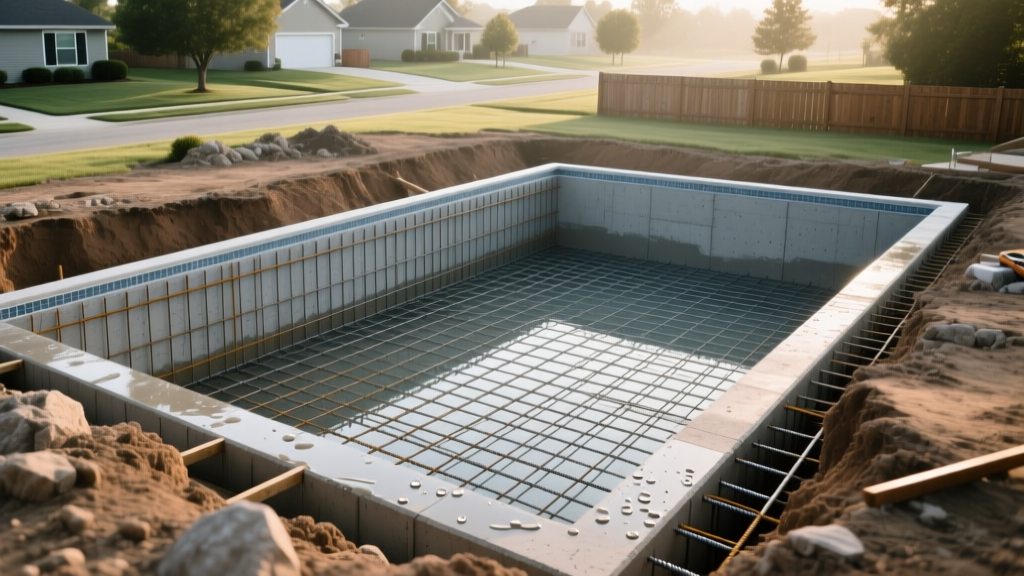
Many budget-conscious homeowners skip the geotechnical survey, relying on the builder's visual assessment. This is a critical error. A certified soil engineer will drill core samples to determine the exact bearing capacity, water table depth, and soil expansiveness. Armed with this data, your pool engineer can specify the exact thickness of the gunite shell and the precise rebar schedule required, locking in your price and eliminating the contractor's need to pad the bid with 'contingency' pricing.
Strategic Planning Framework for Your Region
To accurately forecast your specific costs, apply this three-step framework before soliciting bids:
- Identify Your Micro-Climate Penalties: Call your local municipal building department and ask specifically about frost-line depths, energy code pump requirements, and setback variances. These three factors alone can swing your budget by 15%.
- Audit Your Access: If a standard 30-foot excavation truck and crane cannot easily access your backyard due to narrow side yards or overhead power lines, contractors will have to use smaller, less efficient equipment or even helicopter in materials, adding massive logistical surcharges.
- Demand Itemized Bids: Reject any builder who provides a single lump-sum quote. Require an itemized breakdown separating excavation, steel/gunite, plumbing, equipment, and decking. This allows you to see exactly where regional premiums are being applied and where you can value-engineer the design.
Understanding the regional mechanics of pool construction transforms you from a passive buyer into an informed project manager. By anticipating the specific geological and regulatory hurdles of your zip code, you can build a durable, code-compliant aquatic environment without falling victim to the inevitable change orders that plague unprepared homeowners.
Written by
Elena RodriguezElena Rodriguez is a civil engineer and technical writer specializing in concrete technology, masonry systems, and ASTM/ACI compliance. She earned her B.S. in Civil Engineering from Texas A&M University and spent a decade at a materials testing laboratory, performing over 2,000 concrete compressive strength tests and masonry prism evaluations. Elena is an ACI-certified Field Testing Technician (Grade I) and a member of ASTM Committee C12 on Natural Building Stone. She currently consults on forensic engineering cases involving concrete failures and moisture intrusion. Based in San Antonio, TX, Elena is a proud member of the Society of Women Engineers (SWE) and coaches her daughter's FIRST Robotics team.
More from Elena Rodriguez
View all
Walls & Panels
Cost Analysis: Light Gauge Steel Framing Advantages and Disadvantages
Evaluate light gauge steel framing advantages and disadvantages through a strict cost analysis lens, comparing material, labor, and lifecycle expenses.
Aug 4, 2026

Walls & Panels
Gypsum Board Types: Exact Specifications, Thickness & Dimensions
Compare standard, Type X, and moisture-resistant gypsum board types. Get exact specifications, thicknesses, dimensions, and ASTM standards for your project.
Aug 4, 2026

Fire Resistance
Best Fire-Resistant Outdoor Decking Materials: 2026 Buyer Guide
Discover the best fire-resistant outdoor decking materials for 2026. Compare Class A PVC, aluminum, and hardwood options for WUI compliance and safety.
Aug 4, 2026