How Much Does It Cost to Build an RV Park? 2026 Scope Calculator
Calculate exactly how much it costs to build an RV park in 2026. Our size and scope calculator breaks down pad, utility, and amenity expenses.

The RV Park Cost Calculator Framework
Determining how much does it cost to build a rv park requires moving beyond generic per-acre averages. Modern RV parks are highly engineered civil projects. The final capital expenditure is dictated by a strict matrix of size (total pad count and acreage) and scope (utility tier, pad material, and amenity package). In 2026, supply chain stabilization has normalized material costs, but labor shortages in specialized civil trenching and electrical work continue to drive infrastructure expenses upward.
This size and scope calculator framework deconstructs the development process into three distinct cost phases. By applying your specific project metrics to the data tables below, you can generate a highly accurate baseline estimate for your capital stack.
Phase 1: Land Development & Civil Infrastructure
Before a single pad is poured, the raw land must be transformed into a stable, drainable site. Site preparation costs are heavily dependent on topography, soil composition, and existing vegetation. According to the National Association of RV Parks & Campgrounds (ARVC), inadequate drainage is the number one cause of premature park failure, making civil grading a non-negotiable expense.
| Civil Scope Item | Unit | 2026 Cost Range | Technical Specification |
|---|---|---|---|
| Clearing & Grubbing | Per Acre | $3,500 - $8,000 | Removal of topsoil, stumps, and debris to subgrade. |
| Cut and Fill Grading | Per Cubic Yard | $8.50 - $14.00 | Laser-guided grading to achieve 2% minimum pad slope. |
| Stormwater Retention | Per Acre | $12,000 - $25,000 | Dry detention basins with riprap outfalls. |
| Internal Asphalt Roads | Per Linear Foot | $160 - $240 | 3-inch asphalt surface over 6-inch compacted aggregate base. |
| Concrete Curbing | Per Linear Foot | $12 - $18 | Extruded slip-form curbing for road edges and pad borders. |
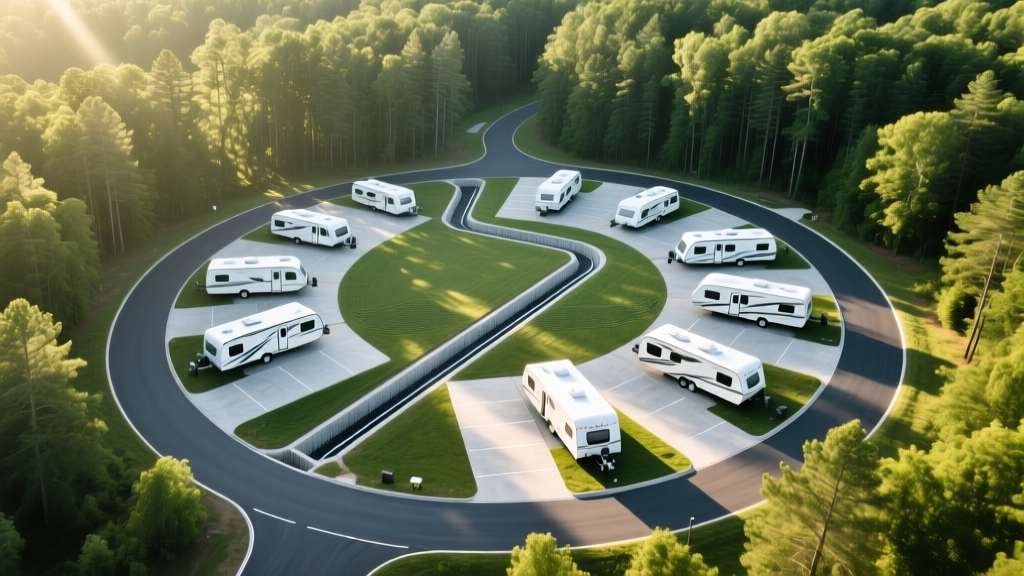
Phase 2: Pad Construction & Utility Hookups
The core product of any RV park is the pad and its accompanying utility pedestal. Modern Class A motorhomes and fifth-wheel trailers frequently exceed 40 feet in length and require robust electrical systems to run multiple HVAC units simultaneously. The RV Industry Association (RVIA) notes that 50-amp service is now the baseline expectation for premium resorts, rendering 30-amp-only parks obsolete for high-yield transient markets.
Pad Material Selection Matrix
- Crushed Angular Gravel (Economy): $1,800 - $3,200 per pad. Requires 6 inches of compacted crushed stone (never use pea gravel, which shifts under heavy axle loads). Requires heavy landscape fabric underneath.
- Broom-Finish Concrete (Mid-Tier): $4,500 - $7,500 per pad. Standard 40x60 foot pad poured at 4 inches thick using 4,000 PSI concrete with a 6x6 W1.4xW1.4 welded wire mesh.
- Stamped & Sealed Concrete (Luxury): $8,000 - $12,500 per pad. Adds aesthetic borders, integrated patio extensions, and heavy-duty acrylic sealers to prevent oil staining.
Utility Trenching & Pedestal Specifications
Underground utilities represent the most capital-intensive phase of pad development. Trenching must accommodate water, sewer, and electrical conduits while maintaining strict separation distances mandated by local building codes.
| Utility Component | Material Standard | Cost Per Pad (Trenched) |
|---|---|---|
| Potable Water Lateral | C900 PVC (2-inch) | $850 - $1,200 |
| Sewer Lateral | SDR-35 PVC (4-inch) | $1,100 - $1,600 |
| Electrical Conduit | Schedule 80 PVC | $600 - $900 |
| Power Pedestal (50/30/20 Amp) | Milbank or Eaton | $1,800 - $2,400 |
| Water/Sewer Vault & Hookups | Polyethylene/Brass | $700 - $1,100 |
Phase 3: Scope Modifiers (Amenities & Facilities)
Amenities dictate your nightly rate ceiling and your park's classification. A basic transient park requires minimal amenities, while a destination resort requires extensive recreational infrastructure.
Amenity Cost Estimator
- Standard Bathhouse (4,000 sq ft): $450,000 - $650,000. Includes masonry exterior, commercial tankless water heaters, and ADA-compliant fixtures.
- Resort-Style Pool & Splash Pad: $350,000 - $800,000. Includes commercial filtration, zero-depth entry, and concrete decking.
- Clubhouse with Fitness Center: $250,000 - $500,000. Metal building construction with upgraded interior finishes and HVAC.
- Off-Leash Dog Park: $25,000 - $45,000. Includes 6-foot chain link fencing, double-gate entry, and crushed granite surfacing.
- Laundry Facility: $120,000 - $180,000. Includes commercial hard-mount washers, high-capacity gas dryers, and heavy-duty plumbing.
Size Multipliers: Scaling Your RV Park
Economies of scale significantly impact your per-pad cost. A 20-pad park bears the same fixed costs for engineering, DOT access permits, and bathhouse construction as a 50-pad park, making smaller parks disproportionately expensive on a per-unit basis. Use the matrix below to calculate your estimated total infrastructure cost (excluding land acquisition and amenities).
| Park Size | Economy Scope (Gravel/30A) | Mid-Tier Scope (Concrete/50A) | Luxury Scope (Stamped/Full Res) |
|---|---|---|---|
| 20 Pads (5 Acres) | $420,000 - $550,000 | $750,000 - $950,000 | $1,100,000 - $1,400,000 |
| 50 Pads (12 Acres) | $850,000 - $1,100,000 | $1,500,000 - $1,900,000 | $2,200,000 - $2,800,000 |
| 100 Pads (25 Acres) | $1,600,000 - $2,000,000 | $2,800,000 - $3,500,000 | $4,200,000 - $5,500,000 |
| 200 Pads (50 Acres) | $3,000,000 - $3,800,000 | $5,200,000 - $6,500,000 | $8,000,000 - $10,500,000 |
The "Hidden" Scope Creep Traps
When calculating how much does it cost to build a rv park, developers frequently underestimate soft costs and regulatory hurdles. These expenses do not yield physical assets but are mandatory for opening day.
- DOT Driveway Permits: $15,000 - $40,000 for traffic impact studies and highway deceleration lane construction.
- Environmental & Wetlands Delineation: $8,000 - $25,000. Building on jurisdictional wetlands can halt a project entirely.
- Utility Impact Fees: $1,000 - $4,000 per pad charged by municipal water/sewer authorities for tapping into city mains.
- Fire Department Access: Upgrading private roads to support 75,000 lb fire trucks may require deeper aggregate bases and wider turning radii.
Financing & ROI Considerations
Securing capital for RV park development has evolved. Traditional commercial lenders often view RV parks as specialized hospitality assets, requiring 30% to 40% down payments. However, developers building in designated rural areas can leverage USDA Rural Development programs, such as the Business & Industry (B&I) Guaranteed Loan Program, which can provide favorable terms and lower equity requirements for projects that stimulate local rural economies.
A well-located mid-tier RV park operating at 65% annual occupancy with a $75 average daily rate (ADR) typically yields a stabilized Net Operating Income (NOI) margin of 40% to 55%. Understanding these operational metrics is crucial when presenting your size and scope calculator outputs to equity partners or lenders.
Frequently Asked Questions
Can I build an RV park in phases to reduce initial capital?
Yes. Phased development is highly recommended. Phase 1 should include all master-planned underground utility mains, road bases, and the primary bathhouse. Subsequent phases can then be activated by simply trenching laterals and pouring pads, drastically reducing the per-pad cost of expansion.
How much does it cost to build a rv park with a septic system versus city sewer?
Connecting to city sewer costs $1,500 to $4,000 per pad in impact fees and tap costs. A commercial engineered septic system (such as a drip dispersal or mound system) costs $150,000 to $400,000 upfront, plus ongoing maintenance and strict environmental compliance monitoring. City sewer is always preferred if accessible.
What is the ideal pad size for a modern RV park?
The industry standard has shifted. While 20x50 foot pads were common in the 1990s, modern rigs require a minimum 20x60 foot pad for the rig, plus an adjacent 20x30 foot patio/utility zone. Designing for 40x60 foot total concrete envelopes ensures maximum compatibility with 45-foot motorhomes and toy haulers.
Written by
David NakamuraDavid Nakamura is a licensed architect (AIA) and construction technology writer focused on sustainable building methods, mass timber engineering, and high-performance building envelopes. He holds a Master of Architecture from the University of Washington and is a certified Passive House Consultant (CPHC). David spent eight years at the Seattle firm Mithun, where he led the design of three LEED Platinum projects, before founding his own practice specializing in net-zero residential design. He serves on the editorial advisory board of GreenBuilder Magazine and has authored peer-reviewed papers on cross-laminated timber (CLT) connections for the Journal of Structural Engineering. In his spare time, David teaches woodworking at Pratt Fine Arts Center and kayaks the Puget Sound.
More from David Nakamura
View all
Construction Cost
Labor Cost to Build a Deck Per Sq Ft: 2026 Installation Guide
Discover the exact labor cost to build a deck per sq ft in 2026. This installation guide breaks down contractor rates, complexity factors, and hidden fees.
Aug 4, 2026

Construction Cost
How Much Does It Cost to Build a 3 Bedroom House? Financing Guide
Learn exactly how much it costs to build a 3 bedroom house and explore 2026 financing options, construction loan types, and budget frameworks for your build.
Aug 4, 2026

Construction Cost
Cost to Build a Tennis Court: 2026 Guide
How much does it cost to build a tennis court in 2026? Breakdowns for asphalt, concrete, and synthetic surfaces plus fencing and lighting.
Jul 30, 2026