Sphere Cost to Build: Complete Pricing Guide for Dome Homes
Discover the true sphere cost to build in our complete guide. Compare monolithic and geodesic dome pricing, materials, and hidden expenses.
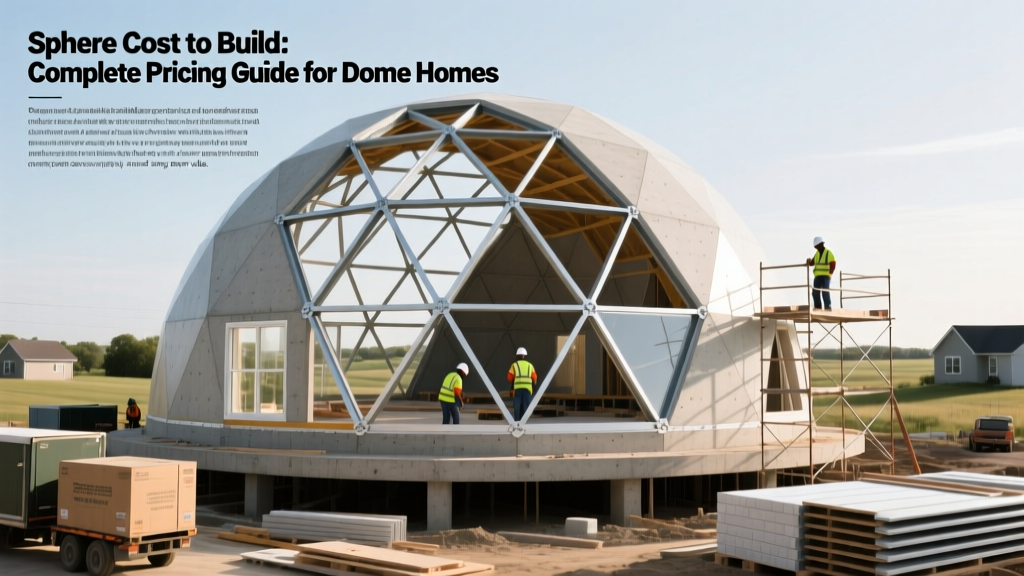
The Economics of Spherical Construction
Calculating the exact sphere cost to build requires distinguishing between the two primary spherical construction methods: monolithic domes and geodesic domes. While both offer superior aerodynamic resilience and energy efficiency compared to traditional rectangular stick-built homes, their material requirements, labor intensities, and finishing costs diverge significantly. A spherical structure eliminates corners, reducing the surface-area-to-volume ratio by up to 30%, which directly translates to lower long-term HVAC expenses. However, the upfront sphere cost to build involves specialized labor, custom fabrication for non-standard openings, and unique foundation engineering.
Quick Cost Snapshot (Per Square Foot)
- Monolithic Dome (Turnkey): $175 – $275 per sq. ft.
- Geodesic Dome (Turnkey): $130 – $220 per sq. ft.
- Traditional Stick-Built Home: $150 – $250 per sq. ft.
- Shell-Only Monolithic: $65 – $90 per sq. ft.
- Shell-Only Geodesic Kit: $15 – $45 per sq. ft.
Monolithic Domes vs. Geodesic Domes: A Cost Matrix
To accurately budget your project, you must select your structural methodology. Monolithic domes are constructed using an inflatable Airform membrane, polyurethane foam insulation, and steel-reinforced shotcrete. Geodesic domes rely on a geometric network of struts (usually timber or steel) connected by specialized hubs to form a spherical lattice. Below is a detailed cost and performance matrix comparing the two approaches.
| Feature | Monolithic Dome | Geodesic Dome |
|---|---|---|
| Average Turnkey Cost | $175 - $275 / sq. ft. | $130 - $220 / sq. ft. |
| Primary Shell Materials | Airform, closed-cell foam, shotcrete | Timber/steel struts, OSB/polycarbonate panels |
| Insulation Value (R-Value) | R-40 to R-60 (continuous) | R-20 to R-40 (cavity dependent) |
| Labor Specialization | High (requires certified shotcrete nozzlemen) | Medium (advanced framing skills required) |
| Lifespan & Durability | 100+ years (tornado/hurricane resistant) | 50-75 years (requires roof maintenance) |
Breakdown: Where Does the Money Go?
Understanding the line-item expenses of a spherical build prevents budget overruns. The sphere cost to build is heavily weighted toward the shell erection and interior finishing phases due to the non-standard geometry.
1. Foundation Engineering (12% - 18% of Budget)
Spherical structures require circular foundations. For monolithic domes, a circular grade beam or reinforced concrete slab is mandatory to anchor the Airform and support the immense weight of the shotcrete shell. Expect to pay $15 to $25 per square foot for a reinforced circular slab. Geodesic domes are lighter and can sometimes be erected on specialized pier foundations or rubble trenches, reducing foundation costs to $8 to $14 per square foot.
2. Shell Construction and Erection (30% - 45% of Budget)
For monolithic builds, the Airform membrane itself costs roughly $2.50 to $4.00 per square foot. The polyurethane foam (applied at 3 to 5 inches thick) and the shotcrete (applied at 3 to 4 inches thick at 3,000 PSI) represent the bulk of the material cost. According to the Monolithic Dome Institute, the continuous application of these materials creates a seamless, monolithic shell that acts as both structure and insulation. Geodesic shell kits range from $15,000 for a basic 800 sq. ft. timber frame to over $80,000 for a 3,000 sq. ft. steel-hub system with structural insulated panels (SIPs).
3. Interior Finishing and Curved Drywall (25% - 35% of Budget)
This is where most first-time dome builders experience sticker shock. Standard 4x8 drywall sheets cannot easily bend around the tight radii of smaller domes. Builders must use flexible gypsum boards (such as USG Sheetrock Flexicost or 1/4-inch flex-board) or apply veneer plaster over curved metal lath. Framing interior partition walls that intersect a curved exterior shell requires custom scribing and coping, increasing finish carpentry labor costs by 20% to 40% compared to rectangular homes.
Warning: The Hidden Costs of Spherical Geometry
Custom Glazing: Standard rectangular windows cannot be flush-mounted on a curved monolithic shell without creating severe water intrusion risks. You must either build out flat 'buck' frames (creating deep window wells) or order custom curved/trapezoidal glass, which can cost 3x to 5x more than standard vinyl replacements.
Roofing Maintenance: While monolithic domes have no traditional roof, geodesic domes feature dozens of triangular seams. The FEMA Building Science division notes that complex roof geometries are highly susceptible to water infiltration if flashing and sealants fail. Budget for high-grade EPDM or TPO membrane coatings and bi-annual seam inspections for geodesic structures.
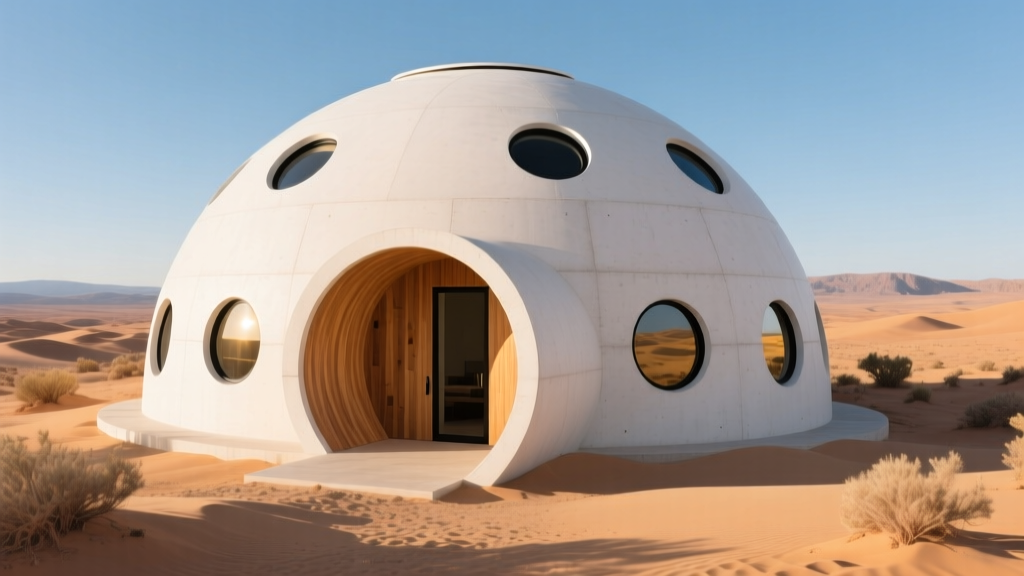
Step-by-Step Budgeting Framework
To develop a reliable estimate for your specific project, follow this sequential budgeting framework:
- Define the Radius and Frequency: Determine your square footage. For geodesic domes, select the frequency (e.g., 3V, 4V, 5V). Higher frequencies yield a smoother sphere but require more struts, hubs, and complex triangular panel cutting, raising the kit price.
- Calculate the Envelope Area: Do not budget based on floor area alone. A 1,500 sq. ft. floor plan in a dome might have 2,200 sq. ft. of exterior surface area. Price your insulation, exterior coatings, and interior drywall based on the envelope area.
- Factor in HVAC Sizing: Because spherical homes are highly energy-efficient, standard HVAC contractors often oversize the equipment. Use a Manual J calculation specific to the dome's R-value. A 2,000 sq. ft. monolithic dome typically requires only a 2-ton heat pump, saving $3,000 to $5,000 on initial equipment costs compared to a stick-built equivalent.
- Allocate 15% for Geometric Contingencies: Standard construction contingencies are 10%. Increase this to 15% for spherical builds to cover unforeseen custom fabrication, specialized scaffolding rentals for interior heights, and curved cabinetry modifications.
Real-World Spherical Build Case Studies
Case Study A: 1,800 Sq. Ft. Monolithic Dome (Arizona)
- Foundation: $22,000 (Circular slab with post-tension cables)
- Shell (Airform, Foam, Shotcrete): $85,000
- Interior Framing & Flex-Drywall: $48,000
- Custom Windows & Doors: $31,000
- Mechanicals & Finishes: $110,000
- Total Turnkey Cost: $296,000 ($164 per sq. ft.)
Insight: The owner saved significantly on cooling costs due to the thermal mass of the concrete shell and the continuous R-50 insulation, but paid a premium for the custom curved kitchen island and circular staircase.
Case Study B: 1,200 Sq. Ft. Geodesic Dome (Colorado)
- Foundation: $14,000 (Pier and grade beam)
- Timber Kit & SIPs Panels: $55,000
- Assembly Labor & Crane Rental: $28,000
- Roofing (Architectural Shingles on Triangles): $19,500
- Interior & Mechanicals: $88,000
- Total Turnkey Cost: $204,500 ($170 per sq. ft.)
Insight: The geodesic kit was relatively inexpensive, but the labor cost to cut and flash 90+ individual roof triangles pushed the exterior finishing budget 30% higher than initially estimated.
FAQs on Dome Construction Costs
Are dome homes more expensive to insure?
Historically, some insurers classified domes as 'non-standard' structures, leading to higher premiums. However, monolithic domes are increasingly recognized for their disaster resilience. Because they meet or exceed FEMA safe room standards for wind resistance (withstanding EF5 tornadoes), many specialized carriers now offer discounted premiums for monolithic builds in hurricane and tornado-prone regions. Geodesic domes, due to their complex roofing seams, may still face standard or slightly elevated premiums depending on the carrier.
How does the resale value of a spherical home compare?
Spherical homes suffer from a limited buyer pool due to their unconventional aesthetics and interior layout challenges (e.g., placing standard rectangular furniture against curved walls). While the construction cost per square foot is comparable to custom luxury homes, appraisers often struggle to find direct 'comps' in the local market. To protect your investment, build with neutral, adaptable interior layouts and avoid overly compartmentalizing the open floor plan.
Can I get a traditional mortgage for a dome home?
Yes, but it requires preparation. Lenders rely on appraisals, and appraisers rely on comparable sales. If you are building a geodesic or monolithic dome, compile a comprehensive 'appraiser packet' before applying for a construction-to-permanent loan. This packet should include detailed material cost breakdowns, energy-efficiency certifications (like HERS index scores), and evidence of similar dome sales in a broader regional radius to justify the valuation.
Written by
Marcus ChenMarcus Chen is a licensed structural engineer (PE) and building materials analyst with over 12 years of experience across residential, commercial, and industrial construction. He holds a Master of Science in Civil Engineering from UC Berkeley and spent six years at Thornton Tomasetti before transitioning to independent consulting and technical writing. Marcus specializes in material selection for seismic-prone regions, concrete reinforcement strategies, and lifecycle cost analysis. His work has been cited by the American Concrete Institute (ACI) and the Structural Engineers Association of California (SEAOC). When he is not on a job site or at his desk, you will find him hiking the Sierra Nevada or restoring a 1920s craftsman bungalow in Oakland, CA.
More from Marcus Chen
View all
Construction Cost
How Much Did the Eiffel Tower Cost to Build?
How much did the Eiffel Tower cost to build in 1889? We adjust for inflation and compare its budget to modern skyscraper construction.
Aug 4, 2026

Fire Resistance
What Is a Fire Resistant Material? Testing & Certification Guide
Discover what is a fire resistant material through ASTM and UL testing. Learn how fire ratings, certifications, and assemblies work in construction.
Aug 4, 2026

Construction Cost
How Much Did the Burj Khalifa Cost to Build?
How much did the Burj Khalifa cost to build? We break down the $1.5B project and extract 5 money-saving strategies for your next build.
Jul 30, 2026