How Much Would a Swimming Pool Cost to Build? 2026 Breakdown
Discover exactly how much a swimming pool costs to build in 2026. We break down excavation, materials, and hidden fees for gunite, vinyl, and fiberglass.

The True Baseline: National Averages vs. Your Backyard
When homeowners ask how much would a swimming pool cost to build, they are often met with vague estimates that fail to account for site-specific variables. In 2026, the national average for a fully installed, mid-sized (14x28 foot) inground swimming pool ranges from $75,000 to $125,000. However, this baseline only covers a standard gunite shell, basic Schedule 40 plumbing, and a standard variable-speed pump. According to Angi's comprehensive pool cost database, custom features, difficult soil conditions, and high-end interior finishes can easily push the final contract price past $150,000. Understanding the line-item breakdown is the only way to prevent budget overruns.
Material Matrix: Gunite, Fiberglass, and Vinyl Liner Costs
The choice of pool shell material dictates not only the initial construction cost but also the long-term maintenance trajectory. Below is a comparative matrix for a standard 14x28 foot footprint (approx. 392 square feet of water surface).
| Material | Average Base Cost (14x28) | Lifespan | Customization | Maintenance Profile |
|---|---|---|---|---|
| Gunite (Concrete) | $85,000 - $125,000 | 50+ years (shell) | Unlimited (any shape/depth) | High (acid washing, resurfacing every 12-15 years) |
| Fiberglass | $70,000 - $95,000 | 25-30 years | Limited (pre-manufactured molds) | Low (non-porous gelcoat resists algae) |
| Vinyl Liner | $55,000 - $80,000 | 10-12 years (liner) | Moderate (custom cuts available) | Moderate (vulnerable to tears, requires liner replacement) |
Phase-by-Phase Construction Breakdown
To accurately estimate your project, you must understand where the capital is deployed during the 8-to-12-week construction cycle. The following breakdown reflects 2026 labor and material rates for a standard gunite installation.
1. Engineering, Permits, and Site Prep
Before dirt is moved, a licensed structural engineer must draft the shell plans, typically costing $1,500 to $3,000. Municipal permits range from $400 to $1,200 depending on local zoning ordinances. Site prep involves clearing vegetation and establishing temporary fencing, adding another $800 to $1,500.
2. Excavation and Soil Hauling
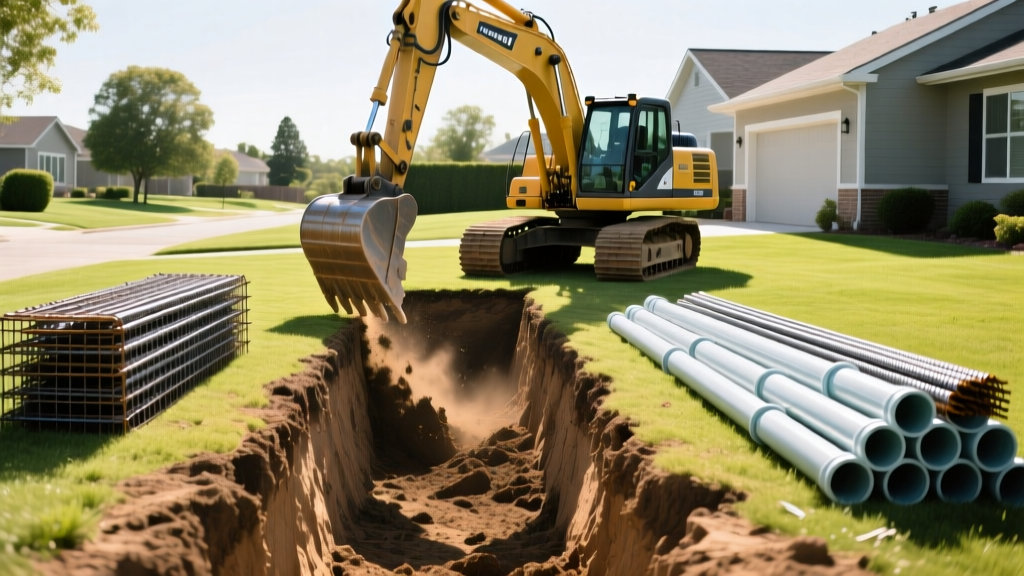
Excavation is priced by the cubic yard. For a 14x28 pool with a 6-foot average depth, you are moving roughly 130 cubic yards of dirt. Standard soil excavation and haul-away costs $12 to $18 per cubic yard. However, this phase is highly volatile.
3. Steel Reinforcement and Plumbing
A structural gunite shell requires a grid of #3 (3/8-inch) and #4 (1/2-inch) Grade 60 rebar, tied on 10-inch to 12-inch centers. Steel costs average $4,500 to $6,500. For plumbing, insist on Schedule 40 PVC for standard runs and Schedule 80 PVC for high-pressure zones near the equipment pad. Using 2.5-inch pipe instead of the standard 2-inch pipe reduces hydraulic head loss, allowing your pump to operate at lower RPMs, saving hundreds in annual electricity costs.
4. Shell Application (Gunite vs. Shotcrete)
Gunite is a dry-mix process where water is added at the nozzle, achieving compressive strengths of 4,000 to 5,000 PSI. Shotcrete is a wet-mix alternative that typically yields 3,000 to 4,000 PSI. Gunite application costs $10 to $15 per square foot of surface area. The shell must cure for 28 days, during which it should be watered daily to prevent thermal cracking.
5. Coping, Tile, and Interior Finish
The waterline tile and coping define the pool's aesthetic. Standard 6x6 porcelain waterline tile costs $15 to $25 per linear foot, while custom glass mosaic can exceed $60 per linear foot. For coping, cantilevered poured concrete is the most economical ($15 to $20 per linear foot), whereas tumbled travertine or bluestone coping ranges from $35 to $55 per linear foot. The interior finish is the final major expense: standard white marcite costs $5 to $7 per square foot, quartz aggregate costs $8 to $12, and premium pebble finishes (like PebbleTec) cost $12 to $18 per square foot.
The 'Hidden' Costs That Derail Pool Budgets
According to HomeGuide's contractor pricing reports, change orders and site-specific surprises account for 15% to 20% of budget overruns. Watch for these specific line items:
- Access Restrictions: If a standard Bobcat or excavator cannot fit through your side yard (minimum 8-foot clearance required), contractors must use a crane to lift equipment or a conveyor belt to remove dirt. Crane mobilization alone adds $2,500 to $4,000.
- Utility Rerouting: Discovering a main sewer line, gas line, or primary electrical conduit beneath the pool footprint requires rerouting. Gas line reroutes average $1,200 to $2,500, while sewer laterals can exceed $5,000.
- Expansive Clay Soils: In regions with heavy clay, the soil expands when wet and shrinks when dry, threatening the pool shell. Engineers may require over-excavation and backfilling with clean gravel, adding $3,000 to $6,000.
- Decking Expansions: The base contract usually includes a basic 3-foot concrete perimeter. Upgrading to a 1,000-square-foot stamped concrete or paver deck will add $12,000 to $25,000 to the final invoice.
Equipment Upgrades: Standard vs. High-Efficiency
The equipment pad is where long-term operational costs are determined. The Pool & Hot Tub Alliance (PHTA) strongly recommends exceeding minimum code requirements for energy efficiency.
Pro-Tip: Automation and Variable Speed
Never install a single-speed pump. A high-efficiency variable speed pump, such as the Pentair IntelliFlo VSF or Hayward TriStar VS, costs $1,800 to $2,500 installed but reduces pumping energy costs by up to 80% compared to single-speed models, paying for itself in under three years.
For sanitation, traditional liquid chlorine or trichlor pucks require constant manual dosing and can degrade pool finishes over time. Upgrading to a saltwater chlorine generator (e.g., Hayward AquaRite) costs an additional $1,200 to $1,800 but provides a steady, low-level chlorine output that is gentler on skin and pool plaster. For those sensitive to chlorine byproducts (chloramines), adding an Ultraviolet (UV) or Ozone sanitation system ($1,500 to $2,200) will oxidize organic contaminants, reducing the required chlorine residual to near-zero.
Frequently Asked Questions
Does a swimming pool increase my property value?
In warm-weather climates (e.g., Florida, Arizona, Southern California), a well-maintained inground pool can increase property value by 5% to 8%. In cooler climates, it may yield a neutral return on investment, though it significantly improves the marketability and time-on-market for luxury homes.
How much does it cost to maintain a pool annually?
Expect to spend $1,500 to $2,500 annually on chemicals, electricity, water top-offs, and routine cleaning. Opening and closing the pool in northern climates adds $400 to $800 per year. Winterizing and spring startup labor rates have increased in 2026 due to technician shortages.
Can I finance the pool construction?
Yes. Most homeowners utilize Home Equity Lines of Credit (HELOC) or specialized pool financing loans. In 2026, unsecured pool loans typically carry interest rates between 8% and 14%, while HELOC rates track closer to prime. Always secure financing pre-approval before signing the excavation contract.
Written by
David NakamuraDavid Nakamura is a licensed architect (AIA) and construction technology writer focused on sustainable building methods, mass timber engineering, and high-performance building envelopes. He holds a Master of Architecture from the University of Washington and is a certified Passive House Consultant (CPHC). David spent eight years at the Seattle firm Mithun, where he led the design of three LEED Platinum projects, before founding his own practice specializing in net-zero residential design. He serves on the editorial advisory board of GreenBuilder Magazine and has authored peer-reviewed papers on cross-laminated timber (CLT) connections for the Journal of Structural Engineering. In his spare time, David teaches woodworking at Pratt Fine Arts Center and kayaks the Puget Sound.
More from David Nakamura
View all
Construction Cost
Labor Cost to Build a Deck Per Sq Ft: 2026 Installation Guide
Discover the exact labor cost to build a deck per sq ft in 2026. This installation guide breaks down contractor rates, complexity factors, and hidden fees.
Aug 4, 2026

Construction Cost
How Much Does It Cost to Build a 3 Bedroom House? Financing Guide
Learn exactly how much it costs to build a 3 bedroom house and explore 2026 financing options, construction loan types, and budget frameworks for your build.
Aug 4, 2026

Construction Cost
Cost to Build a Tennis Court: 2026 Guide
How much does it cost to build a tennis court in 2026? Breakdowns for asphalt, concrete, and synthetic surfaces plus fencing and lighting.
Jul 30, 2026