Cost to Build a House in Texas: 2026 Regional Price Comparison
Analyze the true cost to build a house in Texas in 2026. Compare regional pricing, foundation expenses for expansive clay, and material budgets.

The True Cost to Build a House in Texas (2026 Baseline)
Calculating the exact cost to build a house in Texas requires moving beyond national averages. While the U.S. national baseline for custom residential construction hovers around $165 per square foot, Texas presents a highly fragmented pricing landscape driven by localized labor markets, municipal impact fees, and extreme soil variability. As of 2026, the statewide average to build a standard production home sits at $138 to $152 per square foot, while custom architectural builds range from $185 to $275 per square foot. According to building permit data tracked by the U.S. Census Bureau, Texas consistently leads the nation in new residential authorizations, keeping material supply chains robust but placing intense pressure on specialized trade labor.
- State Average (Production): $145 / sq. ft.
- State Average (Custom): $215 / sq. ft.
- Average Lot Preparation Premium: 6-9% of total budget (varies heavily by soil type)
- Primary Cost Driver: Foundation engineering for expansive clay soils
Regional Cost Matrix: Metro Hubs vs. Rural Tracts
The cost to build a house in Texas fluctuates wildly depending on the specific municipality. Metro areas command higher labor rates and stricter zoning requirements, while rural builds face increased logistical costs for material delivery and well/septic installation. The following matrix breaks down the 2026 regional cost expectations for a 2,500-square-foot, single-story custom home.
| Region | Avg Cost / Sq. Ft. | Total Est. (2,500 sq ft) | Primary Cost Multiplier |
|---|---|---|---|
| Austin / Hill Country | $210 - $260 | $525,000 - $650,000 | Limestone excavation, strict tree preservation ordinances |
| Dallas-Fort Worth | $175 - $220 | $437,500 - $550,000 | Deep pier foundations for Blackland Prairie clay |
| Houston / Gulf Coast | $165 - $210 | $412,500 - $525,000 | Elevation requirements, windstorm engineering (IBHS) |
| San Antonio | $160 - $195 | $400,000 - $487,500 | Standard slab-on-grade, moderate labor rates |
| West Texas / Panhandle | $145 - $180 | $362,500 - $450,000 | Material freight surcharges, rural utility tie-ins |
Foundation Engineering: The Expansive Clay Premium
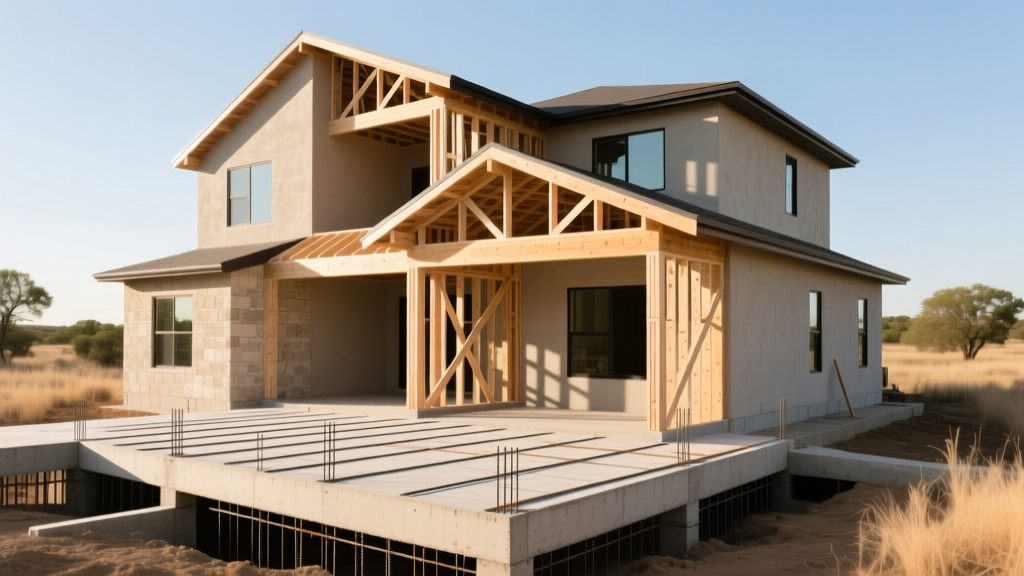
The most overlooked variable when estimating the cost to build a house in Texas is subsurface soil conditions. The Texas Blackland Prairie, which cuts directly through the Dallas-Fort Worth metroplex and down into San Antonio, is notorious for highly expansive clay soils. These soils swell significantly when wet and shrink during droughts, exerting thousands of pounds of uplift pressure on concrete foundations.
Standard slab-on-grade foundations will fail in these regions. Structural engineers typically mandate one of two solutions, which add substantial upfront costs but prevent catastrophic structural damage:
1. Post-Tensioned Slab-on-Grade
Instead of standard rebar, high-strength steel cables are laid in a grid pattern and tensioned with hydraulic jacks after the concrete cures. This compresses the slab, making it highly resistant to cracking from soil movement. Expect to pay a premium of $3.50 to $5.00 per square foot over a standard rebar slab. For a 2,500 sq. ft. home, this adds $8,750 to $12,500 to the foundation budget.
2. Drilled Bell-Bottom Piers
In areas with extreme soil plasticity (Plasticity Index > 35), engineers require drilled concrete piers that bypass the active clay zone and anchor into stable bedrock or load-bearing strata. Piers are typically spaced 8 to 10 feet apart and cost between $800 and $1,200 per pier. A standard home may require 40 to 60 piers, adding $32,000 to $72,000 to the site work budget.
Envelope and Framing: Wood vs. ICF in a High-Wind State
Texas spans multiple climate zones, from the humid, hurricane-prone Gulf Coast to the arid, high-wind Panhandle. Your framing and envelope strategy must align with local environmental threats. The Federal Reserve Bank of Dallas notes that resilient construction methods are increasingly factoring into long-term property valuations and insurance premiums across the state.
- Advanced Wood Framing (2x6 Exterior Walls): The baseline for most Texas builds. Using 2x6 studs at 24-inch on-center spacing allows for deeper insulation cavities. Pair this with closed-cell spray foam (2 lb density, yielding R-7 per inch) to achieve R-22+ in the walls, which is critical for combating the intense summer heat. Cost: $12 - $16 per sq. ft. of wall area.
- Insulated Concrete Forms (ICF): Brands like Fox Blocks or Nudura are gaining traction on the Gulf Coast (Galveston, Corpus Christi) and in Tornado Alley. ICF provides a continuous R-24 insulation value, acts as a vapor barrier, and offers wind resistance up to 250 mph. Cost: $22 - $28 per sq. ft. of wall area. While the upfront cost is 8-12% higher than wood, the reduction in HVAC tonnage requirements and windstorm insurance premiums often yields a 7-year ROI.
Roofing Systems: Hail and Heat Mitigation
Texas leads the nation in severe hail events. Installing standard 3-tab asphalt shingles is a false economy. Budget for impact-resistant roofing materials to qualify for insurance premium discounts (often 15-25% off wind/hail coverage).
Recommended Specifications:
- Class 4 Impact Shingles: Look for UL 2218 Class 4 rated architectural shingles (e.g., GAF Timberline AS II or Owens Corning Duration Storm). These feature a reinforced SBS modified asphalt layer that absorbs hail impacts without fracturing the mat. Installed cost: $4.50 - $6.50 per sq. ft.
- Standing Seam Metal (26-Gauge Galvalume): The premium choice for Hill Country and Panhandle builds. Ensure panels feature a cool-roof Kynar 500 paint finish to reflect solar radiant heat, reducing attic temperatures by up to 20°F. Installed cost: $11.00 - $15.00 per sq. ft.
Texas-Specific Soft Costs and Permitting
When modeling the cost to build a house in Texas, soft costs typically consume 18% to 25% of the total budget. However, Texas has specific regulatory quirks that out-of-state builders often miscalculate:
- Municipal Impact Fees: Rapidly growing suburbs (e.g., Frisco, Celina, Buda) levy aggressive water and wastewater impact fees. These can range from $4,000 to over $9,000 per single-family lot, payable before building permits are issued.
- TCEQ Compliance: The Texas Commission on Environmental Quality enforces strict stormwater runoff rules for sites disturbing more than one acre. If your custom build involves significant clearing, budget $2,500 - $4,500 for SWPPP (Stormwater Pollution Prevention Plan) engineering and silt fencing.
- Property Tax Provisions: Unlike many states, Texas has no state income tax, relying heavily on property taxes. While not a direct construction cost, the appraisal district will assess your new build immediately upon certificate of occupancy. Factor a 1.8% to 2.3% effective annual tax rate into your long-term holding cost models.
Budget Allocation Framework for Texas Climates
To maximize the longevity and energy efficiency of a Texas home, reallocate funds from cosmetic finishes to mechanical and envelope upgrades. According to the U.S. Energy Information Administration, Texas homes consume significantly more electricity for cooling than the national average. Implement the following framework:
- HVAC Sizing: Mandate a Manual J load calculation. Do not allow builders to use "rules of thumb" (e.g., 1 ton per 500 sq ft). Oversized units short-cycle, failing to dehumidify the air. Target 16+ SEER2 variable-speed units with smart thermostats.
- Attic Insulation: Upgrade from the code-minimum R-38 to R-60 blown-in cellulose or open-cell foam. Apply a radiant barrier foil to the roof decking to reflect up to 97% of radiant solar heat.
- Window Glazing: Specify Low-E 366 glass with argon gas fills. The "366" coating features three layers of silver, specifically engineered to block solar heat gain (low SHGC) while allowing visible light transmission—critical for south and west-facing elevations.
Frequently Asked Questions
Is it cheaper to build or buy an existing home in Texas right now?
In 2026, building a custom home in Texas generally costs 10% to 15% more upfront than purchasing a comparable existing resale home, primarily due to land acquisition and site preparation costs. However, building allows you to integrate high-efficiency HVAC, superior insulation, and modern foundation engineering, which drastically reduces monthly utility and maintenance expenses, often achieving cost parity within five years.
How do I verify if my Texas lot requires a septic system?
If the lot is outside a municipal ETJ (Extraterritorial Jurisdiction) or city limit, you will likely need an OSSF (On-Site Sewage Facility). You must hire a licensed site evaluator to conduct a perc test and soil morphology analysis. Aerobic treatment units (ATUs) are required in many Texas counties with poor-draining clay soils, adding $12,000 to $18,000 to your site work budget.
What is the timeline for building a house in Texas?
Expect a 9 to 14-month timeline from breaking ground to final walkthrough for a 2,500 to 3,500 sq. ft. custom home. Foundation curing, framing, and drywall are relatively fast, but municipal inspections in high-growth corridors (like Austin or DFW) can introduce 3-to-5-week delays at the framing, electrical, and final CO (Certificate of Occupancy) stages.
Written by
David NakamuraDavid Nakamura is a licensed architect (AIA) and construction technology writer focused on sustainable building methods, mass timber engineering, and high-performance building envelopes. He holds a Master of Architecture from the University of Washington and is a certified Passive House Consultant (CPHC). David spent eight years at the Seattle firm Mithun, where he led the design of three LEED Platinum projects, before founding his own practice specializing in net-zero residential design. He serves on the editorial advisory board of GreenBuilder Magazine and has authored peer-reviewed papers on cross-laminated timber (CLT) connections for the Journal of Structural Engineering. In his spare time, David teaches woodworking at Pratt Fine Arts Center and kayaks the Puget Sound.
More from David Nakamura
View all
Construction Cost
Labor Cost to Build a Deck Per Sq Ft: 2026 Installation Guide
Discover the exact labor cost to build a deck per sq ft in 2026. This installation guide breaks down contractor rates, complexity factors, and hidden fees.
Aug 4, 2026

Construction Cost
How Much Does It Cost to Build a 3 Bedroom House? Financing Guide
Learn exactly how much it costs to build a 3 bedroom house and explore 2026 financing options, construction loan types, and budget frameworks for your build.
Aug 4, 2026

Construction Cost
Cost to Build a Tennis Court: 2026 Guide
How much does it cost to build a tennis court in 2026? Breakdowns for asphalt, concrete, and synthetic surfaces plus fencing and lighting.
Jul 30, 2026