Material Cost to Build a House: 2026 Detailed Breakdown
Discover the true material cost to build a house in 2026. Detailed breakdown of lumber, exterior, interior, and hidden expenses per square foot.

The Baseline: National Average Material Costs per Square Foot
Calculating the exact material cost to build a house requires moving beyond generic square-foot averages. As of 2026, the national average for residential construction materials ranges from $110 to $165 per square foot, excluding labor, land, and permitting. For a standard 2,000-square-foot home, this translates to a pure material budget of $220,000 to $330,000. According to data tracked by the U.S. Census Bureau and industry analyses from the National Association of Home Builders (NAHB), material volatility has stabilized compared to the early 2020s, but specific categories like engineered lumber and high-efficiency HVAC components have seen permanent price floor increases due to updated energy codes.
To build an accurate budget, you must deconstruct the house into its core phases. The table below outlines the material cost distribution for a mid-grade custom build.
| Construction Phase | Material Category | Low-End Cost / Sq Ft | High-End Cost / Sq Ft | Primary Cost Drivers |
|---|---|---|---|---|
| Foundation | Concrete, Rebar, ICF | $12.00 | $22.00 | Soil conditions, ICF vs. poured wall |
| Framing | Lumber, Engineered Wood, Steel | $28.00 | $45.00 | Lumber market, complex rooflines |
| Exterior Envelope | Siding, Roofing, Windows, WRB | $25.00 | $55.00 | Cladding type, window glazing specs |
| Mechanicals | Plumbing, Electrical, HVAC | $18.00 | $32.00 | Heat pumps, PEX vs. Copper, smart panels |
| Interior Finishes | Drywall, Flooring, Cabinets, Trim | $27.00 | $65.00+ | Custom cabinetry, hardwood vs. LVP |
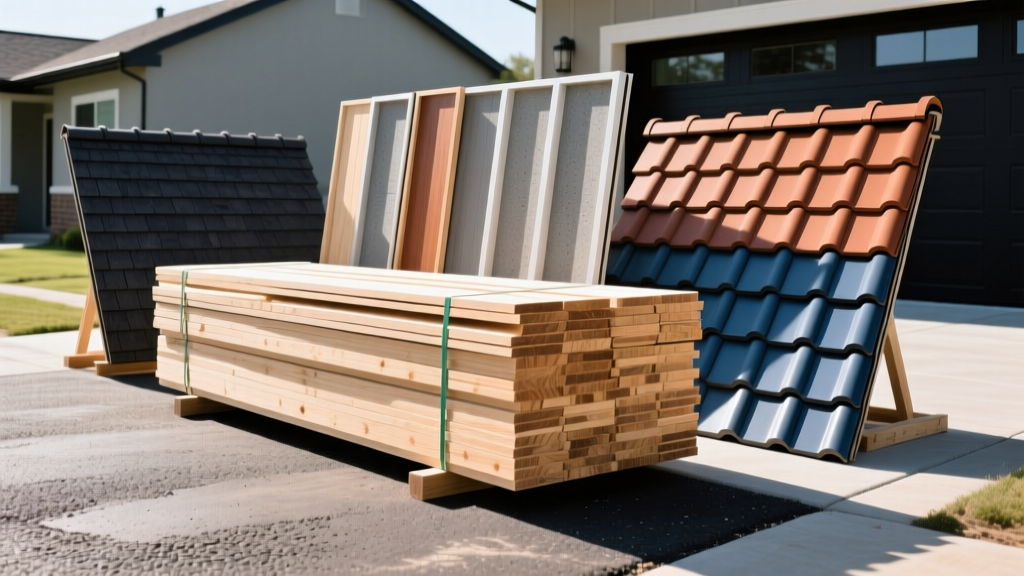
Framing & Structural Lumber: The Biggest Variable
Framing typically consumes 20% to 25% of your total material budget. The choice between traditional dimensional lumber and engineered wood products dictates both cost and structural performance.
- Dimensional Lumber (SPF #2): Standard Spruce-Pine-Fir 2x4 and 2x6 studs currently average $3.50 to $4.80 per linear foot. For exterior walls, the 2024/2026 IECC energy codes heavily favor 2x6 construction to accommodate R-20+ cavity insulation, increasing lumber volume by roughly 15% compared to 2x4 walls.
- Engineered I-Joists (e.g., Weyerhaeuser TJI): For floor systems, TJI joists cost $4.50 to $7.00 per linear foot. While more expensive than solid sawn joists, they eliminate floor squeaks, span longer distances without intermediate beams, and reduce material waste by up to 30%.
- LVL Beams (Laminated Veneer Lumber): Essential for open-concept floor plans. A 1.75-inch x 11.875-inch LVL beam costs approximately $14.00 to $18.00 per linear foot. Always pair these with heavy-duty Simpson Strong-Tie post caps and hangers (add $150-$300 per connection point) to meet sheer wall requirements.
Exterior Envelope: Siding, Roofing, and Weatherization
The envelope protects the structure and defines the home's curb appeal. Material selection here involves a direct trade-off between upfront cost and lifecycle maintenance.
Modern building codes increasingly mandate enhanced drainage planes. Upgrading from traditional Tyvek HomeWrap ($0.65/sq ft) to a liquid-applied membrane or an integrated sheathing system like ZIP System ($1.85/sq ft) adds roughly $3,500 to a 2,500 sq ft home but drastically reduces air infiltration and prevents moisture-related mold failures.
Exterior Cladding Comparison Matrix
| Material | Cost per Sq Ft (Material Only) | Lifespan | Maintenance Profile |
|---|---|---|---|
| Vinyl Siding (Standard) | $1.50 - $3.00 | 30-40 Years | Low (Wash annually) |
| Fiber Cement (James Hardie) | $3.50 - $5.50 | 50+ Years | Medium (Paint every 15 yrs) |
| Brick Veneer (Modular) | $6.00 - $9.00 | 100+ Years | Very Low (Tuckpointing) |
| Stucco (Traditional 3-Coat) | $7.50 - $11.00 | 50-80 Years | Medium (Seal hairline cracks) |
For roofing, architectural asphalt shingles (such as GAF Timberline HDZ) remain the baseline at $1.20 to $1.80 per square foot. However, standing seam metal roofing (24-gauge Galvalume) is surging in popularity for wildfire-prone zones, costing $9.00 to $14.00 per square foot. Never skip the ice and water shield (e.g., Grace Ice & Water Shield at $1.10/sq ft) along eaves and valleys; it is a critical defense against ice damming.
Interior Finishes: Where Budgets Expand or Contract
Interior finishes represent the most elastic portion of your material budget. The gap between builder-grade and custom-grade materials can easily swing the overall project cost by 30%.
Drywall & Insulation: Standard 1/2-inch drywall costs about $0.45 per square foot, but building codes require 5/8-inch Type X (fire-rated per ASTM E119) in garages and utility rooms, pushing that cost to $0.65 per square foot. For insulation, open-cell spray foam ($0.60/board foot) offers superior air sealing compared to fiberglass batts ($0.35/sq ft), but Rockwool Comfortbatt mineral wool ($0.95/sq ft) provides the best balance of thermal resistance (R-23 for 2x6), fire retardation, and soundproofing.
Flooring: Luxury Vinyl Plank (LVP) with a 20-mil wear layer (e.g., CoreTec) dominates the mid-market at $3.50 to $5.50 per square foot, offering waterproof durability. Site-finished solid oak hardwood remains the premium standard at $8.00 to $12.00 per square foot for materials alone, requiring a highly stable subfloor (minimum 3/4-inch AdvanTech OSB) to prevent seasonal cupping.
Mechanical Systems: Plumbing, Electrical, and HVAC
Mechanical materials are heavily regulated and subject to strict efficiency mandates.
- Plumbing: PEX-A tubing (Uponor) has largely replaced Type L Copper for supply lines. PEX-A costs roughly $0.75 per linear foot for materials and fittings, compared to $3.50+ for copper. However, for main water service lines entering the foundation, Schedule 40 PVC or HDPE remains the most cost-effective and freeze-resistant choice.
- Electrical: Standard 12/2 Romex NM-B wire averages $0.65 per foot. Budget an additional $2,500 to $4,000 in materials for smart home infrastructure, including structured wiring (Cat6A), Lutron Caseta smart switches, and a 200-amp Square D QO load center with surge protection.
- HVAC: With federal mandates pushing for higher SEER2 ratings, a standard 16 SEER2 central air system (e.g., Carrier Performance series) costs around $4,500 to $6,000 in equipment. Cold-climate heat pumps (like the Mitsubishi Hyper-Heat series) cost 30% to 40% more upfront in equipment but eliminate the need for gas line trenching and propane tank leasing.
The 'Invisible' Material Costs Often Missed in Estimates
Amateur estimators frequently calculate the macro-materials (lumber, concrete, siding) and forget the micro-materials. According to HomeAdvisor's construction cost indexes, these hidden costs routinely cause 8% to 12% budget overruns if not explicitly line-itemed:
- Fasteners and Connectors: Nails, structural screws (like Simpson SDWS), joist hangers, and anchor bolts can easily consume $4,000 to $6,500 on a standard build.
- Adhesives and Sealants: Subfloor glue (PL Premium), acoustical sealant for drywall, and exterior flashing tapes (Zip System tape) add $1,500 to $2,500.
- The Waste Factor: Material takeoffs must include a waste multiplier. Add 10% for standard framing and drywall, 15% for complex roofing cuts, and up to 20% for intricate tile patterns. Ordering exact net quantities guarantees work stoppages.
Frequently Asked Questions
Do material costs include concrete for the driveway and flatwork?
No. The baseline material cost per square foot generally applies to the conditioned living space. Driveways, patios, and detached flatwork are calculated separately. A standard 4-inch thick broom-finished concrete driveway costs $6.00 to $8.50 per square foot for materials and finishing, while stamped or exposed aggregate finishes push material and chemical costs to $11.00+ per square foot.
Is it cheaper to buy a pre-fabricated material package?
Panelized wall systems and pre-fabricated roof trusses reduce on-site labor time by 20% to 30%, but the material package itself is often 5% to 10% more expensive than stick-built lumber due to factory engineering and shipping logistics. However, the reduction in weather-related material damage and job-site waste often makes the net cost neutral or slightly favorable.
How do I protect my budget against mid-build price spikes?
Lock in pricing through your lumber yard or supplier using a 'price guarantee' or 'will-call' contract. Most major suppliers allow you to pay a small non-refundable deposit (usually 5% to 10%) to lock in current material pricing for up to 90 days. Ensure your foundation and framing schedules are tightly coordinated to utilize the locked inventory before the guarantee expires.
Written by
James ThorntonJames Thornton is a construction industry veteran with 25 years of hands-on experience in wood framing, lumber grading, and residential building codes. He started as a framing carpenter in rural Oregon, earned his ICC Residential Building Inspector certification, and eventually became a senior plan reviewer for the City of Portland Bureau of Development Services. James holds a B.S. in Wood Science & Technology from Oregon State University and is a certified lumber grader through the West Coast Lumber Inspection Bureau (WCLIB). He has inspected over 3,000 residential construction sites and authored the city's internal guide on advanced framing techniques (2x6 at 24" O.C.). James lives in Bend, OR, where he builds custom timber-frame cabins and competes in lumberjack sports.
More from James Thornton
View all
Insulation
Best Home Insulation Materials: Complete 2026 Guide
Compare top home insulation materials for 2026. Find R-values, installed costs per square foot, and best uses for fiberglass, spray foam, and mineral wool.
Aug 4, 2026

Sustainable Building
Certify Your Green Building Material for LEED and WELL
Step-by-step guide to certifying a green building material for LEED v5 and WELL v2. Master EPDs, HPDs, and VOC limits for 2026 project specifications.
Aug 4, 2026

Stone & Masonry
Veneer Stacked Stone Panels: Interior Design & Style Showcase
Discover how veneer stacked stone panels transform interiors. Explore modern design profiles, material pairings, and technical installation specs.
Aug 4, 2026