Cost to Build Luxury Home: Size & Scope Calculator Guide
Calculate the true cost to build luxury home projects using our size and scope framework. Break down premium materials, smart tech, and site work.
The Baseline: Defining Luxury Construction Tiers
Calculating the cost to build luxury home projects requires abandoning standard tract-home metrics. While national averages for custom builds hover between $200 and $400 per square foot, true luxury construction operates in an entirely different financial stratum. According to Forbes Advisor, high-end custom homes start at $450 per square foot, but ultra-luxury and trophy properties easily exceed $1,500 per square foot. This variance is not merely a markup on labor; it reflects fundamental shifts in structural engineering, material procurement, and integrated building systems.
To accurately estimate your project, you must first classify your build into one of three distinct luxury tiers. Each tier demands specific structural allowances, architectural fees, and mechanical systems that drastically alter the final ledger.
Size & Scope Calculator: Cost per Square Foot Breakdown
The following framework calculates the hard construction costs (materials and labor) based on gross conditioned square footage. This does not include land acquisition, but does include site preparation, foundation, framing, and interior finishes.
| Luxury Tier | Cost per Sq. Ft. (2026) | Defining Characteristics | Typical Soft Cost Multiplier |
|---|---|---|---|
| Tier 1: High-End Custom | $450 - $700 | Premium stock materials, smart home ready, custom millwork, high-efficiency HVAC. | 12% - 15% |
| Tier 2: Ultra-Luxury | $700 - $1,200 | Bespoke imported materials, structural glass, enterprise automation, geothermal climate control. | 15% - 20% |
| Tier 3: Trophy / Masterpiece | $1,200 - $2,500+ | Architectural landmarks, seismic/base-isolation engineering, museum-grade climate/art storage. | 20% - 30% |
Tier 1: High-End Custom ($450 - $700 / sq ft)
This tier represents the upper echelon of standard custom building. You are utilizing premium, but readily available, North American materials. Expect Andersen 400 Series or Marvin Essential windows, custom-built local cabinetry, and Carrier or Trane high-efficiency forced-air HVAC systems. The scope here focuses on aesthetic upgrades and spatial volume rather than experimental engineering.
Tier 2: Ultra-Luxury ($700 - $1,200 / sq ft)
At this level, the home becomes a highly integrated machine. The scope shifts to imported, book-matched stone (e.g., Calacatta Viola marble), structural frameless glazing (e.g., Sky-Frame), and fully integrated Lutron HomeWorks QSX lighting and shade control. HVAC transitions to geothermal systems paired with Zehnder Energy Recovery Ventilators (ERVs) for hospital-grade indoor air quality.
Tier 3: Trophy / Architectural Masterpiece ($1,200+ / sq ft)
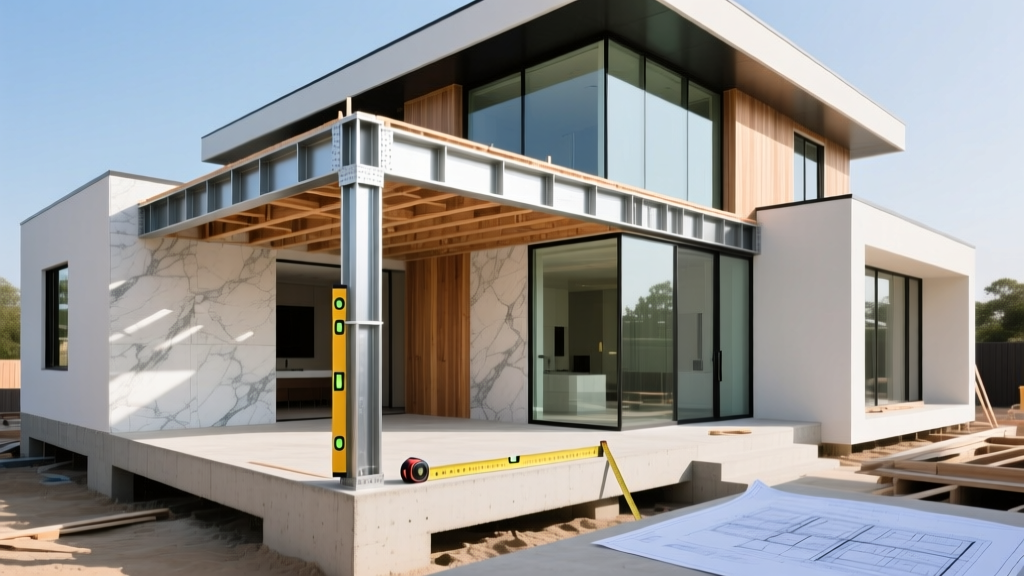
Trophy homes are defined by extreme engineering. This includes cantilevered steel structures, base-isolation seismic foundations, and specialized environments like museum-grade art galleries requiring strict UV and humidity controls. Materials are entirely bespoke, often requiring direct commissioning from international artisans, resulting in 12-to-18-month procurement lead times.
The Hidden Scope Multipliers (Where Budgets Fail)
Most budget overruns in luxury construction do not occur in the finishes; they occur in the unseen site work and soft costs. The National Association of Home Builders (NAHB) notes that soft costs (architectural fees, engineering, permits) and site work consume a massive percentage of the budget, a figure that scales exponentially in luxury builds.
Luxury estates are frequently built on challenging, scenic topography. Blasting bedrock can cost $40 to $65 per cubic yard. If your site requires Mechanically Stabilized Earth (MSE) retaining walls with geogrid reinforcement to create flat building pads, add $150 to $300 per linear foot to your site prep budget before foundation work even begins.
Standard Wi-Fi cannot support a 15,000 sq ft ultra-luxury home with 400+ smart devices. You must scope a commercial-grade networking infrastructure. This includes installing shielded CAT6a cabling, dedicated server racks with UPS battery backups, and enterprise wireless access points (e.g., Ubiquiti UniFi or Ruckus). Budget $40,000 to $85,000 strictly for IT infrastructure and low-voltage wiring.
Material & Systems Matrix: Upgrading from Standard to Luxury
Use this matrix to identify where your specific selections will push your build from Tier 1 into Tier 2 or 3. The cost differentials between these tiers are rarely linear; they are exponential due to the specialized labor required for installation.
| System / Component | Tier 1: High-End Custom | Tier 2: Ultra-Luxury | Tier 3: Trophy Estate |
|---|---|---|---|
| Glazing & Windows | Marvin Ultimate (Aluminum-clad wood) | Sky-Frame (Structural frameless sliding) | SageGlass (Electrochromic dynamic tinting) |
| HVAC & Climate | High-SEER Gas / Mini-splits | WaterFurnace Geothermal + Zehnder ERV | Geothermal + Radiant + Dedicated Wine Cellars |
| Automation | Control4 or Savant Basic | Lutron HomeWorks QSX + Crestron | Full KNX Standard + Enterprise IT Routing |
| Acoustic Envelope | Standard batt insulation + drywall | Rockwool Safe'n'Sound + Resilient Channel | Decoupled staggered-stud + QuietRock 545 |
| Exterior Cladding | HardiePlank / Stucco / Local Stone | Imported Limestone / Rainscreen Zinc | Custom extruded bronze / Titanium panels |
Step-by-Step: Calculating Your Specific Build
To generate a highly accurate preliminary budget, follow this sequential calculation framework. Do not skip the soft-cost and procurement multipliers, as they are the primary culprits in luxury project delays and financial shortfalls.
- Calculate Net Conditioned Space: Measure only the heated/cooled interior square footage. Exclude three-season porches, detached garages, and unfinished basements. (Add these later as separate line items at 30-40% of the main tier cost).
- Apply the Tier Base Rate: Multiply your net space by the median cost of your chosen tier. (e.g., 8,000 sq ft x $850 = $6,800,000).
- Add Site & Geotechnical Work: Add a flat 8% to 12% of the base rate for site prep, utility trenching, and landscaping, adjusting upward if your lot features severe slopes or poor soil bearing capacity.
- Calculate Soft Costs: According to the American Institute of Architects (AIA), luxury architectural and engineering fees typically range from 12% to 18% of total construction costs. Multiply your running total by 0.15 to find your design and permitting budget.
- Factor in the Procurement Buffer: Add a 10% contingency specifically for supply chain volatility. Imported materials like Italian elevators (e.g., Savaria or Cibes) and European structural glass routinely face 6-to-14-month lead times, requiring early capital deployment and potential climate-controlled storage fees.
Expert Insights: Avoiding the 'Luxury Tax'
Building at the highest tiers often attracts a 'luxury tax'—not from the municipality, but from contractors and suppliers who inflate quotes based on the perceived wealth of the client. To mitigate this, implement strict procurement strategies.
'The most effective way to control ultra-luxury costs is to decouple the material procurement from the general contractor's markup. For Tier 2 and Tier 3 builds, owners should establish direct accounts with specialty vendors for lighting, automation, and imported stone, utilizing the GC strictly for installation labor and project management. This can shave 15% to 20% off the most expensive line items.'
— Senior Construction Manager, Boutique Luxury Development Firm
Furthermore, consider the long-term operational costs. While a WaterFurnace 700A11 geothermal system requires a massive upfront capital expenditure for well-drilling (often $40,000 to $80,000 for a large estate), the U.S. Department of Energy highlights that geothermal heat pumps can reduce energy consumption by up to 60% compared to traditional systems. In a 15,000-square-foot trophy home, the monthly utility savings will offset the initial drilling costs within a 7-to-10-year horizon, making it a financially sound scope inclusion rather than a mere luxury upgrade.
Accurately estimating the cost to build luxury home properties requires treating the project as a commercial development rather than a residential upgrade. By utilizing precise tier classifications, accounting for extreme site engineering, and decoupling procurement from labor, you can establish a scope calculator that reflects the true financial reality of bespoke construction.
Written by
Marcus ChenMarcus Chen is a licensed structural engineer (PE) and building materials analyst with over 12 years of experience across residential, commercial, and industrial construction. He holds a Master of Science in Civil Engineering from UC Berkeley and spent six years at Thornton Tomasetti before transitioning to independent consulting and technical writing. Marcus specializes in material selection for seismic-prone regions, concrete reinforcement strategies, and lifecycle cost analysis. His work has been cited by the American Concrete Institute (ACI) and the Structural Engineers Association of California (SEAOC). When he is not on a job site or at his desk, you will find him hiking the Sierra Nevada or restoring a 1920s craftsman bungalow in Oakland, CA.
More from Marcus Chen
View all
Construction Cost
How Much Did the Eiffel Tower Cost to Build?
How much did the Eiffel Tower cost to build in 1889? We adjust for inflation and compare its budget to modern skyscraper construction.
Aug 4, 2026

Fire Resistance
What Is a Fire Resistant Material? Testing & Certification Guide
Discover what is a fire resistant material through ASTM and UL testing. Learn how fire ratings, certifications, and assemblies work in construction.
Aug 4, 2026

Construction Cost
How Much Did the Burj Khalifa Cost to Build?
How much did the Burj Khalifa cost to build? We break down the $1.5B project and extract 5 money-saving strategies for your next build.
Jul 30, 2026