Cost to Build a 10x10 Deck: 2026 Upfront vs Maintenance Costs
Analyze the true cost to build a 10x10 deck in 2026. Compare upfront material prices with 10-year maintenance expenses to find your best total value.

The 100-Square-Foot Baseline: Upfront Cost to Build a 10x10 Deck
When calculating the initial cost to build a 10x10 deck, you are pricing exactly 100 square feet of surface area. However, professional contractors factor in a 10% waste allowance for cuts and defects, meaning you will purchase 110 square feet of decking boards. In 2026, the national average for deck construction ranges from $25 to $75 per square foot installed, depending heavily on the decking material and local labor rates, which currently average $45 to $65 per hour for specialized carpentry.
According to HomeGuide's 2026 deck cost report, the framing and substructure typically account for 40% to 50% of the total project cost, regardless of the surface material you choose. For a 10x10 footprint, you will need approximately 120 linear feet of 2x8 pressure-treated joists, 4x4 or 6x6 support posts, and concrete footings engineered to your local frost line.
| Decking Material | Material Cost (110 sq ft) | Labor & Framing | Total Upfront Cost |
|---|---|---|---|
| Pressure-Treated Pine | $385 - $550 | $1,800 - $2,200 | $2,185 - $2,750 |
| Western Red Cedar | $660 - $990 | $1,900 - $2,300 | $2,560 - $3,290 |
| Capped Composite (e.g., Trex Select) | $1,100 - $1,540 | $2,000 - $2,500 | $3,100 - $4,040 |
| Advanced PVC (e.g., TimberTech Landmark) | $1,650 - $2,200 | $2,100 - $2,600 | $3,750 - $4,800 |
Note: Prices reflect 2026 material averages and do not include complex site grading, demolition of an existing structure, or premium railing upgrades like glass or cable systems.
The Maintenance Multiplier: 10-Year Care Requirements
The initial cost to build a 10x10 deck is only the entry fee. Wood decks demand a strict chemical and physical maintenance regimen to prevent UV degradation, moisture intrusion, and fungal rot. Conversely, polymer-based decks shift the financial burden almost entirely to the upfront phase.
Pressure-Treated Pine & Cedar: The High-Maintenance Route
Natural wood is porous. To maintain structural integrity and aesthetic appeal, a 10x10 wood deck requires annual cleaning with a sodium hypochlorite or oxygenated bleach solution (like 30 Seconds Outdoor Cleaner) to kill mildew spores. More critically, the UV stabilizers and water repellents in penetrating oil-based stains (such as Cabot Australian Timber Oil or Armstrong Clark) break down after 18 to 24 months of direct sun exposure.
- Annual Cleaning: $40 - $60 in chemicals and equipment rental.
- Bi-Annual Sealing/Staining: $120 - $180 for premium stain, plus 6-8 hours of labor. If hiring a pro, expect to pay $1.50 to $3.00 per square foot ($150 - $300 per application).
- Year 5 Sanding & Refinishing: If the wood grays or splinters, a professional floor sander rental and heavy-duty refinishing will cost $350 - $500.
Capped Composite & PVC: The Low-Maintenance Premium
Capped composite boards feature a protective polymer shell that resists staining, fading, and moisture absorption. The Trex official care and cleaning guidelines explicitly state that their capped composite boards do not require sanding, staining, or sealing. Maintenance is reduced to bi-annual washing with mild soap and water to remove surface dirt and pollen.
- Bi-Annual Washing: $15 - $25 for basic dish soap or specialized composite deck wash.
- Stain Removal: Immediate cleanup of grease or tannin spills using a specialized composite cleaner ($20 per bottle, used rarely).
- Sealing/Staining: $0. Applying wood sealers to composite decks will actually void the manufacturer's warranty and trap moisture.
Total Cost of Ownership (TCO) Matrix: 10-Year Projection
To understand the true financial impact, we must calculate the Total Cost of Ownership (TCO). This matrix assumes a 10-year holding period, factoring in the upfront cost to build a 10x10 deck alongside a decade of professional and DIY maintenance.
| Material | Upfront Build Cost | 10-Yr Maintenance Cost | 10-Year TCO | Annualized Cost |
|---|---|---|---|---|
| Pressure-Treated Pine | $2,450 | $1,850 | $4,300 | $430 / year |
| Western Red Cedar | $2,900 | $1,600 | $4,500 | $450 / year |
| Capped Composite | $3,500 | $350 | $3,850 | $385 / year |
| Advanced PVC | $4,200 | $200 | $4,400 | $440 / year |
Insight: Capped composite yields the lowest 10-year TCO for a 10x10 footprint. The breakeven point where composite becomes cheaper than pressure-treated pine typically occurs around year 6 or 7.
Hidden Maintenance Costs That Destroy Deck Budgets
Surface maintenance is only half the battle. The American Wood Council's deck construction standards highlight that structural failures often occur in hidden areas where maintenance is ignored. When budgeting for a 10x10 deck, account for these edge cases:
- Joist Rot from Moisture Trapping: If water pools on top of the joists beneath the deck boards, the framing will rot long before the surface boards fail. Applying a butyl joist tape (like Trex Protect or G-Tape) during the initial build costs roughly $60 for a 10x10 deck but prevents $800+ in framing repairs later.
- Fastener Corrosion: Using standard galvanized screws with modern pressure-treated wood (which contains highly corrosive copper azole preservatives) will cause the fasteners to snap within 5 years. You must budget for hot-dipped galvanized or stainless steel fasteners (e.g., Simpson Strong-Tie ZMAX) during the build.
- Railing Post Wobble: Surface-mounted 4x4 railing posts rely on lag screws that can loosen as the wood expands and contracts. Upfront installation of internal steel post anchors (like the OZCO OWT Ironwood) costs an extra $150 but eliminates the need for annual tightening and structural shimming.
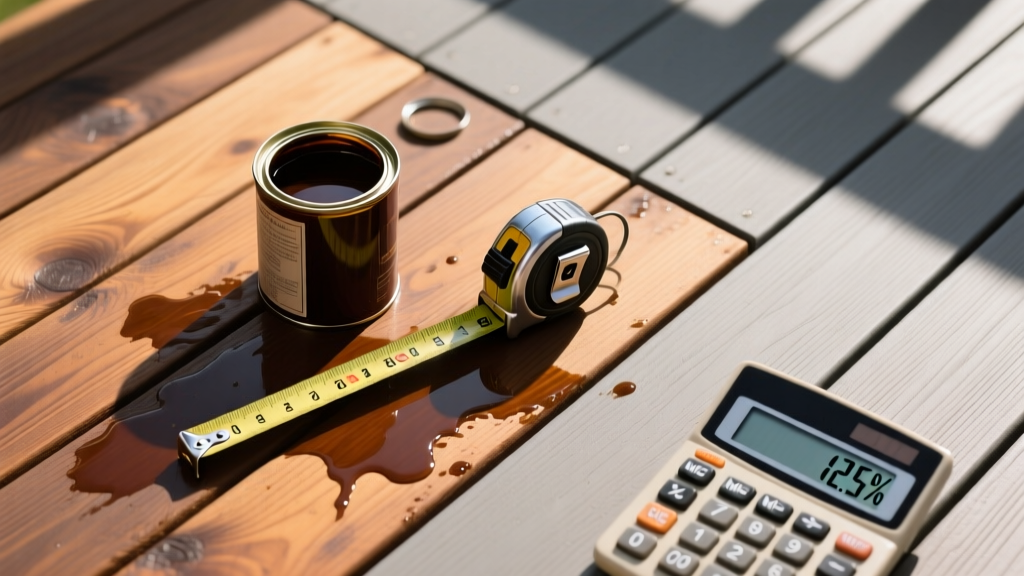
Strategic Maintenance Budgeting Framework
If you opt for a wood deck to keep the initial cost to build a 10x10 deck under $3,000, you must implement a strict maintenance escrow strategy to avoid deferred maintenance penalties.
Delaying wood deck staining by even one year allows UV rays to lignify the surface wood cells. This requires aggressive power washing and sanding to remove the dead wood fibers before new stain can penetrate, effectively doubling your maintenance labor costs.
Follow this annual framework to protect your investment:
- Spring (April/May): Perform the 'water drop test'. Splash water on high-traffic areas. If it beads up, your sealer is intact. If it absorbs immediately, schedule a re-seal for early autumn.
- Summer (July): Inspect the substructure. Clear debris from between the deck boards using a putty knife to ensure proper drainage and airflow, preventing joist rot.
- Autumn (September/October): Apply penetrating oil-based sealant when daytime temperatures are consistently between 50°F and 80°F, and no rain is forecast for 48 hours.
Frequently Asked Questions
Is a 10x10 deck considered a small or medium project?
A 10x10 deck (100 square feet) is classified as a small-to-medium residential project. It is large enough to require building permits and code-compliant footings in most municipalities, but small enough that material quantities can often be transported in a standard half-ton pickup truck, saving on commercial delivery fees.
Can I reduce the cost to build a 10x10 deck by doing it myself?
Yes. Labor accounts for 50% to 60% of the total price. A skilled DIYer can build a 10x10 pressure-treated deck for roughly $1,200 to $1,500 in materials. However, improper flashing at the house ledger board is the leading cause of catastrophic structural failure and interior water damage. If you DIY, hire a professional specifically to install and flash the ledger board.
Does adding a 10x10 deck increase home resale value?
According to the 2026 Remodeling Impact Report, composite deck additions recoup approximately 63% to 68% of their cost at resale, while wood decks recoup about 72%. However, a poorly maintained, splintering wood deck will actively detract from your home's appraisal value, negating any initial savings.
Written by
David NakamuraDavid Nakamura is a licensed architect (AIA) and construction technology writer focused on sustainable building methods, mass timber engineering, and high-performance building envelopes. He holds a Master of Architecture from the University of Washington and is a certified Passive House Consultant (CPHC). David spent eight years at the Seattle firm Mithun, where he led the design of three LEED Platinum projects, before founding his own practice specializing in net-zero residential design. He serves on the editorial advisory board of GreenBuilder Magazine and has authored peer-reviewed papers on cross-laminated timber (CLT) connections for the Journal of Structural Engineering. In his spare time, David teaches woodworking at Pratt Fine Arts Center and kayaks the Puget Sound.
More from David Nakamura
View all
Construction Cost
Labor Cost to Build a Deck Per Sq Ft: 2026 Installation Guide
Discover the exact labor cost to build a deck per sq ft in 2026. This installation guide breaks down contractor rates, complexity factors, and hidden fees.
Aug 4, 2026

Construction Cost
How Much Does It Cost to Build a 3 Bedroom House? Financing Guide
Learn exactly how much it costs to build a 3 bedroom house and explore 2026 financing options, construction loan types, and budget frameworks for your build.
Aug 4, 2026

Construction Cost
Cost to Build a Tennis Court: 2026 Guide
How much does it cost to build a tennis court in 2026? Breakdowns for asphalt, concrete, and synthetic surfaces plus fencing and lighting.
Jul 30, 2026