Cost to Build a Paver Patio: 2026 Price Breakdown
Detailed 2026 cost breakdown to build a paver patio. Analyzes material prices, base prep, labor rates, and hidden excavation fees for accurate budgeting.

The True Cost to Build a Paver Patio
The national average cost to build a paver patio ranges from $18 to $32 per square foot for a professionally installed, ground-level system. For a standard 200-square-foot patio (roughly 10x20 feet), homeowners should budget between $3,600 and $6,400. However, this baseline assumes standard soil conditions, basic concrete pavers, and straightforward site access. When you introduce natural stone, complex grading, or expansive clay soils that require deep excavation, the cost to build a paver patio can easily exceed $45 per square foot.
- Economy (Basic Concrete Pavers, Standard Base): $3,600 - $4,400
- Mid-Range (Upgraded Concrete/Brick, Polymeric Sand): $4,500 - $5,800
- Premium (Natural Stone, Permeable Base, Lighting): $6,000 - $9,000+
Material Cost Breakdown by Paver Type
The paving stones themselves typically account for only 25% to 35% of the total project budget. The table below outlines 2026 material-only pricing for the most common paver categories, excluding base materials and labor.
| Paver Material | Cost Per Sq. Ft. (Materials) | Durability & PSI Rating | Maintenance Profile |
|---|---|---|---|
| Concrete (Standard) | $3.00 - $6.00 | 8,000+ PSI (ASTM C936) | Low; requires sealing every 3-5 years |
| Clay Brick | $5.00 - $9.00 | High; color-fast, fade-resistant | Very Low; no sealing required |
| Porcelain Pavers | $8.00 - $14.00 | Extreme; stain and scratch proof | Zero; non-porous surface |
| Natural Stone (Flagstone/Bluestone) | $12.00 - $25.00+ | Variable; depends on stone density | Moderate; prone to moss in shade |
Base Preparation: The Hidden 40% of Your Budget
The most critical factor dictating the longevity of your patio is the sub-base. According to the Interlocking Concrete Pavement Institute (ICPI), a proper pedestrian paver base requires excavating 9 to 11 inches of native soil and replacing it with a compacted aggregate base. Skimping here guarantees settling, pooling water, and heaving within two winters.
Excavation and Aggregate Costs
- Excavation Labor: Removing 10 inches of topsoil across 200 square feet yields roughly 6.2 cubic yards of dirt. At $45 to $75 per cubic yard for excavation and loading, expect to pay $280 to $465 just for the digging phase.
- Geotextile Fabric: Mandatory for clay or silt-heavy soils to prevent the aggregate base from migrating into the subgrade. A roll of Mirafi 500X or equivalent non-woven fabric costs $0.40 to $0.60 per square foot.
- Aggregate Base (Class II Road Base): You need 6 to 8 inches of 3/4-inch minus crushed angular gravel. Round river rock is unacceptable as it lacks shear strength. Delivered bulk gravel costs $45 to $70 per ton, with 1 ton covering roughly 80 square feet at a 2-inch depth. Total material cost for a 6-inch base: $1.20 to $1.80 per square foot.
- Bedding Sand: A strict 1-inch layer of coarse, sharp concrete sand (ASTM C33) is screeded over the compacted base. Mason sand or play sand is too fine and will wash out. Budget $0.30 per square foot for bedding sand.
If your soil test reveals highly expansive clay, standard aggregate bases will fail due to frost heave and moisture swelling. You must integrate a biaxial or triaxial geogrid (e.g., Tensar TriAx) between the subgrade and the aggregate base. This adds $1.50 to $2.50 per square foot in materials but prevents catastrophic base failure.
Edge Restraints and Jointing Compounds
Pavers are not mortared; they are a flexible pavement system held together by friction and perimeter confinement. Without rigid edge restraints, the outer courses of pavers will creep outward, causing the entire patio to unzip.
Edge Restraint Options
- Plastic/PVC Restraints (e.g., SnapEdge): $2.50 to $3.50 per linear foot. Secured with 10-inch galvanized spikes every 12 inches. Suitable for straight lines and gentle curves.
- Aluminum Restraints: $4.00 to $6.00 per linear foot. Superior rigidity, will not warp under heavy thermal expansion. Recommended for large patios or areas with heavy retaining wall loads.
- Poured Concrete Curb: $8.00 to $12.00 per linear foot. Hidden beneath the soil line, this is the permanent, commercial-grade standard, but requires forming and curing time.
Jointing Sand: Polymeric vs. Traditional
Traditional silica sand costs pennies per square foot but requires annual reapplication and promotes weed growth. Polymeric sand contains water-activated polymers that bind the sand grains together, creating a flexible, weed-proof joint. A 55-lb bag of premium polymeric sand (e.g., Alliance Gator Dust or Techniseal) costs $35 to $45 and covers 60 to 80 square feet. Factor in $0.60 to $0.90 per square foot for polymeric jointing materials.
Labor Rates, Haul-Away, and Site Access
Labor typically accounts for 40% to 50% of the total cost to build a paver patio. In 2026, hardscape installation crews charge between $8.00 and $14.00 per square foot for the physical laying, screeding, and compacting of the pavers. However, site logistics heavily influence this rate.
The Wheelbarrow Multiplier
If a skid-steer loader (Bobcat) cannot access your backyard due to narrow side yards, fences, or steps, all excavated soil must be removed by wheelbarrow, and all aggregate must be brought in manually. This "manual carry" surcharge adds $2.00 to $4.00 per square foot to the labor bill due to the extreme time penalty.
Dirt Haul-Away Fees
Disposing of native soil is expensive. A standard 10-yard dump truck hold roughly 12 to 14 tons of dirt. Contractors charge $350 to $600 per truckload for hauling and dump fees. For a 200-square-foot patio requiring 10 inches of excavation, expect to pay for two full truckloads, adding $700 to $1,200 to your final invoice.
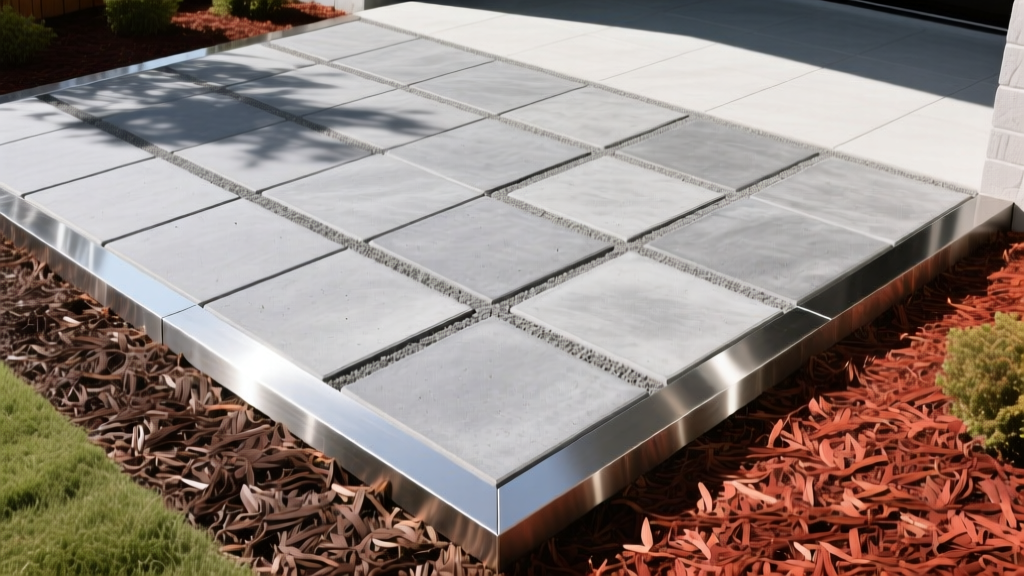
Permeable Paver Upgrades and Stormwater Management
Many municipalities now mandate permeable surfaces to reduce runoff. Permeable pavers feature wider joints filled with clean, crushed aggregate (no fines) and sit atop an open-graded stone reservoir base. According to EPA stormwater management research, these systems can capture and infiltrate up to 100% of typical rainfall events.
Upgrading to a permeable system increases the cost to build a paver patio by 15% to 25%. The pavers themselves are slightly more expensive, but the primary cost driver is the deeper excavation (often 12 to 18 inches) required to create the sub-base stone reservoir, and the strict requirement for open-graded, washed aggregates (like ASTM No. 57 and No. 8 stone) which cost more to source and transport.
DIY vs. Professional Installation: A Financial Matrix
While laying the pavers themselves is highly DIY-friendly, the base preparation requires heavy machinery and precise grading. Below is a financial and risk matrix comparing a DIY approach versus hiring a certified hardscape contractor.
| Factor | DIY Installation (200 Sq. Ft.) | Professional Installation |
|---|---|---|
| Total Estimated Cost | $1,800 - $2,600 | $3,600 - $6,400 |
| Equipment Rentals | $450 (Skid steer, plate compactor, laser level) | Included in labor rate |
| Time Investment | 4 to 7 full weekends | 3 to 5 consecutive days |
| Warranty | None; manufacturer voids base warranties | 2 to 5 years on workmanship and settling |
| Primary Risk Factor | Improper compaction leading to frost heave | Contractor cutting corners on base depth |
When to Hire a Professional
If your project involves retaining walls over 3 feet, integrating drainage catch basins, tying into existing foundation weeping tiles, or working on slopes exceeding a 5% grade, professional engineering and installation are mandatory. The cost to build a paver patio on a sloped lot requires tiered retaining walls, which operate under entirely different structural and geotechnical load requirements than flat, pedestrian-grade paving.
Written by
Priya KapoorPriya Kapoor is a real estate market analyst and construction economics researcher with expertise in housing affordability, development feasibility, and infrastructure investment. She holds a Master of Regional Planning from Cornell University and previously worked as a senior analyst at CBRE's Investment Properties group, where she modeled returns for $4B in mixed-use development pipelines. Priya now runs an independent research practice advising developers, municipalities, and REITs on construction cost forecasting and market timing. She publishes the quarterly "BuildMat Market Pulse" report tracking material price indices across 12 commodity categories. Based in Austin, TX, Priya serves on the board of Habitat for Humanity Austin and is a marathon runner.
More from Priya Kapoor
View all
Construction Cost
Cost to Build a 1600 Sq Ft Home in 2026: Full Breakdown
Accurate 2026 cost to build a 1600 sq ft home—material, labor, and regional pricing breakdowns included. Plan your budget with real-time estimates.
Aug 11, 2026

Wood & Lumber
Name the Types of Wood for Pressure Treatment and Preservation
Learn how to name the types of wood best suited for pressure treatment. Compare species treatability, chemical retention levels, and 2026 preservation costs.
Aug 4, 2026

Stone & Masonry
Stone Veneer Suppliers Lindenhurst: 2026 Cost Analysis
Analyze 2026 stone veneer costs in Lindenhurst, NY. Compare local supplier pricing, delivery fees, and Suffolk County installation labor rates.
Aug 4, 2026