Using a Cost to Build a Deck Calculator for Accurate Budgets
Learn how to use a cost to build a deck calculator effectively. Break down material, labor, and hidden fees for precise outdoor project budgets.
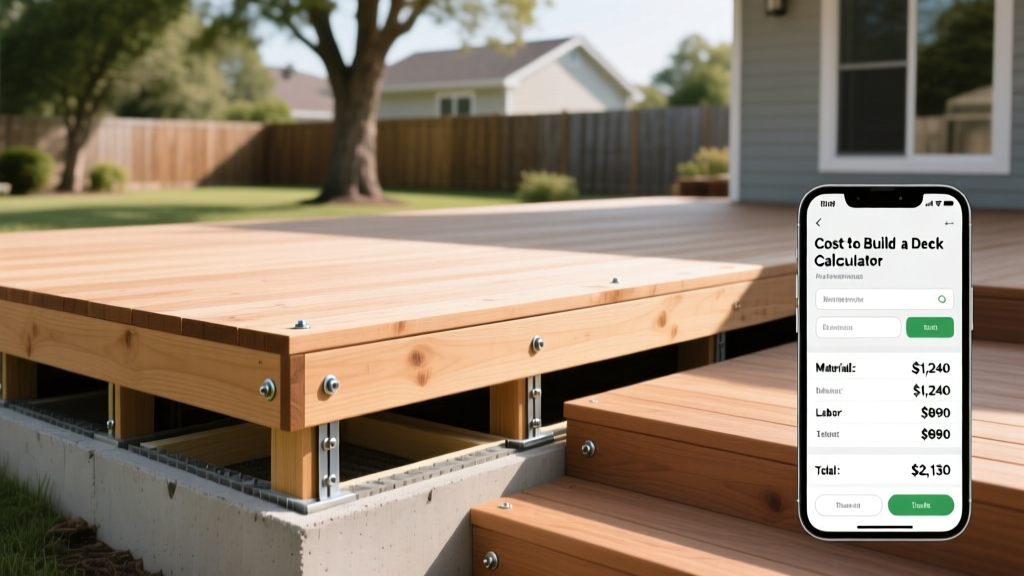
The Flaw in Standard Deck Cost Estimators
When planning an outdoor living space, relying on a basic cost to build a deck calculator often leads to severe budget shortfalls. Most free online estimators operate on a flawed premise: they calculate total square footage and multiply it by a national average (typically $35 to $55 per square foot). This simplistic math ignores the structural realities of modern deck building. According to industry data compiled by the North American Decking and Railing Association (NADRA), the variance between a basic ground-level platform and an elevated structure with complex framing can exceed 300% in total project costs.
To use a deck calculator effectively, you must treat its initial output as a baseline material cost, not a final project estimate. True planning requires adjusting this baseline against specific structural requirements, soil conditions, and premium hardware that standard algorithms simply do not ask about.
A 400-square-foot deck (20x20) and a 400-square-foot deck (10x40) require vastly different amounts of framing lumber, footings, and joist tape, despite having the same square footage. Always input the exact length and width into your calculator rather than just the total area to ensure the linear footage of beams and joists is accurately estimated.
Calibrating Your Inputs: Material Baselines
Before running your numbers, you must select the exact material tier. The price gap between entry-level composites and premium capped polymers is substantial. When using a cost to build a deck calculator, override generic 'composite' selections with specific product lines to get accurate material costs. Below are the baseline material costs (boards only, excluding fasteners and substructure) for top-tier products available on the market.
| Material Type | Specific Product Line | Board Cost (Per Sq. Ft.) | Lifespan / Warranty |
|---|---|---|---|
| Premium Composite | Trex Transcend Lineage | $13.50 - $15.00 | 50-Year Limited |
| Advanced PVC | TimberTech Advanced PVC Landmark | $14.00 - $16.50 | 50-Year Fade & Stain |
| Mineral-Based Composite | Deckorators MBC Voyage | $11.00 - $12.50 | 50-Year Structural |
| Pressure-Treated Pine | #1 Grade Southern Yellow Pine | $3.50 - $5.00 | 10-15 Years (with maintenance) |
The Hidden Variables Most Calculators Ignore
Once your calculator generates a baseline figure, you must manually add the hidden structural and hardware costs. These elements protect the integrity of the deck and are mandated by modern building codes, yet they are rarely included in automated estimates.
- Joist Tape and Flashing: Applying butyl-based joist tape (like Trex Protect or Grace Vycor) to the top of every joist and beam prevents moisture intrusion and wood rot. Budget $0.45 to $0.60 per linear foot. For a standard 400 sq. ft. deck, this adds $150 to $250 to the material cost.
- Structural Screws vs. Nails: Modern framing relies on structural screws rather than galvanized nails for critical load paths. Using GRK RSS or LedgerLok screws for ledger board attachments and beam-to-post connections costs roughly 3 to 4 times more than nails, adding $200 to $400 to the fastener budget.
- Hidden Fastener Systems: If you are installing composite decking, using a hidden clip system (like Trex Hideaway) adds $2.50 to $3.50 per square foot compared to face-screwing with color-matched composite screws.
- Concrete and Footing Forms: Standard calculators assume basic sonotube forms. If your local frost line requires deep excavation (48+ inches), the cost of concrete and specialized forms like Bigfoot Systems can increase footing costs by 40%.
Site Topography and Access Multipliers
The physical environment of your property dictates labor time and specialized equipment needs. Use the following decision matrix to apply a multiplier to your calculator's labor estimate.
| Site Condition | Required Solution | Cost Multiplier |
|---|---|---|
| Sloped Grade (>10% drop) | Helical piers (e.g., Techno Metal Post) instead of poured concrete footings to avoid massive excavation. | 1.25x to 1.40x |
| Expansive Clay / Poor Soil | Deeper footings, engineered soil reports, and wider footing bases to prevent frost heave and settling. | 1.15x to 1.20x |
| Restricted Access (<4 ft side yard) | Manual material transport, hand-mixing concrete, or renting specialized mini-skid steers. | 1.20x to 1.30x |
| High Elevation (>8 ft off grade) | Engineered lateral bracing, scaffolding rental, and heavier structural posts (6x6 minimum). | 1.35x to 1.50x |
Reconciling Calculator Results with Contractor Bids
When you finally solicit bids from licensed contractors, you will likely notice a discrepancy between their proposals and your cost to build a deck calculator output. According to comprehensive remodeling data tracked by Angi's deck cost guides, professional contractors typically apply a 20% to 35% overhead and profit margin on top of hard material and labor costs. To reconcile your calculator results with real-world bids, follow this step-by-step framework:
- Isolate the Material Cost: Extract the pure material cost from your calculator. Cross-reference this with a localized lumber yard quote to ensure the calculator's supply chain data is current.
- Apply the Hidden Hardware Adder: Add 12% to the material cost to account for joist tape, structural screws, post bases (like Simpson Strong-Tie ZMAX), and hidden fasteners.
- Calculate True Labor: Take the calculator's labor estimate and multiply it by your Topography Multiplier (from the matrix above).
- Factor in Soft Costs: Add local permit fees (typically $150 to $500), engineering stamps (if required for spans over 14 feet, costing $300 to $800), and waste removal (dumpster rental at $400 to $600).
- Apply the Contractor Margin: Multiply the combined total of steps 1 through 4 by 1.25 to 1.30 to establish the expected professional bid range.
Expert Insight: 'A calculator is a planning tool, not a bidding tool. If a contractor's bid comes in 15% lower than your meticulously adjusted calculator output, they have likely omitted critical structural hardware, skipped the permit process, or are using uncategorized sub-contractors. In deck building, an abnormally low bid is the most expensive mistake a homeowner can make.'

Final Budget Reconciliation
Mastering a cost to build a deck calculator requires moving beyond simple square-footage math. By inputting exact dimensions, selecting specific composite or PVC product lines, and rigorously applying multipliers for site topography and hidden structural hardware, you transform a generic web tool into a precision budgeting instrument. This level of granular planning ensures that when you sit down with a structural engineer or a master deck builder, you are negotiating from a position of deep technical knowledge, securing both your financial investment and the long-term safety of your outdoor living space.
Written by
David NakamuraDavid Nakamura is a licensed architect (AIA) and construction technology writer focused on sustainable building methods, mass timber engineering, and high-performance building envelopes. He holds a Master of Architecture from the University of Washington and is a certified Passive House Consultant (CPHC). David spent eight years at the Seattle firm Mithun, where he led the design of three LEED Platinum projects, before founding his own practice specializing in net-zero residential design. He serves on the editorial advisory board of GreenBuilder Magazine and has authored peer-reviewed papers on cross-laminated timber (CLT) connections for the Journal of Structural Engineering. In his spare time, David teaches woodworking at Pratt Fine Arts Center and kayaks the Puget Sound.
More from David Nakamura
View all
Construction Cost
Labor Cost to Build a Deck Per Sq Ft: 2026 Installation Guide
Discover the exact labor cost to build a deck per sq ft in 2026. This installation guide breaks down contractor rates, complexity factors, and hidden fees.
Aug 4, 2026

Construction Cost
How Much Does It Cost to Build a 3 Bedroom House? Financing Guide
Learn exactly how much it costs to build a 3 bedroom house and explore 2026 financing options, construction loan types, and budget frameworks for your build.
Aug 4, 2026

Construction Cost
Cost to Build a Tennis Court: 2026 Guide
How much does it cost to build a tennis court in 2026? Breakdowns for asphalt, concrete, and synthetic surfaces plus fencing and lighting.
Jul 30, 2026