Complete 12x16 Deck Material List: Wood vs. Composite Compared
Compare wood, composite, and PVC options with our complete 12x16 deck material list. Get exact framing specs, 2026 costs, and hardware requirements.

The Baseline 12x16 Deck Material List: Substructure and Framing
Building a 12x16 deck yields 192 square feet of usable outdoor space. However, an accurate 12x16 deck material list must account for a 10% waste factor, bringing your total coverage requirement to roughly 212 square feet. Before selecting your surface boards, you must establish the substructure. The framing material list remains largely consistent regardless of whether you choose wood, composite, or PVC decking, though joist spacing requirements may shift slightly based on the surface material's structural rigidity.
Standard pressure-treated lumber requires 16 inches on-center (OC) joist spacing. If you plan to install composite or PVC decking in a diagonal (45-degree) pattern, you must reduce your joist spacing to 12 inches OC, which increases your joist lumber count by 33%.
Exact Framing Lumber Quantities for a 16-Foot Span
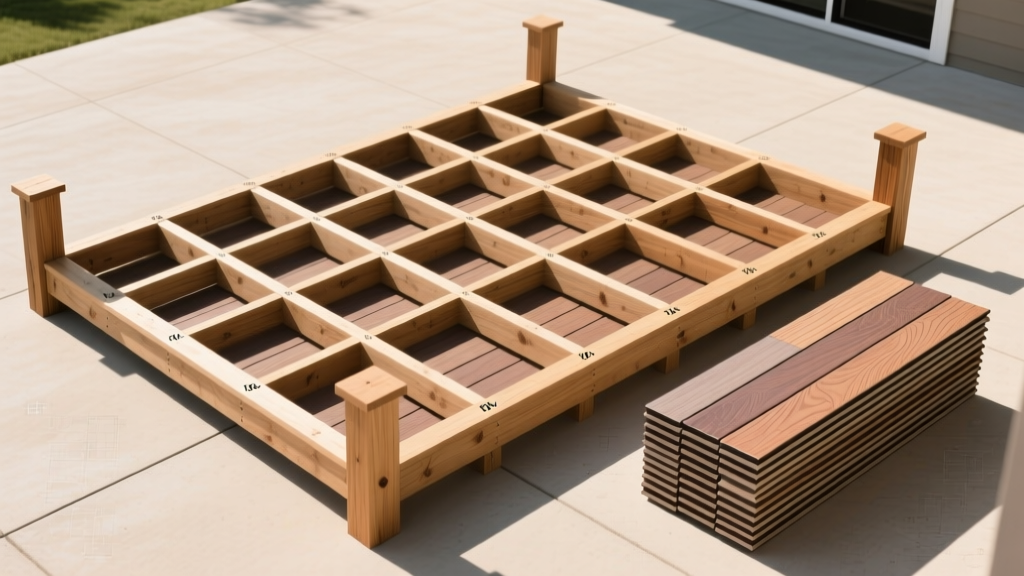
Assuming a standard 12-foot width by 16-foot length with the 16-foot dimension serving as the joist span, your framing material list requires the following:
- Posts: Six 6x6 pressure-treated (PT) posts (minimum 8-foot length). The American Wood Council's DCA 6 prescriptive guide mandates 6x6 posts for decks supporting significant loads or exceeding 8 feet in height, phasing out 4x4s for primary structural support.
- Beams: Two 2-ply 2x10 or 3-ply 2x8 PT lumber beams to support the 16-foot joist spans, broken up by intermediate posts to prevent deflection.
- Joists: Twelve 2x8 PT joists (16-foot length). This includes 10 interior joists spaced at 16 inches OC, plus two rim joists.
- Blocking: Six 2x8 PT blocks (14.5 inches each) installed at the mid-span of the joists to prevent twisting and provide lateral stability.
Footings and Concrete
Your 12x16 footprint requires a minimum of six concrete footings to distribute the dead and live loads (typically 50 PSF total load) into undisturbed soil below the local frost line. You will need six 10-inch or 12-inch Sonotubes and approximately 18 to 24 bags of 5000 PSI high-strength concrete mix, depending on your local frost depth requirements.
Surface Material Comparison Matrix
The most significant variable in your 12x16 deck material list is the decking surface. Below is a direct comparison of the three dominant material categories available in 2026, evaluated for a 212-square-foot purchasing requirement.
| Feature | #2 Pressure-Treated Pine | Capped Wood Composite | Advanced PVC (Cellular) |
|---|---|---|---|
| Top Brands/Models | Severe Weather, YellaWood | Trex Transcend Lineage, TimberTech Pro | AZEK Vintage, TimberTech Advanced PVC |
| Material Cost (per sq. ft.) | $3.50 - $4.50 | $8.50 - $11.50 | $11.00 - $14.50 |
| Boards Needed (16ft x 5.5in) | ~25 boards | ~25 boards | ~25 boards |
| Lifespan Expectancy | 12 - 18 years | 25 - 30 years | 30 - 50+ years |
| Maintenance Cycle | Annual cleaning, stain every 2-3 yrs | Bi-annual soap and water wash | Occasional rinse, highly stain-resistant |
| Heat Retention (Direct Sun) | Moderate (absorbs heat but dissipates) | High (dense core traps thermal energy) | Low to Moderate (reflective cap layers) |
Deep Dive: Capped Composite vs. Advanced PVC
When upgrading from traditional lumber, builders typically choose between capped composite and cellular PVC. Capped composite boards, like the Trex Transcend Lineage, feature a wood-flour core wrapped in a high-density polyethylene (HDPE) shell. They offer superior rigidity and a more natural wood-grain embossing. However, the wood flour core makes them susceptible to moisture absorption if the uncapped ends are not sealed, and they are notably heavier, requiring strict adherence to 16-inch OC joist spacing.
Advanced PVC boards, such as AZEK's Vintage collection, contain zero organic wood fibers. This makes them 100% impervious to rot, mold, and moisture wicking. PVC is significantly lighter than composite and can be heat-bent for custom curved deck perimeters—a technique impossible with standard composite or wood. The trade-off is a higher upfront cost and a slightly more synthetic, plastic-like acoustic response when walked on with hard-soled shoes.
Fasteners and Hardware: The Hidden Costs
A critical error in many DIY 12x16 deck material lists is underestimating the cost and specification of structural hardware. Standard zinc-plated nails and screws will corrode rapidly when in contact with modern Micronized Copper Azole (MCA) or Alkaline Copper Quaternary (ACQ) pressure-treated lumber.
Never use aluminum flashing or standard aluminum fasteners in direct contact with pressure-treated wood or concrete. The copper preservatives in the wood will cause rapid galvanic corrosion, compromising the structural integrity of the connection. Always specify ZMAX or hot-dipped galvanized (HDG) steel.
According to the Simpson Strong-Tie deck connector catalog, you must use hardware rated for the specific chemical treatment of your lumber. For a 12x16 deck, add the following to your material list:
- Post Bases: Six ABA66Z (ZMAX) adjustable post bases to elevate the 6x6 posts above the concrete footings, preventing end-grain moisture wicking.
- Joist Hangers: Twenty-four 2x8 LUS28Z joist hangers, secured with 1.5-inch HDG structural connector screws (never use drywall screws or standard nails for shear-load connections).
- Decking Fasteners: If using composite, budget for a hidden fastener system like the Trex Hideaway Universal clips (one box covers 50 sq ft; you will need 5 boxes). For wood or PVC, the CAMO Edge Fastener system with 2.375-inch stainless steel driver bits provides a clean, screw-hole-free surface.
2026 Cost Analysis for a 192 Sq Ft Footprint
Material costs have stabilized compared to the extreme volatility of previous years, but premium hardware and composite manufacturing remain capital-intensive. The following table outlines the estimated material-only costs (excluding labor, permits, and specialized tools) for a 12x16 deck in 2026.
| Material Category | All Pressure-Treated Build | PT Frame + Composite Surface | PT Frame + PVC Surface |
|---|---|---|---|
| Framing & Substructure | $850 - $1,100 | $850 - $1,100 | $850 - $1,100 |
| Decking Surface (212 sq ft) | $750 - $950 | $1,800 - $2,450 | $2,350 - $3,100 |
| Hardware & Fasteners | $150 - $250 | $350 - $500 | $400 - $550 |
| Concrete & Footing Tubes | $120 - $180 | $120 - $180 | $120 - $180 |
| Total Estimated Material Cost | $1,870 - $2,480 | $3,120 - $4,230 | $3,720 - $4,930 |
Railing and Stair Material Additions
A 12x16 deck elevated more than 30 inches above grade requires code-compliant guardrails and stairs. Do not omit these from your initial material list, as they can add 20% to 30% to your total budget.
- Stairs: For a standard 36-inch deck height, you need a 4-step stringer system. Purchase four pre-cut PT 2x12 stringers, plus composite or PT stair treads (11.5-inch depth minimum) and risers.
- Guardrails: The International Residential Code (IRC) mandates a minimum 36-inch railing height for residential decks. If utilizing a composite system like Trex Signature, you will need line posts, top and bottom rails, and either aluminum balusters or composite square balusters. Aluminum balusters are highly recommended for a 12x16 deck as they maintain unobstructed sightlines and resist the warping often seen in long composite baluster spans.
Expert Decision Framework: Which List is Right for You?
Selecting the right 12x16 deck material list comes down to evaluating your long-term property plans, maintenance tolerance, and immediate budget constraints. Use this framework to finalize your purchasing decisions:
Choose the All Pressure-Treated List if:
- You are building on a strict budget and the total material cost must remain under $2,500.
- You are planning to sell the home within 3 to 5 years and need to maximize immediate ROI without over-improving the property.
- You do not mind spending a weekend every two years sanding, staining, and sealing the wood.
Choose the Composite Surface List if:
- You want a premium aesthetic with deep wood-grain embossing and multi-tonal color streaking.
- You are willing to pay a 60% premium over wood for a surface that requires zero staining and resists fading for 25+ years.
- Your deck design incorporates standard straight lines and 90-degree corners (composite is difficult to curve without specialized routing).
Choose the PVC Surface List if:
- The deck is located in a high-moisture environment, such as directly over water, in a heavily shaded woodland area prone to mold, or in a coastal salt-spray zone.
- Your design includes curved perimeters, radius benches, or custom inlays (PVC can be heat-formed on-site).
- You demand the absolute lowest maintenance profile and highest resistance to staining from grease, wine, or pollen, and budget is a secondary concern.
For comprehensive structural span tables, load calculations, and regional code adaptations, always cross-reference your final plans with the Fine Homebuilding deck project guides and your local municipal building department before purchasing materials.
Written by
Priya KapoorPriya Kapoor is a real estate market analyst and construction economics researcher with expertise in housing affordability, development feasibility, and infrastructure investment. She holds a Master of Regional Planning from Cornell University and previously worked as a senior analyst at CBRE's Investment Properties group, where she modeled returns for $4B in mixed-use development pipelines. Priya now runs an independent research practice advising developers, municipalities, and REITs on construction cost forecasting and market timing. She publishes the quarterly "BuildMat Market Pulse" report tracking material price indices across 12 commodity categories. Based in Austin, TX, Priya serves on the board of Habitat for Humanity Austin and is a marathon runner.
More from Priya Kapoor
View all
Construction Cost
Cost to Build a 1600 Sq Ft Home in 2026: Full Breakdown
Accurate 2026 cost to build a 1600 sq ft home—material, labor, and regional pricing breakdowns included. Plan your budget with real-time estimates.
Aug 11, 2026

Wood & Lumber
Name the Types of Wood for Pressure Treatment and Preservation
Learn how to name the types of wood best suited for pressure treatment. Compare species treatability, chemical retention levels, and 2026 preservation costs.
Aug 4, 2026

Stone & Masonry
Stone Veneer Suppliers Lindenhurst: 2026 Cost Analysis
Analyze 2026 stone veneer costs in Lindenhurst, NY. Compare local supplier pricing, delivery fees, and Suffolk County installation labor rates.
Aug 4, 2026