Cheapest Decking Material in 2026: Costs & Comparison
Discover the cheapest decking material in 2026. We compare upfront costs, 10-year lifetime expenses, and hidden maintenance fees for PT wood vs. composite.
The True Cost of 'Cheap' Decking: Upfront vs. Lifetime
When homeowners search for the cheapest decking material, they are usually looking at the price tag per linear foot at the local lumber yard. However, evaluating deck materials strictly on initial purchase price is a financial trap. The true cost of a deck must account for material acquisition, specialized fasteners, substructure protection, and a decade of maintenance. In 2026, the gap between the lowest upfront cost and the lowest lifetime cost remains significant, but the math has shifted due to advancements in entry-level composite manufacturing and the rising cost of exterior wood sealers.
A 400-square-foot deck built with the cheapest pressure-treated pine will cost roughly $1,100 in decking boards. Over 10 years, you will spend an additional $1,400 to $1,800 on stains, sealers, and replacement boards for warped or split areas. An entry-level capped composite deck for the same footprint costs $2,800 upfront but requires less than $150 in maintenance over the same decade.
Material Breakdown: Upfront Pricing Matrix
The following table outlines the material-only costs (excluding joists, concrete footings, and labor) for the most common budget-friendly decking options available in 2026.
| Decking Material | Upfront Cost (per sq. ft.) | Required Fasteners | Annual Maintenance |
|---|---|---|---|
| Pressure-Treated Southern Yellow Pine | $2.50 - $3.75 | Hot-dipped galvanized or polymer-coated screws | $0.35 - $0.50 / sq. ft. |
| Entry-Level Capped Composite (e.g., Trex Enhance Basics) | $6.50 - $8.00 | Color-matched composite screws or hidden clips | $0.02 / sq. ft. (soap & water) |
| Reclaimed / Pallet Wood | $0.50 - $1.50 | Standard exterior wood screws | $0.60+ / sq. ft. (high failure rate) |
Deep Dive: The Budget Contenders
1. Pressure-Treated Southern Yellow Pine (The Upfront Budget King)
Pressure-treated (PT) lumber remains the undisputed champion of low initial costs. For residential decking, you must specify lumber treated to the AWPA U1 standard, specifically looking for MCA (Micronized Copper Azole) or CA-C (Copper Azole Type C) preservatives. These chemicals protect against fungal decay and termite damage.
The KDAT Advantage: If you are buying PT pine, actively seek out KDAT (Kiln-Dried After Treatment) lumber. Standard PT wood is saturated with liquid preservatives and shipped wet. As it dries on your deck, it shrinks, twists, and cups. KDAT lumber is dried in a kiln after treatment, stabilizing the cellular structure. It costs about $0.40 more per square foot but saves you from replacing 10% of your boards due to severe warping within the first two years.
- Best for: DIYers on a strict cash budget, ground-level decks, and painted deck surfaces.
- Worst for: Low-maintenance seekers, elevated decks with poor ventilation (trapped moisture accelerates rot).
2. Entry-Level Capped Composite (The Lifetime Value Pick)
If your definition of 'cheap' factors in a 15-year timeline, entry-level capped composites like Trex Enhance Basics or Fiberon Good Life are the most economical choices. Unlike first-generation uncapped composites that stained easily and degraded under UV exposure, modern capped boards feature a high-performance polymer shell that resists fading and moisture intrusion.
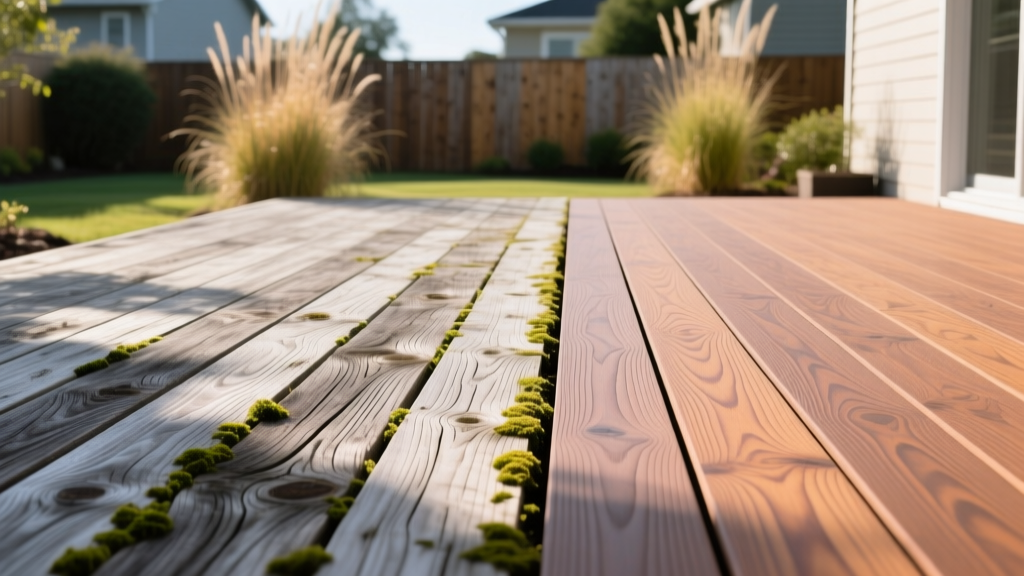
While the material cost is roughly 2.5x that of PT pine, you eliminate the need for joist flashing tape (the composite cap prevents moisture from being trapped against the joists in the same way wet wood does, though tape is still recommended) and completely eliminate the $65-per-gallon exterior sealers required every 24 months for wood.
3. Reclaimed and Pallet Wood (The False Economy)
Social media is saturated with DIY pallet deck builds boasting material costs under $100. From a structural engineering perspective, this is highly discouraged. Pallet wood is typically untreated or treated with methyl bromide (a toxic fumigant not meant for prolonged human skin contact). Furthermore, the boards are incredibly short (often under 4 feet), requiring thousands of additional fasteners and vastly increasing labor time. The rapid decay rate of non-kiln-dried pallet wood makes this a false economy that will require a full rebuild within 3 to 5 years.
Expert Insight: 'The cheapest decking board is useless if the substructure rots. According to research from the USDA Forest Products Laboratory, moisture trapped between the decking board and the joist is the primary cause of premature deck failure. If you buy cheap PT pine, you must spend $0.75 per linear foot on butyl-based joist flashing tape to protect your framing.'
Hidden Costs That Destroy Budget Decks
When calculating your final budget, you must add these frequently overlooked line items to your material list:
The 'Budget Deck' Add-On Matrix
- Joist Flashing Tape (Butyl): $0.75 - $1.10 per linear foot. (Mandatory for wood decking to prevent joist rot).
- Premium Exterior Sealer (e.g., Defy Extreme or TWP): $55 - $75 per gallon. Covers ~150 sq. ft. Must be reapplied every 2-3 years.
- Hidden Fastener Systems: $0.85 per sq. ft. (Using standard face-screws on PT wood leads to 'nail pops' as the wood shrinks, requiring annual hammering and re-screwing).
- Sanding and Prep Labor: If hiring out, pressure washing and sanding a 400 sq. ft. PT deck before staining costs $250 - $400 per cycle.
Decision Framework: Which Material Should You Buy?
Use this framework to select the cheapest material that actually fits your specific situation:
Scenario A: You have less than $1,500 total for materials, you are doing 100% of the labor, and you enjoy annual weekend maintenance projects.
Verdict: Buy standard Pressure-Treated Southern Yellow Pine. Use hot-dipped galvanized screws (polymer-coated will react with the copper in modern MCA treatments and corrode). Apply a semi-transparent penetrating oil stain 30 days after installation once the wood moisture content drops below 15%.
Scenario B: You have $3,500 for materials, you hate sanding and staining, and you plan to stay in the home for at least 7 years.
Verdict: Buy an entry-level capped composite (Trex Enhance or TimberTech Edge). The higher upfront cost is entirely offset by the elimination of staining chemicals, prep labor, and the time value of your weekends. Use manufacturer-approved hidden fastener clips to allow for thermal expansion and contraction.
Scenario C: You are building a ground-level or floating deck directly over soil or concrete.
Verdict: Avoid standard composites and standard PT pine. Ground-level decks trap moisture underneath. You must upgrade to a thicker, heavily capped composite board designed for low-clearance ventilation, or use 2x6 PT lumber rated specifically for 'Ground Contact' (UC4A or UC4B AWPA standard), which contains a higher concentration of copper preservatives and costs roughly $0.80 more per linear foot than standard above-ground rated lumber.
Written by
Marcus ChenMarcus Chen is a licensed structural engineer (PE) and building materials analyst with over 12 years of experience across residential, commercial, and industrial construction. He holds a Master of Science in Civil Engineering from UC Berkeley and spent six years at Thornton Tomasetti before transitioning to independent consulting and technical writing. Marcus specializes in material selection for seismic-prone regions, concrete reinforcement strategies, and lifecycle cost analysis. His work has been cited by the American Concrete Institute (ACI) and the Structural Engineers Association of California (SEAOC). When he is not on a job site or at his desk, you will find him hiking the Sierra Nevada or restoring a 1920s craftsman bungalow in Oakland, CA.
More from Marcus Chen
View all
Construction Cost
How Much Did the Eiffel Tower Cost to Build?
How much did the Eiffel Tower cost to build in 1889? We adjust for inflation and compare its budget to modern skyscraper construction.
Aug 4, 2026

Fire Resistance
What Is a Fire Resistant Material? Testing & Certification Guide
Discover what is a fire resistant material through ASTM and UL testing. Learn how fire ratings, certifications, and assemblies work in construction.
Aug 4, 2026

Construction Cost
How Much Did the Burj Khalifa Cost to Build?
How much did the Burj Khalifa cost to build? We break down the $1.5B project and extract 5 money-saving strategies for your next build.
Jul 30, 2026