Top Pontoon Deck Material Choices: Aluminum vs PVC
Compare the best pontoon deck material options for 2026. We analyze marine-grade aluminum vs. PVC planking, covering weight, costs, and corrosion risks.

Replacing a pontoon deck is a structural intervention, not merely a cosmetic upgrade. The choice of pontoon deck material directly dictates your vessel's payload capacity, longitudinal rigidity, and long-term maintenance cycles. While traditional marine plywood has dominated the industry for decades, modern synthetic and metal alternatives are rapidly capturing the refit market due to their superior resistance to hydrolysis and biological decay.
This analysis breaks down the physical properties, installation requirements, and lifecycle costs of the top pontoon deck material contenders for 2026: marine-grade aluminum extrusions and closed-cell PVC planking.
The Baseline: Why Marine Plywood is Failing Modern Pontoons
To understand the shift toward alternative materials, we must examine the failure modes of traditional 3/4-inch CCA (Chromated Copper Arsenate) or ACQ (Alkaline Copper Quaternary) treated marine plywood. Even when sealed with epoxy and covered in marine-grade carpet or woven vinyl, plywood remains vulnerable to capillary wicking at the fastener holes and exposed edges.
Furthermore, modern ACQ-treated wood is highly corrosive to aluminum. If the protective barrier between the ACQ wood and the aluminum cross-members is compromised, a galvanic reaction occurs, literally eating away at the boat's structural tubes. According to maintenance bulletins from BoatUS Expert Advice, trapped moisture beneath carpeted plywood decks is the leading cause of premature pontoon structural failure, often adding hundreds of pounds of water weight to the hull before the rot becomes visible on the surface.
Pontoon Deck Material Comparison Matrix
| Material | Weight (lbs/sq ft) | Max Joist Spacing | Lifespan | Maintenance Level |
|---|---|---|---|---|
| ACQ Treated Plywood | 2.2 - 2.8 | 24 inches OC | 7 - 12 years | High (Annual sealing) |
| Marine Aluminum (5052-H32) | 1.4 - 1.8 | 12 - 16 inches OC | 30+ years | None |
| Cellular PVC Planking | 1.7 - 2.1 | 16 inches OC | 20+ years | Low (Wash only) |
Marine-Grade Aluminum: The Lightweight Contender
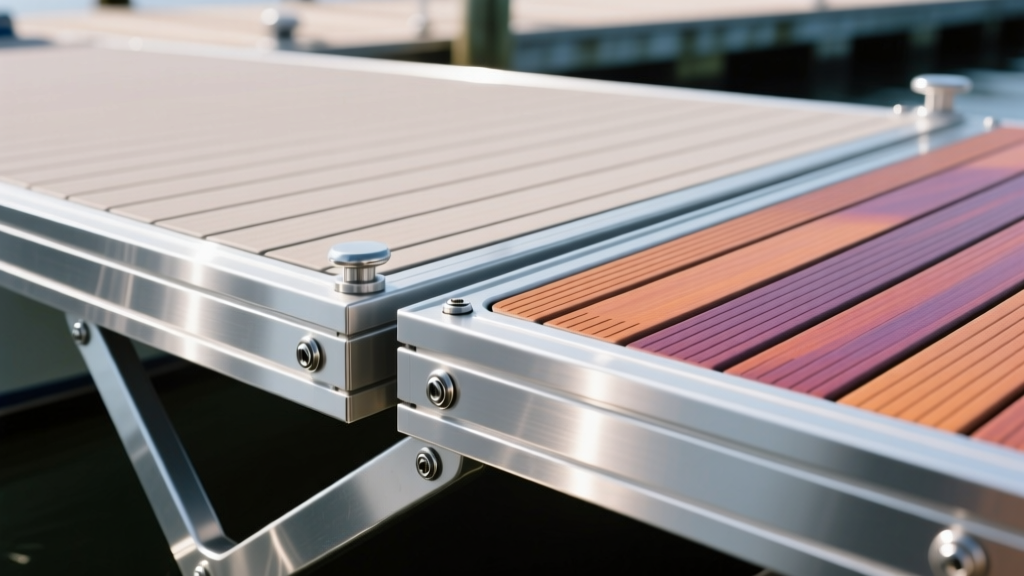
Aluminum decking, typically extruded from 5052-H32 marine-grade alloy, offers the highest strength-to-weight ratio available for pontoon refits. The Aluminum Association classifies 5052-H32 for its exceptional resistance to saltwater corrosion and high fatigue strength. Extruded aluminum deck panels feature an integrated I-beam or box-beam substructure, allowing them to span greater distances while remaining remarkably light.
Thermal Conductivity and Barefoot Comfort
The primary drawback of aluminum is thermal conductivity. Bare aluminum can reach 140°F (60°C) in direct summer sunlight. To mitigate this, manufacturers apply specialized marine-grade ceramic or polyurethane non-skid coatings. These coatings not only reduce surface temperatures by up to 20°F but also provide essential traction when wet. When selecting aluminum decking, verify that the coating is UV-stabilized to prevent chalking and delamination over time.
Installation Nuances: Preventing Oil-Canning
Aluminum is susceptible to 'oil-canning' (visible rippling or buckling) if installed incorrectly. Because aluminum expands and contracts at a different rate than the steel or aluminum cross-members beneath it, installers must use slotted fastener holes and neoprene isolation washers. Never overtighten the screws; the panel must be allowed to float microscopically along the X-axis to accommodate thermal cycling.
Marine PVC Planking: The Wood-Look Alternative
For boaters who prefer the aesthetic of traditional wood planking without the biological vulnerabilities, marine-grade cellular PVC is the premier pontoon deck material. Products like Aeratis Marine Decking utilize a closed-cell, high-density PVC formulation that is completely impervious to water absorption. Unlike standard composite decking (which uses wood fibers that can wick moisture and swell), true marine PVC contains zero organic material.
The Cellular vs. Solid PVC Debate
When sourcing PVC for a pontoon, you will encounter both solid and cellular extrusions. Cellular PVC is preferred for marine applications because it is lighter and can be routed, milled, and painted using standard woodworking tools. Solid PVC, while slightly more impact-resistant, adds unnecessary weight to the vessel. Ensure the PVC you select includes a high concentration of titanium dioxide (TiO2) UV inhibitors to prevent the plastic from becoming brittle and yellowing under intense solar exposure.
Thermal Expansion Management
PVC expands and contracts significantly with temperature fluctuations—approximately 1/8 inch per 10 feet of board length for every 40°F change. Installers must leave precise gapping at butt joints and use hidden fastener systems (like the Cortex system) that allow for lateral movement while securing the board vertically to the joists.
⚠️ Critical Warning: The Galvanic Corrosion Trap
When installing any synthetic or aluminum decking over aluminum pontoon cross-members, fastener selection is non-negotiable. You must exclusively use 316-grade stainless steel screws. Standard 304 stainless steel or galvanized screws will induce severe galvanic corrosion when in contact with aluminum in a wet environment, leading to fastener failure and structural compromise. Always reference the American Boat & Yacht Council (ABYC) standards for marine fastener compatibility.
2026 Refit Cost Analysis
When budgeting for a pontoon deck replacement, material costs are only one part of the equation. The substructure preparation and fastener requirements heavily influence the final price. Below is a breakdown of estimated material costs per square foot for a standard 24-foot by 8-foot pontoon deck (192 sq ft) in 2026.
| Material Type | Cost per Sq Ft (Material Only) | Estimated Total Material Cost (192 sq ft) | Hidden Costs to Anticipate |
|---|---|---|---|
| ACQ Plywood + Carpet | $4.50 - $6.00 | $864 - $1,152 | Epoxy sealants, carpet adhesive, annual replacement |
| Marine PVC Planking | $9.50 - $13.00 | $1,824 - $2,496 | Hidden fastener kits, PVC-specific glue for butt joints |
| Extruded Aluminum | $16.00 - $22.00 | $3,072 - $4,224 | Neoprene isolation pads, specialized non-skid coatings |
While aluminum and PVC require a higher upfront capital expenditure, the elimination of the 7-to-10-year plywood replacement cycle results in a net-positive ROI by year 12, factoring in labor savings and increased resale value.
Decision Framework: Choosing Your Decking
Selecting the right pontoon deck material requires aligning the physical properties of the material with your specific boating profile and hull configuration.
- Choose Extruded Aluminum If: You operate a high-performance pontoon where minimizing top-side weight is critical for handling and speed. Aluminum is also the mandatory choice if your cross-member spacing is 12 inches OC and you want to avoid adding additional structural bracing.
- Choose Cellular PVC If: You prioritize barefoot comfort, acoustic dampening (PVC is significantly quieter than aluminum when walking or dropping gear), and a traditional wood-grain aesthetic. PVC is ideal for family cruisers and party barges where thermal comfort is a priority.
- Stick with Treated Plywood If: You are executing a budget-constrained flip or restoration on an older, low-value hull where a $3,000+ synthetic refit would exceed the total market value of the vessel.
Substructure Considerations for Refits
Before ordering your new pontoon deck material, inspect the underlying aluminum cross-members. If you are transitioning from 3/4-inch plywood (which can safely span 24-inch joist spacing) to PVC or aluminum planking, you will likely need to add intermediate cross-members to achieve the required 16-inch or 12-inch on-center spacing. Failing to reinforce the substructure will result in a spongy deck feel and eventual fastener pull-through.
Written by
Marcus ChenMarcus Chen is a licensed structural engineer (PE) and building materials analyst with over 12 years of experience across residential, commercial, and industrial construction. He holds a Master of Science in Civil Engineering from UC Berkeley and spent six years at Thornton Tomasetti before transitioning to independent consulting and technical writing. Marcus specializes in material selection for seismic-prone regions, concrete reinforcement strategies, and lifecycle cost analysis. His work has been cited by the American Concrete Institute (ACI) and the Structural Engineers Association of California (SEAOC). When he is not on a job site or at his desk, you will find him hiking the Sierra Nevada or restoring a 1920s craftsman bungalow in Oakland, CA.
More from Marcus Chen
View all
Construction Cost
How Much Did the Eiffel Tower Cost to Build?
How much did the Eiffel Tower cost to build in 1889? We adjust for inflation and compare its budget to modern skyscraper construction.
Aug 4, 2026

Fire Resistance
What Is a Fire Resistant Material? Testing & Certification Guide
Discover what is a fire resistant material through ASTM and UL testing. Learn how fire ratings, certifications, and assemblies work in construction.
Aug 4, 2026

Construction Cost
How Much Did the Burj Khalifa Cost to Build?
How much did the Burj Khalifa cost to build? We break down the $1.5B project and extract 5 money-saving strategies for your next build.
Jul 30, 2026