Aluminum Deck Railing Cost Calculator & 2026 Pricing Guide
Calculate your aluminum deck railing costs for 2026. Get exact linear foot pricing, quantity formulas, and hidden hardware estimates for top brands.
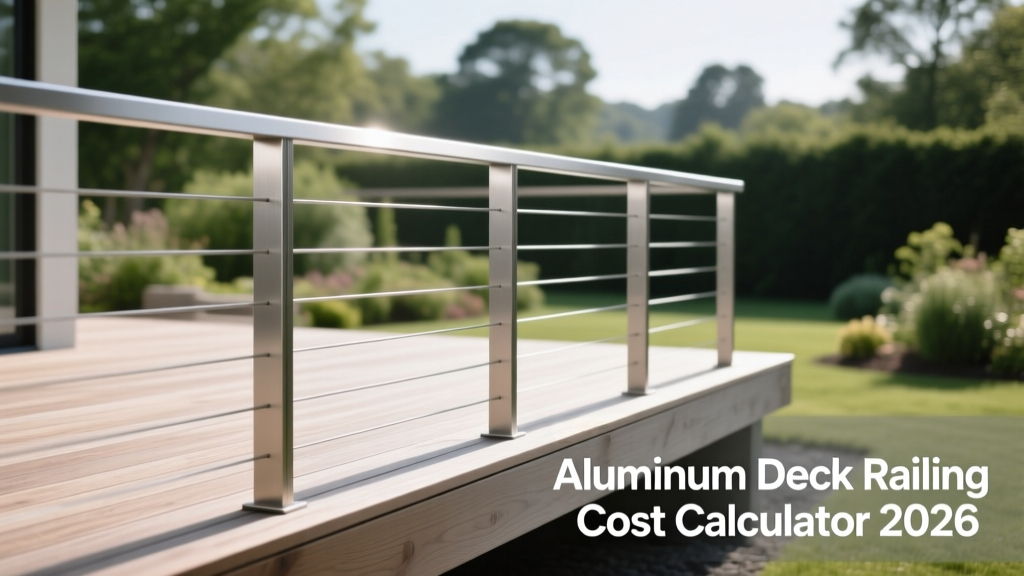
The True Cost of Aluminum Deck Railing in 2026
Estimating the cost of aluminum deck railing requires moving beyond simple linear-foot averages. While wood railing material costs fluctuate wildly with lumber markets, aluminum pricing has stabilized in 2026, though premium powder-coated finishes and integrated lighting have pushed the ceiling higher. For a standard residential installation, expect to pay between $75 and $135 per linear foot for materials alone. When factoring in professional labor, the total installed cost typically ranges from $125 to $220 per linear foot.
- Economy Stick-Built (e.g., basic 3/4" square balusters): $65 - $85 / linear ft.
- Mid-Range Pre-Assembled Panels (e.g., Deckorators ALX): $85 - $110 / linear ft.
- Premium Architectural (e.g., Trex Signature, Westbury T3): $110 - $145 / linear ft.
- Professional Installation Labor: $45 - $85 / linear ft.
According to industry data tracked by Angi's deck railing cost guide, aluminum remains the fastest-growing railing segment due to its zero-maintenance profile and high strength-to-weight ratio. However, inaccurate quantity calculations are the primary reason DIYers and contractors blow their budgets. Below is the exact framework to calculate your material needs.
Step-by-Step Quantity Calculator Formulas
To order the correct amount of aluminum railing, you must break the perimeter down into distinct runs, accounting for the specific maximum span allowed by your chosen manufacturer and local building codes. The International Residential Code (IRC Section R312) mandates that guardrails must be a minimum of 36 inches high for residential decks and balusters must not allow a 4-inch sphere to pass through.
1. Calculating Linear Footage and Post Count
Never calculate posts based on the total perimeter. Calculate them per continuous run. Most aluminum railing systems mandate a maximum post span of 72 inches (6 feet) or 96 inches (8 feet), depending on the brand.
The Formula: Posts per run = (Run Length in inches / Maximum Span in inches) + 1
Example: You have a straight 14-foot (168-inch) run. Your aluminum system allows a 72-inch max span.
168 / 72 = 2.33. Always round up to the next whole number (3).
3 + 1 = 4 posts required for this single run.
2. Baluster and Panel Quantities
If you are using pre-assembled panels, you will need one panel per span between posts. If you are using stick-built aluminum (cutting individual balusters to length), use the manufacturer's spacing template. Standard spacing is 4.5 inches on-center for 3/4-inch square balusters.
| System Type | Quantity Formula | Waste Factor |
|---|---|---|
| Pre-Assembled Panels | Total Spans (Post Count - 1 per run) | 0% (Order exact spans) |
| Stick-Built Balusters | (Span Length / On-Center Spacing) x Total Spans | Add 5-8% for cuts/errors |
| Top & Bottom Rails | Total Linear Feet / Rail Stock Length (usually 6' or 8') | Add 10% for miter cuts |
Brand-Specific Pricing & Specification Matrix
Not all aluminum railings are engineered equally. The thickness of the extrusion, the type of powder coating (standard vs. AAMA 2604 architectural grade), and the fastening mechanisms dictate the price. According to the Trex Signature Aluminum specifications, premium systems use heavier gauge aluminum and concealed fasteners to prevent water infiltration and rust streaking.
| Brand & Model | Est. Cost / Lin. Ft. | Max Span | Baluster Style | Best For |
|---|---|---|---|---|
| Trex Signature | $115 - $145 | 72 inches | Square or Round | High-end composite decks |
| Deckorators ALX Pro | $90 - $115 | 72 inches | Pre-assembled Panel | Fast DIY installation |
| Westbury T3 | $100 - $130 | 96 inches | Rectangular Pickets | Wide spans, modern views |
| Ultra-Tech Basic | $65 - $85 | 72 inches | Stick-built Square | Budget-conscious builds |
The Stair Railing Multiplier: Where Budgets Fail
Stair runs are the most common point of failure in railing estimations. You cannot use standard level-run panels on stairs. Stair railing requires specialized pivoting brackets, stair-specific baluster lengths, and often a different top rail profile.
Do not measure the horizontal run of your stairs to order railing. You must measure the actual sloped distance (the hypotenuse) from the top post to the bottom post. A stair run with a 4-foot horizontal footprint and a 3-foot rise actually requires a 5-foot (60-inch) railing panel. Always add a 15% upcharge to your material budget specifically for stair hardware and angled cuts.
Stair Hardware Checklist
- Pivoting Mount Brackets: Required for top and bottom rails to match the stair stringer angle (usually 32 to 38 degrees).
- Stair Balusters: Typically sold in 32" or 36" lengths to accommodate the slope without violating the 4-inch sphere code at the bottom rail.
- Angled Fascia Mounts: If mounting to the side of a stair stringer rather than the top, specialized side-mount brackets are required.
Hidden Costs That Blow Up Railing Budgets
When running your final calculator numbers, ensure you have line items for the following easily forgotten accessories:
- Post Sleeves and Caps ($25 - $45 each): Aluminum railings usually mount to structural 4x4 wood posts or steel structural posts. You must buy aluminum post sleeves to cover the wood, plus decorative or flat post caps.
- Base Plates and Skirts ($15 - $30 each): Required to secure the sleeve to the deck surface and hide the structural lag bolts.
- Integrated LED Lighting ($40 - $80 per light): Post cap lights or under-rail strip lighting require low-voltage transformers and weatherproof wiring, adding $300-$600 to an average deck project.
- Aluminum Gates ($400 - $800+ each): If your deck requires a gate for stairs, pre-hung aluminum gates are notoriously expensive and require heavy-duty hinge hardware and magnetic latches.
- Permitting and Inspections ($150 - $350): Most municipalities require a permit for guardrail installation or replacement, and inspectors will strictly measure the 4-inch baluster spacing.
Expert Installation vs. DIY Cost Analysis
Aluminum is significantly lighter than wrought iron but requires more precision than wood. Cutting aluminum rails requires a chop saw equipped with a non-ferrous carbide blade (such as a 60-tooth Diablo aluminum cutting blade) to prevent burring and melting the powder coat.
Pro-Tip on Fasteners: Never use standard galvanized or zinc-plated screws to assemble aluminum railing. The galvanic corrosion between the zinc and the aluminum will cause severe pitting and rust streaks within two seasons. Always use the manufacturer-provided stainless steel self-tapping screws or apply a dielectric grease to the fastener threads before driving them into the aluminum extrusions.
For a 50-linear-foot project, DIY installation will save you approximately $2,250 to $4,250 in labor costs. However, if your design includes multiple angled corners, stairs, and gates, the complexity of cutting miters and aligning pivoting brackets often justifies hiring a specialized deck contractor. Professional crews can typically install 15 to 20 linear feet of pre-assembled aluminum railing per hour, whereas a DIYer will average 4 to 6 linear feet per hour once layout and leveling are factored in.
Frequently Asked Questions
Can I install aluminum railing on a concrete patio?
Yes, but you cannot use standard wood post anchors. You must use core-drilled aluminum posts set in hydraulic cement, or heavy-duty structural steel post bases (like the Simpson Strong-Tie ABU44Z) anchored with 1/2-inch wedge anchors into the concrete, followed by an aluminum post sleeve.
Does black aluminum railing get too hot in the sun?
Dark-colored aluminum will absorb heat and can reach surface temperatures of 120°F to 140°F in direct summer sunlight. While it will not burn skin instantly like dark composite or wood can, it will be uncomfortable to lean against. Lighter colors like white, bronze, or light gray stay significantly cooler.
What is the maximum slope allowed for aluminum stair railing?
Most manufacturer pivoting brackets accommodate stair slopes between 30 and 40 degrees. This aligns with standard residential stair codes, which dictate a maximum riser height of 7.75 inches and a minimum tread depth of 10 inches, naturally resulting in a slope of roughly 34 to 37 degrees.