Above Ground Pool Deck: Matching Materials to Your Yard Scenario
Match the perfect above ground pool deck material and layout to your yard. Compare composite, wood, and aluminum for specific poolside scenarios and budgets.
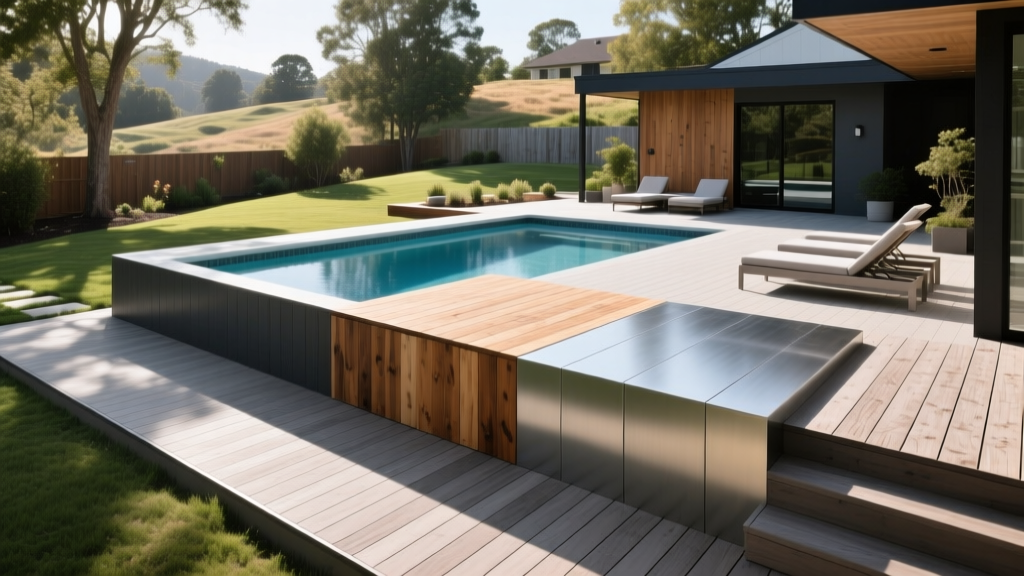
Above ground pools present distinct engineering and material challenges compared to inground installations. The deck must bridge the gap between grade and a water vessel that shifts under hydrostatic load, all while enduring a highly corrosive 'splash zone.' Selecting the right above ground pool deck requires matching materials, framing techniques, and layouts to your specific yard topography, climate, and maintenance tolerance. A mismatched deck will suffer from premature rot, chemical staining, or structural sway.
The Scenario Matrix: Matching Deck Layout to Pool Configuration
Before selecting materials, you must define the deck's footprint. The structural load and material volume change drastically based on how the deck interfaces with the pool wall.
| Layout Scenario | Best Application | Structural Footprint | Material Waste Factor |
|---|---|---|---|
| Full Surround (360-degree) | Large, flat yards where the pool is the central focal point. Ideal for high-traffic entertaining. | Requires continuous ring of footings. Must include expansion gaps (1/2 inch) between deck and pool top rail to prevent binding during pool wall expansion. | High (15-20% waste due to radial cuts on round pools). |
| Half-Wrap / Sun Deck | Smaller yards or pools placed near property lines. Maximizes sun exposure while minimizing material costs. | Standard rectangular framing. Easier to integrate lateral bracing since one side is fully accessible. | Low (5-8% waste, mostly straight rip cuts). |
| Side-Platform / Entry Deck | Strict budgets or sloped yards where a full deck is structurally prohibitive. Serves strictly as a transition zone. | Minimal footings (often 4 to 6). Can utilize precast concrete deck blocks in frost-free zones if properly anchored. | Minimal (Under 5%). |
Material Selection Based on Micro-Climate & Budget
The immediate environment around an above ground pool is a micro-climate characterized by constant moisture, UV exposure, and chemical splash. Standard decking rules do not apply here.
Scenario A: High-Splash Zone on a Strict Budget (KDAT Pressure-Treated Pine)
If budget is the primary constraint, pressure-treated Southern Yellow Pine remains the standard. However, you must specify KDAT (Kiln-Dried After Treatment) lumber. Standard pressure-treated wood is saturated with water-based preservatives; as it dries in the sun, it shrinks, twists, and cups aggressively. KDAT lumber has been re-dried after treatment, locking in the dimensions and allowing for immediate sealing.
For any framing members within 6 inches of the ground or resting on concrete footings, the American Wood Protection Association (AWPA) requires a minimum of UC4A (Ground Contact) or UC4B (Heavy Ground Contact) preservative retention levels. Standard above-ground rated lumber (UC3B) will rot within three to five years in a constantly damp pool environment.
Scenario B: Zero-Maintenance in High-Humidity (Advanced PVC Decking)
For homeowners who refuse to sand and seal wood annually, capped wood-plastic composite (WPC) or advanced PVC are the top choices. However, there is a critical distinction for pool decks. Standard WPC contains wood flour. If concentrated pool shock (calcium hypochlorite) or algaecide splashes onto WPC and is not immediately rinsed, it can bleach the wood fibers inside the composite, causing permanent white spotting.
The Fix: Use 100% polymer (PVC) decking, such as TimberTech Advanced PVC or Azek. PVC contains zero organic wood fibers, making it entirely impervious to chlorine staining, saltwater degradation, and mold. Furthermore, PVC dissipates heat faster than dense WPC, keeping the deck surface cooler under bare feet in direct summer sun.
Never use uncapped composite or standard composite fascia boards as skirting around the base of an above ground pool. The trapped moisture and chemical runoff from the pool wall will cause the bottom edges to swell, delaminate, and crumble within two seasons. Always use marine-grade aluminum or PVC trim for below-grade skirting.
Scenario C: Coastal or High-Salinity Environments (Aluminum Decking)
If you live within five miles of a coastline, salt spray will corrode steel fasteners and degrade wood finishes rapidly. Extruded aluminum decking (e.g., Craft-Bilt or Wahoo Knots) is the ultimate scenario match. Aluminum naturally forms a protective oxide layer that prevents rust. Modern aluminum deck boards feature interlocking gutters that channel splash water away from the substructure, keeping the joists significantly drier than traditional gap-spaced decking.
Structural Framing: Adapting to Soil and Hydrostatic Load
The most common failure point in above ground pool decks is not the surface material, but the substructure. Above ground pools exert massive outward hydrostatic pressure when filled (a 24-foot round pool holds roughly 13,500 gallons, weighing over 112,000 pounds).
The Independence Rule
Your deck must be 100% structurally independent from the pool. The deck's joists and beams cannot rest on, attach to, or lean against the pool's top rail or vertical uprights. If the pool is drained for winterization or liner replacement, the pool wall may flex inward; if the deck is tied to it, the deck will pull apart. Maintain a strict 1/2-inch to 1-inch expansion gap between the deck surface and the pool rail.
Footing and Frost Line Adaptations
In regions with freezing winters, frost heave will destroy a poorly founded deck. You must dig sonotube footings below the local frost line. For a standard 10x12 side-platform deck, use a minimum of six 10-inch diameter sonotubes filled with 3,000 PSI concrete, anchored with 4x6 ground-contact posts. In expansive clay soils, consider using Bigfoot Systems footing forms to distribute the load over a wider surface area, preventing seasonal sinking.
Code Compliance and Safety Clearances
An above ground pool deck fundamentally alters the safety profile of the pool, often triggering strict residential building codes regarding drowning prevention. According to the U.S. Consumer Product Safety Commission (CPSC), the deck itself often becomes part of the required isolation barrier.
- Barrier Height: The deck must feature a continuous barrier (railing or wall) at least 48 inches above the deck surface.
- Climbable Zones: The railing must not have horizontal members or decorative cutouts that create a 'ladder effect' on the outside of the deck.
- Gate Requirements: Any stairs leading from grade to the deck must be protected by a self-closing, self-latching gate that opens outward, away from the pool. The latch must be placed at least 54 inches from the bottom of the gate.
- Ladder Removal: The factory-supplied A-frame ladder that came with the pool must be removed. The deck stairs become the sole point of entry, allowing you to secure the gate when the pool is unsupervised.
If you enclose the space beneath your above ground pool deck with lattice or solid skirting, you must install cross-ventilation. Provide at least 1 square foot of net free ventilation area for every 150 square feet of under-deck space. Without this, trapped humidity will cause rapid mold growth on the pool's exterior metal wall and rot your floor joists.
2026 Cost Breakdown by Scenario
Costs vary significantly based on the material chosen and the complexity of the layout. The following estimates reflect national averages for a professionally installed 200-square-foot half-wrap deck, including concrete footings, framing, and surfacing.
| Material Scenario | Framing Cost (per sq ft) | Surface Material (per sq ft) | Labor & Hardware | Total Installed (per sq ft) |
|---|---|---|---|---|
| KDAT Pressure-Treated Pine | $6.50 - $8.00 | $3.50 - $5.00 | $10.00 - $14.00 | $20.00 - $27.00 |
| Capped Wood-Plastic Composite | $7.00 - $9.00 | $8.00 - $12.00 | $14.00 - $18.00 | $29.00 - $39.00 |
| Advanced PVC (Polymer) | $7.00 - $9.00 | $11.00 - $16.00 | $15.00 - $20.00 | $33.00 - $45.00 |
| Extruded Aluminum | $8.00 - $11.00 | $15.00 - $22.00 | $18.00 - $24.00 | $41.00 - $57.00 |
By accurately diagnosing your yard's specific topography, local climate, and maintenance tolerance, you can select an above ground pool deck configuration that provides structural longevity and safety without overspending on materials engineered for scenarios you do not face.