Average Cost to Build a Deck in 2026: Material Comparison Guide
Discover the true average cost to build a deck in 2026. Compare installed prices for wood, composite, PVC, and aluminum with expert material insights.

The True Breakdown: Average Cost to Build a Deck by Material
When calculating the average cost to build a deck, national aggregators often cite a baseline of $8,000 to $12,000. However, this figure is practically useless for precise budgeting because it blends cheap pressure-treated pine with premium aluminum and PVC systems. In 2026, the actual installed cost of a standard 200-square-foot deck ranges from $3,400 for basic ground-level wood to over $13,000 for high-end capped composite or aluminum. The primary variable driving this 300% variance is the decking material itself, followed closely by substructure requirements and regional labor rates.
According to Angi's deck cost database, material selection dictates not only the upfront build price but also the 10-year total cost of ownership, factoring in maintenance, sealing, and replacement. Below is the definitive 2026 material comparison matrix for a standard 200 sq. ft. elevated deck.
| Material Type | Material Cost (per sq. ft.) | Installed Cost (per sq. ft.) | 200 Sq. Ft. Total Installed | 10-Year Maintenance Cost |
|---|---|---|---|---|
| Pressure-Treated Pine | $3.50 - $5.00 | $17.00 - $24.00 | $3,400 - $4,800 | $2,500 - $3,500 |
| Cedar / Redwood | $6.00 - $9.50 | $24.00 - $32.00 | $4,800 - $6,400 | $2,000 - $3,000 |
| Capped Composite | $8.50 - $13.00 | $30.00 - $42.00 | $6,000 - $8,400 | $200 - $400 |
| Advanced PVC | $11.00 - $16.00 | $38.00 - $52.00 | $7,600 - $10,400 | $150 - $300 |
| Aluminum | $16.00 - $24.00 | $48.00 - $68.00 | $9,600 - $13,600 | $0 - $100 |
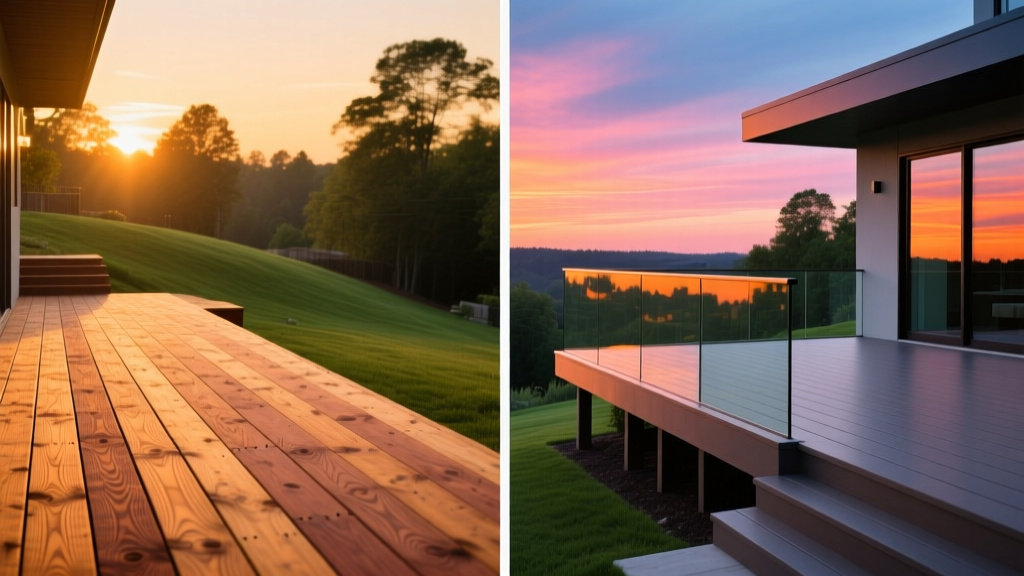
Material Deep-Dive: Performance, Pricing, and Edge Cases
Pressure-Treated Southern Yellow Pine (The Budget Baseline)
Pressure-treated (PT) wood remains the most common choice for budget-conscious builds. Modern PT lumber is treated with Micronized Copper Quaternary (MCQ) or Alkaline Copper Quaternary (ACQ) preservatives to resist rot and insects. While the upfront material cost is low, PT lumber carries significant hidden expenses. It arrives with high moisture content and must dry for 30 to 90 days before it can be sealed. If sealed too early, the trapped moisture causes warping and premature sealant failure. Furthermore, PT decking requires power washing and re-sealing every 1 to 2 years, costing roughly $300 to $500 per session. Over a decade, the maintenance cost of a PT deck often exceeds its initial installation price.
Cedar and Redwood (The Natural Mid-Tier)
Cedar and Redwood offer natural tannins and oils that resist decay without chemical treatments. When sourcing these woods, it is critical to specify 'Heartwood' grades (Clear Heart or B-Grade). Sapwood, which is often mixed into lower grades like Construction Common, lacks these natural oils and will rot at nearly the same rate as untreated pine. Redwood prices have surged due to sustainable harvesting restrictions in California, pushing premium grades past $9.50 per square foot for materials alone. Both woods are softer than composite alternatives, making them susceptible to scratching from heavy patio furniture and pet claws.
Capped Wood-Composite (The Market Standard)
Composite decking has evolved past the early-generation uncapped boards that suffered from severe mold and fading. Modern capped composites, such as Trex Transcend Lineage or TimberTech Advanced PVC, feature a high-density polyethylene (HDPE) shell that completely encases the wood-flour core. This capping prevents moisture intrusion, effectively eliminating mold growth and staining. The trade-off is thermal retention; dark-colored composite boards can reach surface temperatures of 150°F in direct midday summer sun. If building in unshaded southern climates, specifying light-colored boards (e.g., Coastal Bluff or Beach Dune) is mandatory for barefoot comfort.
Aluminum Decking (The Premium Niche)
Aluminum decking, such as Wahoo Decks' AridDek system, represents the absolute ceiling for deck material costs. Extruded aluminum planks are powder-coated, entirely waterproof, and non-combustible. The interlocking tongue-and-groove design creates a dry-under-deck environment without requiring secondary ceiling systems. Aluminum is the only material that will not warp, splinter, or degrade under UV exposure, yielding a functional lifespan of 50+ years. However, it requires specialized carbide-tipped blades for cutting and specific aluminum-compatible hidden fasteners to prevent galvanic corrosion.
Most online calculators only factor in the surface decking and railings. The substructure (joists, beams, and footings) accounts for 30% to 40% of the total build cost. If you are installing heavy composite or PVC boards, you must reduce joist spacing from the standard 16 inches on-center (used for wood) to 12 inches on-center to prevent sagging. This requires 30% more framing lumber and labor, artificially inflating the 'average' cost of a composite deck beyond just the surface material upgrade.
Hidden Costs That Skew the Average
To accurately budget your project, you must account for line items that rarely appear in basic square-footage estimates:
- Hidden Fasteners: Surface screws are cheap but unsightly. Hidden fastener systems (like Tiger Claw or Trex Hideaway) add $1.50 to $2.50 per square foot to the material cost and increase installation time by 15%.
- Flashing Tape: Applying butyl flashing tape (e.g., Trex Protect) to the top of all wooden joists is mandatory when installing composite decking to prevent moisture rot at the screw penetrations. This adds $0.75 per linear foot of framing.
- Helical Piles vs. Concrete Footings: Traditional poured concrete Sonotubes cost $150-$250 per footing. If your site has poor soil drainage or requires building in winter, galvanized helical piles cost $300-$450 per pier but can be installed in minutes without curing time.
- Stair Stringers and Landings: Stairs are priced per 'tread' or 'run', not per square foot. A standard 4-foot wide composite stair run costs $400 to $600 per step, installed.
Labor vs. Materials: Where Your Money Actually Goes
The ratio of labor to materials shifts dramatically depending on the decking tier you select. Understanding this ratio helps in negotiating contractor bids.
| Decking Material | Material % of Total | Labor % of Total | Contractor Strategy |
|---|---|---|---|
| Pressure-Treated Wood | 30% | 70% | Highly labor-intensive due to cutting, routing, and finishing. Shop for competitive labor rates. |
| Cedar / Redwood | 45% | 55% | Balanced ratio. Material waste is high due to board grading and cutting around defects. |
| Capped Composite | 65% | 35% | Material-heavy. Ensure the contractor is certified by the manufacturer to maintain the 25-year warranty. |
| Aluminum | 75% | 25% | Specialty install required. Do not use standard wood deck builders; hire metal-fabrication experienced crews. |
Decision Matrix: Matching Material to Climate and Use Case
Selecting the right material requires aligning the physical properties of the board with your specific environmental and usage constraints.
- High-Moisture / Coastal Environments: Avoid wood and standard composites. Salt air and constant humidity will degrade wood rapidly and cause uncapped composites to swell. Choose Advanced PVC (which contains zero organic wood fibers) or Aluminum.
- Heavy Shade / Forested Lots: Pine and Cedar will succumb to moss and algae within two years in deep shade. Capped composite with integrated antimicrobial protection (like TimberTech's Mold Guard technology) is required.
- Second-Story Decks over Living Spaces: You must create a watertight seal. Use an interlocking aluminum deck system with integrated gutters, or apply a heavy-duty polyurea liquid membrane over a plywood subfloor before installing floating composite tiles.
- Resale Value Focus: According to Home Depot's material guide and national real estate trends, composite decks recoup roughly 60% to 70% of their cost at resale, while wood decks recoup up to 80% simply because their initial cost is so much lower. If selling within 3 years, build with premium PT wood; if staying for 10+ years, invest in composite.
Final Budgeting Directive
Do not anchor your budget to the national average cost to build a deck. Instead, calculate your exact square footage, multiply by the installed square-foot rate of your chosen material tier from the matrix above, and add a mandatory 20% contingency for substructure upgrades, hidden fasteners, and site-access complexities. This methodology guarantees an accurate, surprise-free build in 2026.
Written by
Priya KapoorPriya Kapoor is a real estate market analyst and construction economics researcher with expertise in housing affordability, development feasibility, and infrastructure investment. She holds a Master of Regional Planning from Cornell University and previously worked as a senior analyst at CBRE's Investment Properties group, where she modeled returns for $4B in mixed-use development pipelines. Priya now runs an independent research practice advising developers, municipalities, and REITs on construction cost forecasting and market timing. She publishes the quarterly "BuildMat Market Pulse" report tracking material price indices across 12 commodity categories. Based in Austin, TX, Priya serves on the board of Habitat for Humanity Austin and is a marathon runner.
More from Priya Kapoor
View all
Construction Cost
Cost to Build a 1600 Sq Ft Home in 2026: Full Breakdown
Accurate 2026 cost to build a 1600 sq ft home—material, labor, and regional pricing breakdowns included. Plan your budget with real-time estimates.
Aug 11, 2026

Wood & Lumber
Name the Types of Wood for Pressure Treatment and Preservation
Learn how to name the types of wood best suited for pressure treatment. Compare species treatability, chemical retention levels, and 2026 preservation costs.
Aug 4, 2026

Stone & Masonry
Stone Veneer Suppliers Lindenhurst: 2026 Cost Analysis
Analyze 2026 stone veneer costs in Lindenhurst, NY. Compare local supplier pricing, delivery fees, and Suffolk County installation labor rates.
Aug 4, 2026