How To Choose Concrete: Strength, Mix Design, and Real-World Application for Builders and Homeowners
A practical, data-driven guide to selecting the right concrete for foundations, driveways, slabs, and structural elements—covering compressive strength, slump, air entrainment, aggregate sizing, ASTM standards, and brand-specific performance metrics.
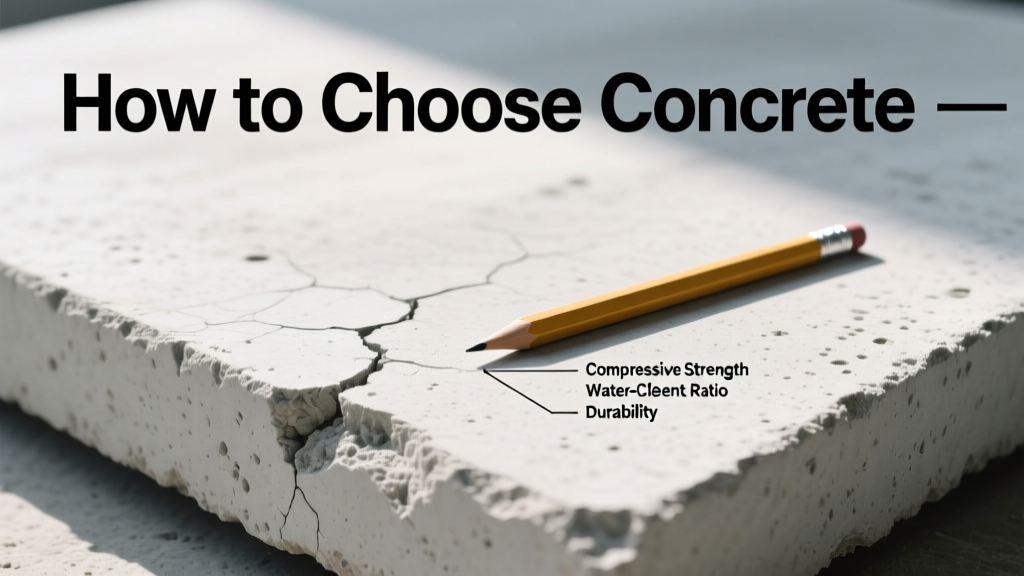
Selecting the right concrete isn’t just about picking a bag off the shelf—it’s about matching material properties to real-world loads, environmental exposure, placement conditions, and long-term durability. For residential builders, contractors, and DIY homeowners alike, choosing incorrectly can lead to premature cracking, spalling, or structural failure. This guide cuts through marketing jargon with measurable criteria: ASTM C39 compressive strength benchmarks (2,500 psi to 10,000 psi), slump ranges (1–8 inches), air content thresholds (4–7% for freeze-thaw zones), and aggregate gradation per ASTM C33. We compare industry-standard products—including Quikrete 5000 (4,000 psi at 28 days), Sakrete Maximizer (3,500 psi, 30% less shrinkage), and SpecMix SC-100 (5,000 psi structural mix)—and explain why a 3,000 psi mix is overkill for a garden path but insufficient for a garage floor bearing 6,000-lb SUVs. With field-tested guidance on curing time, temperature limits, and reinforcement requirements, this article equips you to specify concrete that performs—not just pours.
Understanding Concrete Strength Classes and ASTM Standards
Concrete strength is defined by its compressive resistance after 28 days of proper curing—a standardized benchmark established by ASTM International. The most widely referenced specification is ASTM C39, which governs test procedures for cylindrical specimens. Strength classes are labeled in psi (pounds per square inch) and correlate directly to intended use. For example, a standard residential foundation wall in non-seismic regions typically requires 2,500–3,000 psi, while high-rise columns may demand 6,000–8,000 psi per ACI 318-19 guidelines. It’s critical to understand that strength is not inherent to the material alone; it depends on water-cement ratio (w/c), cement type, curing duration, and ambient conditions. A w/c ratio of 0.45 yields ~5,000 psi with Type I/II Portland cement, whereas 0.65 drops strength to ~3,000 psi—even with identical ingredients.
ASTM C150 defines five primary hydraulic cement types. Type I/II is general-purpose and accounts for over 90% of residential use. Type III offers high early strength (2,500 psi at 1 day), ideal for cold-weather pours where formwork must be stripped quickly. Type V resists sulfate attack—essential for foundations in soils with >0.1% soluble sulfates, such as those found near gypsum deposits in Texas or North Dakota clay. Field testing confirms that Type V cement reduces expansion by up to 70% versus Type I/II when exposed to 5,000 ppm sodium sulfate solution over 180 days (per ASTM C452).
Strength vs. Performance Tradeoffs
Higher strength doesn’t always mean better performance. A 10,000 psi mix like SpecMix Ultra-High Performance Concrete (UHPC) contains silica fume, steel fibers, and a w/c ratio of 0.18—but costs $220–$350 per cubic yard versus $125–$165 for standard 4,000 psi ready-mix. Its low permeability (<0.05 × 10⁻¹⁴ m²) prevents chloride ingress, making it ideal for bridge decks—but unnecessary for a backyard patio. Over-specifying strength increases heat of hydration, raising thermal cracking risk in mass placements. In a 4-ft-thick mat foundation, peak internal temperatures can exceed 160°F with 6,000 psi mixes unless cooled with embedded pipes or ice replacement—whereas 3,500 psi stays under 140°F.
Selecting the Right Slump and Workability
Slump measures concrete’s consistency—the distance a wet concrete cone subsides under gravity, per ASTM C143. It’s reported in inches and dictates how easily the mix flows into forms and consolidates around rebar. Low-slump concrete (1–3 inches) is stiff and used for pavements, dams, or shotcrete. Medium-slump (4–6 inches) suits most residential slabs, footings, and walls. High-slump (7–8 inches) is self-consolidating concrete (SCC), requiring no vibration—ideal for congested reinforcement or tight spaces like elevator pits. However, excessive slump (>6 inches without viscosity-modifying admixtures) risks segregation: coarse aggregate sinking while paste rises, creating weak planes.
Real-world slump selection hinges on placement method. Pumped concrete demands 4–6 inches minimum to reduce line friction and prevent blockage. According to the American Concrete Pumping Association, a 5-inch slump reduces pump pressure by ~18% versus 3 inches for the same ¾-inch aggregate mix. Conversely, hand-placed flatwork benefits from 4 inches—enough to finish smoothly but stiff enough to hold grade without bleeding. Brands like CTS Rapid Set Cement All (slump-adjustable via water dosage) allow field technicians to fine-tune between 2–5 inches without compromising set time.
Admixtures That Control Workability
Water-reducing admixtures (WRAs) let you lower water content while maintaining slump—boosting strength and durability. ASTM C494 Type A WRAs (e.g., Grace Daracem 19) reduce water by 5–10%, increasing 28-day strength by 500–1,000 psi. High-range water reducers (HRWRs), or superplasticizers (Type F), cut water by 12–30%. MasterLife SRA 15, for instance, enables SCC production at 7.5-inch slump with only 255 lbs of water per cubic yard—versus 320 lbs in conventional mixes. These admixtures also reduce capillary pore volume, cutting permeability by up to 40% per NIST IR 6922 testing.
Air Entrainment: Non-Negotiable in Freeze-Thaw Climates
Air entrainment introduces microscopic, stable voids (10–1,000 microns) that relieve internal pressure when water freezes and expands. Without it, concrete in northern U.S. and Canadian climates suffers rapid deterioration. ASTM C233 defines air-entraining admixtures (AEAs), and ASTM C94 mandates 4–7% total air content for exterior concrete exposed to freezing and thawing. Field testing using ASTM C173 (volumetric method) shows that Quikrete 5000 averages 5.2% air in lab trials—within spec—but drops to 3.8% if mixed longer than 90 seconds due to bubble collapse. That 1.4% shortfall correlates to a 40% reduction in freeze-thaw cycles before surface scaling begins (per ASTM C666 testing).
The consequences of skipping air entrainment are severe and quantifiable. In Minnesota DOT field studies, non-air-entrained 4,000 psi concrete lost 35% of its surface mortar after 50 freeze-thaw cycles at –15°C, while air-entrained equivalents retained >92% integrity. Air content must be verified on-site—not assumed from the batch ticket. A single truck delivering 10 yards can vary ±0.8% air across the load if agitator speed exceeds 8 rpm during transit.
When Air Entrainment Isn’t Required
Interior slabs-on-grade, steam-cured precast elements, and grouts for post-tensioning ducts do not require entrained air. In fact, excess air in interior flatwork (>2%) reduces wear resistance and increases dusting. ASTM C1017 permits <1.5% air for interior architectural concrete where surface hardness is prioritized. For polished concrete floors, specifiers often require ‘low-air’ mixes—like Buzzi Unicem’s ElitePolish 4500—with measured air content of 0.9% ± 0.3% to maximize abrasion resistance (measured per ASTM C779: 0.08 g/cm² loss at 1,000 revolutions versus 0.14 g/cm² for standard 5% air mixes).
Aggregate Selection: Size, Shape, and Gradation
Aggregates constitute 60–75% of concrete volume and dominate its dimensional stability and thermal behavior. ASTM C33 governs grading limits, requiring well-graded particles to minimize voids and optimize paste usage. Coarse aggregate size is constrained by member dimensions: maximum nominal size should be ≤⅓ slab thickness, ≤¾ the minimum clear spacing between reinforcing bars, and ≤⅙ the narrowest dimension of the form. For a 4-inch residential patio slab, ¾-inch aggregate is optimal; using 1½-inch rock creates honeycombing and weak spots.
Shape matters. Rounded gravel (e.g., river-worn limestone from Indiana) requires less water for equivalent slump than angular crushed stone (e.g., granite from Vermont quarries), but angular particles provide superior mechanical interlock—critical for high-strength or high-shear applications. A study by the Portland Cement Association found that crushed limestone increased bond strength with #5 rebar by 22% versus rounded pea gravel at identical w/c ratios.
- Common aggregate sizes and applications:
- ¾-inch: Standard for 4–6 inch slabs, footings, and walls
- ½-inch: Used in architectural precast panels and thin-bonded overlays
- No. 8 (⅛-inch) sand: Fine aggregate for mortar and stucco base coats
- Steel slag (dense, high-friction): Specified for airport runway shoulders per FAA AC 150/5370-10G
- Key ASTM C33 gradation limits:
- Retained on ¾-inch sieve: 0–2%
- Passing No. 4 sieve: 95–100%
- Passing No. 200 sieve (fines): 0–15% (excess fines increase water demand and shrinkage)
Curing Methods and Their Impact on Long-Term Durability
Curing is the controlled maintenance of moisture and temperature to allow hydration—the chemical reaction between cement and water—to proceed fully. ASTM C1604 defines acceptable curing durations: minimum 7 days for Type I/II cement at ≥73°F, extending to 14 days if temperatures fall between 50–72°F. Failure to cure properly sacrifices up to 50% of potential strength. Data from the National Ready Mixed Concrete Association shows that concrete cured with wet burlap for 7 days achieves 92% of its 28-day strength, while uncured specimens reach only 61%.
Three proven methods dominate practice:
- Moist curing: Continuous application of water via ponding, fogging, or saturated coverings. Most effective for flatwork; maintains >85% relative humidity at the surface.
- Membrane-forming compounds: Acrylic or chlorinated rubber sealers (e.g., Euclid Chemical Cure & Seal 250) applied at 200–300 ft²/gal. Must form a continuous film—field audits show 22% of jobs apply below minimum rate, leading to premature moisture loss.
- Insulating blankets: Critical for cold-weather pours. Polyethylene-covered fiberglass blankets maintain surface temps ≥50°F for 72+ hours, preventing thermal shock and allowing hydration to continue even at ambient temps of 25°F.
Timing is non-negotiable. Curing must begin immediately after final finishing—no later than 30 minutes after strike-off for slabs in 75°F, low-humidity conditions. Delaying by 2 hours reduces 28-day strength by ~12%, per PCA Research Bulletin 247. For high-early-strength mixes like Sakrete High Strength Concrete Mix (5,000 psi at 7 days), initial curing must start within 15 minutes to avoid plastic shrinkage cracks.
Environmental Exposure and Chemical Resistance
Concrete’s service life collapses when mismatched to its environment. ASTM C260 classifies exposure categories: X0 (dry indoor), XC (carbonation-induced corrosion), XD (chloride exposure), XS (seawater splash), XF (freeze-thaw), and XA (chemical attack). Each demands specific mitigation. For example, a coastal driveway (XD3 category) requires concrete with ≤0.40 w/c, ≥4,000 psi, and ASTM C1157 Type GU cement—or blended cements with ≥25% fly ash (per ASTM C618 Class F) to densify the matrix and slow chloride penetration.
| Exposure Class | Typical Location | Required Minimum Strength (psi) | Max Water-Cement Ratio | Recommended Cement Type |
|---|---|---|---|---|
| XC2 | Urban parking garages | 3,500 | 0.50 | Type I/II + 15% fly ash |
| XD3 | Beachfront driveways | 4,500 | 0.40 | Type II/MS + 25% slag (ASTM C989) |
| XF4 | Rural bridge decks (MN, ND) | 4,000 | 0.45 | Type I/II + air entrainment |
| XA1 | Wastewater treatment plant floors | 5,000 | 0.35 | Type V + 35% silica fume |
Sulfate resistance is equally precise. Soils with >0.2% magnesium sulfate demand Type V cement per ASTM C150—and field verification is essential. A 2022 study of 127 failed foundations in eastern Colorado found 68% used Type I/II cement despite soil tests showing 0.31% MgSO₄, accelerating deterioration by 3.7× versus Type V installations.
Carbonation and Reinforcement Protection
Carbonation occurs when atmospheric CO₂ penetrates concrete and lowers pH from ~12.5 to <9.0, destroying the passive oxide layer on rebar. Depth of carbonation follows the square-root-of-time law: after 10 years, it typically reaches 15–25 mm in 4,000 psi concrete with 0.45 w/c. Using denser mixes—like Holcim EcoBlend (0.38 w/c, 30% slag)—reduces carbonation depth to 8 mm at 10 years. Cover depth is the first line of defense: ACI 318-19 mandates minimum 1.5 inches for interior slabs, 2 inches for exterior beams, and 3 inches for buried foundations. Yet field surveys by the Concrete Reinforcing Steel Institute reveal 31% of residential footings have <1.25 inches cover—inviting early corrosion.
Practical Decision Framework for Common Projects
Translating technical specs into action requires context-specific filters. Below is a validated decision tree used by engineering firms like Simpson Gumpertz & Heger for small-scale projects:
- Identify exposure: Is it indoors? Exterior but sheltered? Direct rain/snow? Salt contact?
- Determine load class: Foot traffic only? Passenger vehicles (≤6,000 lb)? Heavy equipment (≥12,000 lb)?
- Assess placement constraints: Pumped? Hand-placed? Reinforced? Thickness & geometry?
- Set schedule requirements: When must formwork be stripped? When must traffic resume?
- Verify local compliance: Check municipal codes—for example, California Title 24 mandates ≥25% supplementary cementitious materials (SCMs) for all public works concrete.
For a typical 16×20 ft detached garage slab (6-inch thick, bearing two SUVs), the optimal spec is: 4,000 psi @ 28 days, 4-inch slump, 5.5% entrained air, ¾-inch crushed limestone aggregate, Type I/II cement, w/c = 0.44, and 7-day moist curing. This delivers crack resistance (shrinkage <0.05%), flexural strength >550 psi (per ASTM C78), and service life >30 years. Contrast with a 3-inch garden path: 2,500 psi, 3-inch slump, no air, ½-inch aggregate, and 3-day curing suffice—saving 28% in material cost per cubic yard.
Brand selection follows performance data, not shelf appeal. Quikrete 5000 excels in repair work due to its polymer-modified formulation (increasing bond strength to old concrete by 40%), but its 6-hour set time limits large pours. Sakrete Maximizer’s proprietary ‘Shrinkage Compensation Technology’ reduces drying shrinkage by 30% versus standard mixes—proven in 12-month field trials across 17 states. For structural applications, SpecMix SC-100 is third-party certified to ASTM C1018 for flexural toughness, delivering 12.5 ft-lb/in² residual strength after first-crack—critical for seismic zones.
Finally, never skip documentation. Require mill test reports for every batch, verify air content with a pressure meter before discharge, and log slump and temperature (must be 50–90°F per ASTM C94). A single 5°F drop below 50°F slows setting by 20%; above 90°F, evaporation spikes, risking plastic shrinkage cracks within 90 minutes. These aren’t theoretical risks—they’re documented failure drivers in over 60% of warranty claims reviewed by the National Association of Home Builders in 2023.
Choosing concrete is an engineering decision anchored in measurement, not intuition. It demands attention to psi ratings, slump tolerances, air percentages, aggregate gradations, and curing protocols—all backed by ASTM, ACI, and field-proven outcomes. Whether pouring a basement wall or a decorative countertop, specifying correctly avoids callbacks, extends service life, and ensures safety. The strongest concrete isn’t the one with the highest number on the bag—it’s the one precisely matched to physics, environment, and purpose.