Composite Deck Building Materials: 2026 Cost Breakdown
Detailed 2026 cost breakdown for composite deck building materials, including boards, framing, fasteners, and labor by top brands like Trex and TimberTech.
The True Cost of Composite Deck Building Materials in 2026
Building a composite deck requires a precise understanding of material tiers, hidden structural costs, and current supply chain pricing. While pressure-treated lumber remains the baseline for budget builds, composite deck building materials have captured over 40% of the residential decking market due to advanced polymer capping and minimal lifecycle maintenance. For a standard 320-square-foot (16x20) deck, the total material cost for a premium composite system typically ranges from $14,500 to $22,800 in 2026, excluding labor.
Quick Cost Snapshot (320 Sq. Ft. Deck)
- Entry-Level Composite (Hollow core, basic cap): $9,200 - $11,500
- Mid-Tier Capped Composite (Solid core, wood-grain embossed): $12,800 - $16,400
- Premium Advanced PVC / High-End Composite: $17,500 - $22,800+
Tier 1 vs. Tier 2 vs. Tier 3: Board Pricing by Brand
Composite decking is not a monolith. Pricing fluctuates wildly based on the core density (hollow vs. solid), the thickness of the polymer cap, and the realism of the surface embossing. According to industry data tracked by Forbes Home Improvement, premium lines can cost up to 60% more than entry-level options per linear foot.
| Brand & Product Line | Material Type | Cost per Linear Foot | Cost per Sq. Ft. (Boards Only) |
|---|---|---|---|
| Trex Enhance Naturals | Scalloped Capped Composite | $4.50 - $5.80 | $7.50 - $9.60 |
| Fiberon Promenade | Solid Capped Composite | $6.20 - $7.50 | $10.30 - $12.50 |
| Trex Transcend Lineage | Premium Capped Composite | $8.50 - $10.20 | $14.15 - $17.00 |
| TimberTech Landmark | Advanced PVC (Solid) | $9.80 - $12.50 | $16.30 - $20.80 |
The Hidden Costs: Framing, Fasteners, and Substructures
Beginners often budget strictly for the deck boards and railings, only to be blindsided by substructure requirements. Composite boards are heavier and more flexible than traditional lumber, requiring stricter joist spacing to prevent sagging. While standard pressure-treated pine allows for 16-inch on-center (OC) joist spacing, most composite manufacturers mandate 12-inch OC spacing for diagonal board layouts and 16-inch OC for straight layouts per the North American Decking and Railing Association (NADRA) guidelines.
Wood vs. Steel Framing Systems
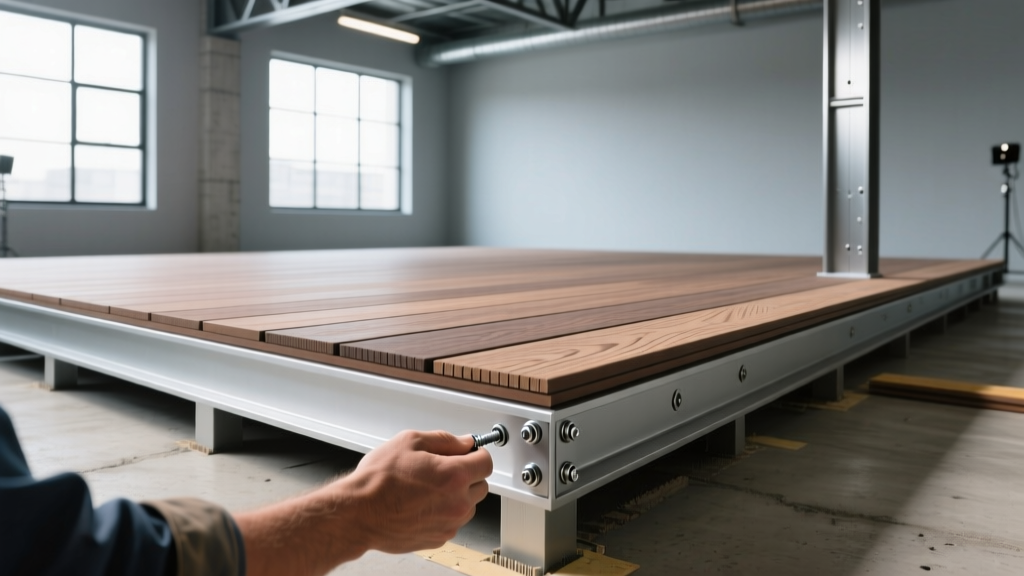
Pressure-treated (PT) southern yellow pine remains the most common framing material, costing roughly $3.50 to $5.00 per square foot. However, PT wood is prone to warping, twisting, and rotting, which can compromise the structural integrity of a composite surface over time. Light-gauge steel framing systems, such as Trex Elevations or Fortress Evolution, cost between $9.00 and $14.00 per square foot. While steel framing increases upfront material costs by roughly 150%, it guarantees a perfectly flat substructure that matches the 25-to-50-year lifespan of the composite boards above it.
Hidden Fasteners vs. Face Screws
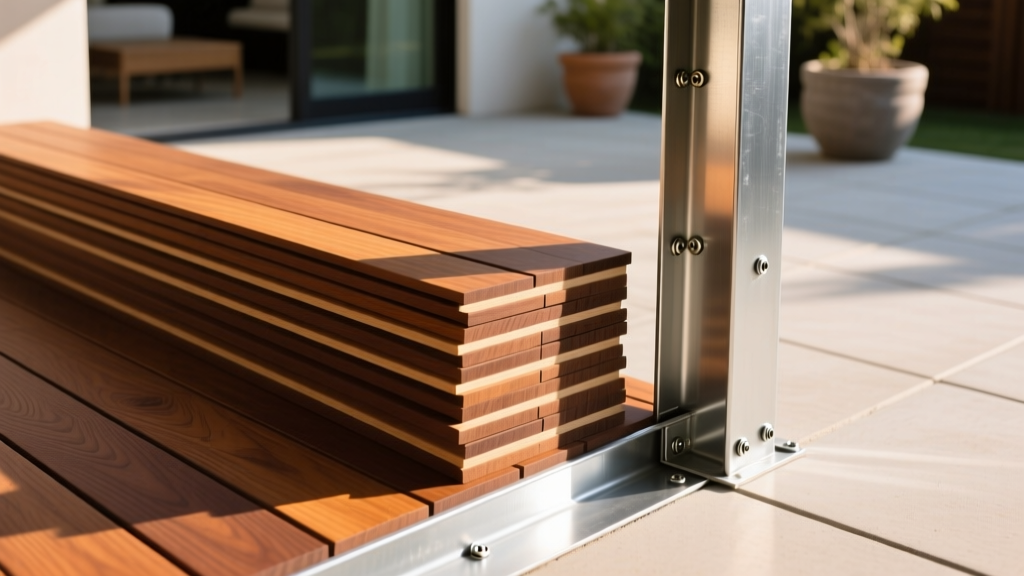
To maintain a clean, splinter-free surface, hidden fastener systems are the industry standard for grooved composite boards.
- Trex Hideaway Universal Clips: Approximately $1.40 to $1.80 per square foot.
- TigerClaw TC-G Stainless Steel Clips: Approximately $2.10 to $2.60 per square foot (recommended for high-shear coastal environments).
- Composite Face Screws (Cortex System): Used for perimeter boards and stairs where hidden clips cannot reach. Budget $0.85 per linear foot for color-matched plugs and screws.
Joist Tape and Moisture Protection
Applying butyl joist tape to the top edge of every floor joist is a non-negotiable best practice in 2026. This prevents moisture intrusion into the end-grain of wood joists, which is the primary cause of premature substructure failure. Trex Protect or G-Tape costs between $0.35 and $0.55 per linear foot. For a 320-square-foot deck requiring roughly 450 linear feet of joist tape, expect to add $160 to $250 to your material list.
Labor and Installation Variables
Material costs only tell half the story. Labor rates for composite deck installation range from $18 to $35 per square foot, heavily dependent on regional labor markets and design complexity. According to Angi's 2026 decking cost guide, complex designs command significant premiums.
"Contractors typically charge a 15% to 25% labor premium for 'picture framing' (using a perimeter border of boards running perpendicular to the field boards) and diagonal inlays. These techniques require 45-degree miter cuts, increase the waste factor, and double the number of hidden fasteners required at the seams."
Waste Factor and Overordering Calculations
Composite deck boards are manufactured in standard lengths (12', 16', and 20'). Because you cannot reuse short offcuts as easily as natural wood (due to hidden fastener groove limitations on the ends), the waste factor is a critical budgeting metric.
Always calculate your total square footage and apply the correct waste multiplier before ordering. Running short on composite boards risks color batch mismatches, as manufacturers frequently update dye lots and embossing patterns year-over-year.
- Straight Lay (Standard rectangle): Add 10% waste factor.
- Diagonal Lay (45-degree angle): Add 15% waste factor.
- Complex Shapes (Curves, octagons, multi-level): Add 20% waste factor.
Fascia and Railing Integration
Composite fascia boards (typically 12-inch wide) are used to cover the rim joists, providing a finished look and hiding the substructure. Budget $4.50 to $6.50 per linear foot for composite fascia. Furthermore, pairing composite decking with composite railings (like Trex Signature or TimberTech Premier) will add $65 to $120 per linear foot of railing, depending on whether you choose standard square balusters or premium glass/metal infill panels.
Long-Term ROI: Composite vs. Pressure-Treated Wood
While the initial material cost for composite deck building materials is 2.5 to 3 times higher than pressure-treated pine, the total cost of ownership diverges sharply after year four. Pressure-treated decks require annual cleaning, bi-annual sanding, and staining every 2 to 3 years (costing roughly $450 to $800 per maintenance cycle for a 320 sq. ft. deck). Composite decking requires only periodic washing with soap and water. When factoring in a 15-year horizon, the maintenance savings of composite materials offset approximately 40% of the initial price premium, making it a mathematically sound investment for long-term homeowners.
Written by
James ThorntonJames Thornton is a construction industry veteran with 25 years of hands-on experience in wood framing, lumber grading, and residential building codes. He started as a framing carpenter in rural Oregon, earned his ICC Residential Building Inspector certification, and eventually became a senior plan reviewer for the City of Portland Bureau of Development Services. James holds a B.S. in Wood Science & Technology from Oregon State University and is a certified lumber grader through the West Coast Lumber Inspection Bureau (WCLIB). He has inspected over 3,000 residential construction sites and authored the city's internal guide on advanced framing techniques (2x6 at 24" O.C.). James lives in Bend, OR, where he builds custom timber-frame cabins and competes in lumberjack sports.
More from James Thornton
View all
Insulation
Best Home Insulation Materials: Complete 2026 Guide
Compare top home insulation materials for 2026. Find R-values, installed costs per square foot, and best uses for fiberglass, spray foam, and mineral wool.
Aug 4, 2026

Sustainable Building
Certify Your Green Building Material for LEED and WELL
Step-by-step guide to certifying a green building material for LEED v5 and WELL v2. Master EPDs, HPDs, and VOC limits for 2026 project specifications.
Aug 4, 2026

Stone & Masonry
Veneer Stacked Stone Panels: Interior Design & Style Showcase
Discover how veneer stacked stone panels transform interiors. Explore modern design profiles, material pairings, and technical installation specs.
Aug 4, 2026