Evaluating Deck Building Material Options for Your Climate Zone
Compare top deck building material options including pressure-treated wood, composite, PVC, and aluminum to find the best fit for your climate and budget.

The Core Matrix: Deck Building Material Options at a Glance
Selecting the right surface for your outdoor living space requires moving beyond basic aesthetics. The structural longevity of your project depends on matching specific material properties to your local microclimate, joist spacing, and maintenance tolerance. Below is a baseline matrix comparing the primary deck building material options available in 2026, with pricing reflecting current market averages for standard 5.5-inch wide boards.
| Material Category | Core Composition | Avg Cost (per linear foot) | Max Joist Span (16'' oc) | Maintenance Cycle |
|---|---|---|---|---|
| Pressure-Treated Pine | Southern Yellow Pine + MCA/ACQ | $2.80 - $4.50 | 16 inches | Annual sealing/staining |
| Capped Composite | HDPE/PP + Wood Flour + Polymer Cap | $6.50 - $9.50 | 16 inches | Bi-annual soap washing |
| Cellular PVC | 100% Extruded Polyvinyl Chloride | $8.50 - $12.50 | 16 inches (some 12 inches) | Bi-annual soap washing |
| Mineral-Based Composite | PP + Calcium Carbonate + Polymer Cap | $8.00 - $11.00 | 24 inches | Bi-annual soap washing |
| Extruded Aluminum | 6061-T6 Marine-Grade Aluminum | $13.00 - $19.00 | 24 inches | Decade+ / None |
Pressure-Treated Lumber: The Budget Baseline
Pressure-treated (PT) wood remains the most economical entry point, but treating all PT lumber as identical is a critical error. The American Wood Protection Association (AWPA) categorizes treatment levels based on end-use. For deck joists and framing, you must specify UC4A (Ground Contact) or UC4B (Heavy Duty Ground Contact) rather than UC3B (Above Ground), as modern building codes and best practices demand higher copper retention levels to prevent substructure rot.
Chemical Treatments and Fastener Compatibility
Modern PT lumber is primarily treated with Micronized Copper Azole (MCA) or Alkaline Copper Quaternary (ACQ). According to the Environmental Protection Agency (EPA), these copper-based preservatives are highly effective against fungal decay and termite damage, but they are also highly corrosive to standard steel. You must exclusively use hot-dipped galvanized (HDG) fasteners meeting ASTM A153 standards, or stainless steel (Type 304 minimum, Type 316 for coastal zones), to prevent rapid galvanic corrosion.
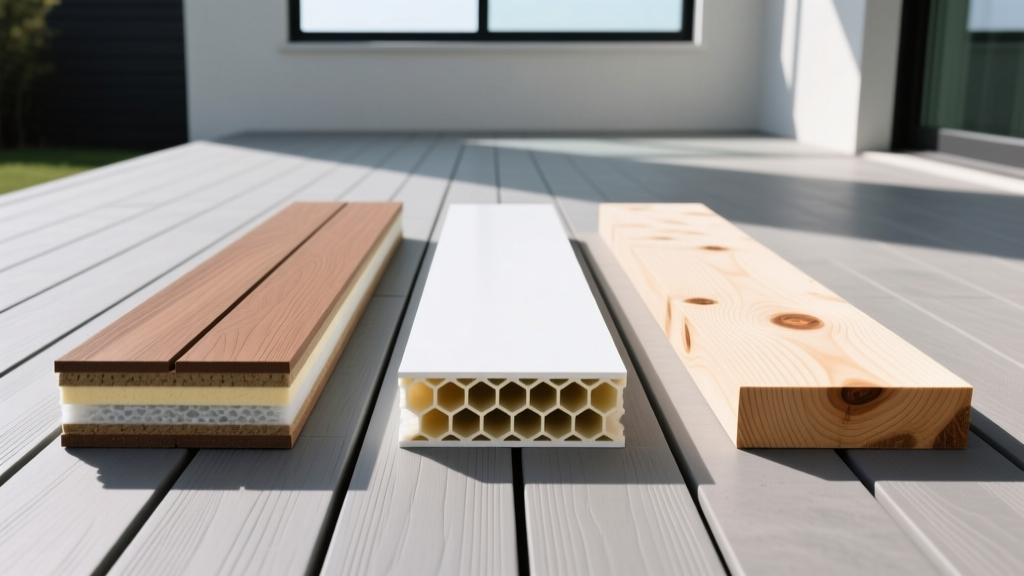
Capped Composite Decking: The Mainstream Standard
Capped composite decking dominates the mid-to-high-tier market. Unlike first-generation uncapped composites that absorbed moisture and stained easily, modern capped boards feature a co-extruded polymer shell that fully encases the wood-plastic core. Premium lines, such as Trex Transcend Lineage or TimberTech Terrain+, utilize a polypropylene (PP) or high-density polyethylene (HDPE) cap that is UV-stabilized and deeply embossed to mimic natural wood grain.
Thermal Expansion and Structural Limitations
The primary engineering challenge with capped composites is thermal expansion. A standard 16-foot composite board can expand or contract up to 1/4 inch across a 100-degree temperature swing. Installers must leave precise gapping at butt joints (typically 1/8 inch per 10 degrees of temperature difference from installation day to peak summer heat). Furthermore, the wood flour in the core remains susceptible to moisture intrusion if the board is cut and the end is left unsealed. Always apply an end-sealant or use color-matched end-caps on any exposed cuts.
Expert Insight: Never route or rip-cut the width of a capped composite board. Removing the protective polymer cap on the long edge exposes the organic wood-flour core to moisture, voiding the manufacturer warranty and guaranteeing edge swelling within two seasons.
Cellular PVC and Mineral-Based Composites: The Premium Tier
For environments with extreme moisture, high humidity, or ground-level installations where ventilation is restricted, organic-free materials are mandatory.
Cellular PVC Decking
Cellular PVC boards, like the TimberTech Advanced PVC Landmark Collection, contain zero wood flour. The material is foamed during extrusion to reduce weight while maintaining rigidity. PVC is entirely impervious to water absorption and mold. However, PVC has a higher coefficient of thermal expansion than composite. Dark-colored PVC boards in direct southern exposure can experience surface temperatures exceeding 150 degrees, leading to noticeable flexing if joist spacing exceeds 16 inches on center.
Mineral-Based Composite (MBC)
Mineral-based composites represent the latest advancement in synthetic decking. Products like Deckorators Vault replace organic wood flour with calcium carbonate (limestone). This mineral core completely eliminates the food source for mold and reduces thermal expansion by up to 50 percent compared to traditional composites. Because MBC is exceptionally stable, many manufacturers approve it for 24-inch on-center joist spacing, which can offset the higher per-board cost by reducing the amount of substructure framing lumber required.
Aluminum Decking: The Wildcard for Fire Zones
Extruded aluminum decking is a niche but rapidly growing category, driven primarily by stringent building codes in wildfire-prone regions. According to the National Fire Protection Association (NFPA), structures in the Wildland-Urban Interface (WUI) must utilize non-combustible exterior materials. Aluminum decking provides a Class A fire rating, is impervious to rot, and will not warp.
Modern aluminum deck boards, such as those from Wahoo Decks or LockDry, feature interlocking tongue-and-groove edges that create a watertight surface, allowing the area below the deck to remain dry. The primary drawbacks are the high initial cost, the metallic acoustic profile (it sounds hollow when walked on with hard-soled shoes), and the inability to easily modify or cut the boards on-site without specialized carbide-tipped blades designed for non-ferrous metals.
Decision Framework: Matching Materials to Microclimates
Use this practical framework to finalize your material selection based on your specific site conditions:
- High Shade / Heavy Foliage / High Humidity: Avoid pressure-treated wood and standard composites. Choose Cellular PVC or Mineral-Based Composite to prevent mold and mildew buildup in the board cores.
- Coastal / Salt Air Environments: Avoid all steel fasteners and ACQ-treated wood. Use Marine-Grade PT lumber (UC4C) with Type 316 stainless steel fasteners, or opt for Aluminum decking with powder-coated finishes.
- Ground-Level / Low Clearance Decks (Under 18 inches): Standard composites will cup and warp due to trapped moisture. You must use Mineral-Based Composites, PVC, or Aluminum, and ensure a crushed-gravel sub-base for drainage.
- Budget-Constrained with High DIY Tolerance: Pressure-Treated Southern Yellow Pine remains the undisputed king of ROI, provided you commit to sanding and re-sealing the surface every 18 to 24 months.
Hidden Fasteners vs. Face Screws: The Structural Detail
The fastening system is just as critical as the deck building material options you select for the surface. Hidden clip systems (such as Trex Hideaway or Tiger Claw) slide into the grooved edges of the boards, providing a clean, screw-free surface. However, they do not provide the same sheer structural pull-down force as face screws.
For high-traffic areas, commercial applications, or boards installed at extreme angles where thermal movement is magnified, structural face screws are superior. Systems like the CAMO Marksman tool drive screws at a 28-degree angle through the edge of the board, hiding the fastener head while providing the structural holding power of a top-down screw. According to testing data from the USDA Forest Products Laboratory, angled edge-fastening provides withdrawal resistance comparable to traditional face-screwing, without compromising the walking surface or creating water-catching divots in the board face.
By aligning your material choice with your local climate data, structural framing capabilities, and long-term maintenance bandwidth, you ensure the outdoor space performs flawlessly for decades rather than just seasons.
Written by
James ThorntonJames Thornton is a construction industry veteran with 25 years of hands-on experience in wood framing, lumber grading, and residential building codes. He started as a framing carpenter in rural Oregon, earned his ICC Residential Building Inspector certification, and eventually became a senior plan reviewer for the City of Portland Bureau of Development Services. James holds a B.S. in Wood Science & Technology from Oregon State University and is a certified lumber grader through the West Coast Lumber Inspection Bureau (WCLIB). He has inspected over 3,000 residential construction sites and authored the city's internal guide on advanced framing techniques (2x6 at 24" O.C.). James lives in Bend, OR, where he builds custom timber-frame cabins and competes in lumberjack sports.
More from James Thornton
View all
Insulation
Best Home Insulation Materials: Complete 2026 Guide
Compare top home insulation materials for 2026. Find R-values, installed costs per square foot, and best uses for fiberglass, spray foam, and mineral wool.
Aug 4, 2026

Sustainable Building
Certify Your Green Building Material for LEED and WELL
Step-by-step guide to certifying a green building material for LEED v5 and WELL v2. Master EPDs, HPDs, and VOC limits for 2026 project specifications.
Aug 4, 2026

Stone & Masonry
Veneer Stacked Stone Panels: Interior Design & Style Showcase
Discover how veneer stacked stone panels transform interiors. Explore modern design profiles, material pairings, and technical installation specs.
Aug 4, 2026