Decking Materials Calculator: A Selection Framework Guide
Learn how to use a decking materials calculator as a selection framework. Compare wood, composite, and PVC costs, waste factors, and substructure needs.
The Core Variables: Beyond Basic Square Footage
Most homeowners and junior contractors use a decking materials calculator for a single, flawed purpose: multiplying total square footage by a flat waste factor. This approach leads to severe material shortages or massive overages because it ignores the geometric realities of board dimensions and layout patterns. To use a calculator as a true material selection framework, you must input variables that dictate structural requirements and hidden costs.
The foundational metric is the linear footage conversion. A standard nominal 6-inch deck board has an actual face width of 5.5 inches (0.458 feet). Therefore, one square foot of deck area requires exactly 2.18 linear feet of decking. If your calculator only asks for square footage and assumes a standard 10% waste factor, it is already failing to account for your specific layout. A 400-square-foot deck requires a baseline of 872 linear feet of material before any cuts, miters, or waste are factored in.
Material-Specific Inputs: The Selection Matrix
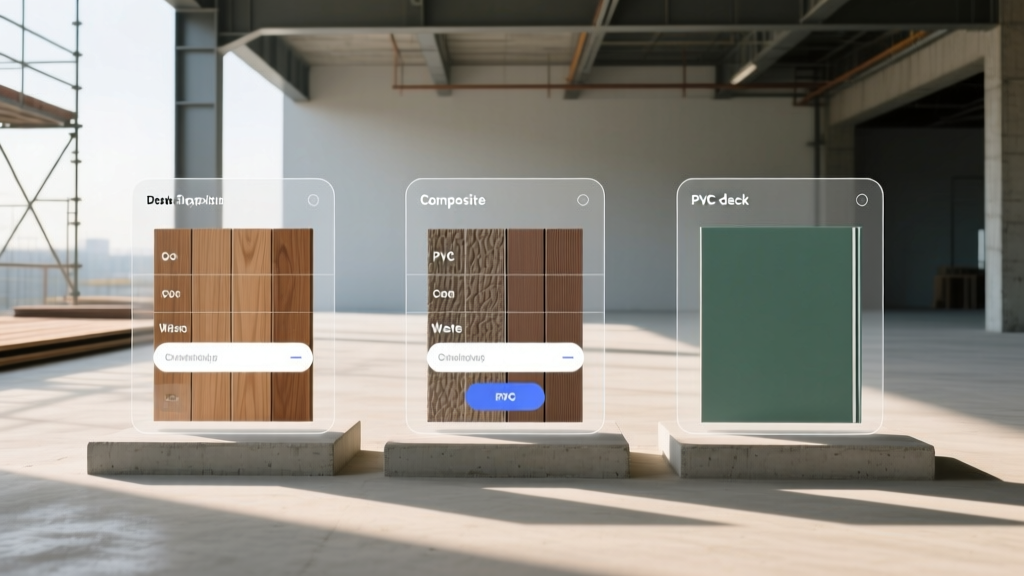
Different decking materials behave differently under the saw and on the joists. When comparing wood, capped composite, PVC, and aluminum, your calculator must adjust for material-specific waste factors, joist spacing requirements, and thermal expansion. The matrix below outlines the precise variables you must toggle when switching material types within your estimation software.
| Material Type | Standard Joist Spacing (Straight) | Required Waste Factor | Fastener Type & Density | Thermal Expansion Gap |
|---|---|---|---|---|
| Pressure-Treated Pine | 16" OC | 10% (Straight) / 15% (Diagonal) | Top-down screws (2 per joist) | 1/8" (varies by moisture) |
| Capped Composite | 16" OC (12" OC for Diagonal) | 12% (Straight) / 18% (Diagonal) | Hidden clips (1 per joist intersection) | 1/8" to 3/16" per 12' board |
| Cellular PVC | 16" OC (12" OC for Diagonal) | 12% (Straight) / 18% (Diagonal) | Hidden clips or color-matched screws | 1/4" to 3/8" (high expansion) |
| Aluminum (Interlocking) | 16" OC to 24" OC (varies by extrusion) | 8% (Straight) / 12% (Diagonal) | Stainless steel pan-head screws | Negligible (1/16" max) |
Step-by-Step Framework: Modeling Three Deck Scenarios
To understand how a calculator drives material selection, let us model a 400-square-foot deck (20x20) across three distinct material and layout scenarios using 2026 market pricing.
Scenario A: Pressure-Treated Wood (Straight Lay, 16" OC)
For a straight lay with 5.5" boards, the baseline is 872 linear feet. Adding a standard 10% waste factor for square cuts and end trims brings the total to 960 linear feet. At an average 2026 material cost of $4.25 per linear foot for premium ground-contact treated lumber, the decking material cost is $4,080. Top-down screws cost approximately $0.15 per intersection. With 16" OC framing, you have 0.75 joist intersections per linear foot, requiring 1,440 screws ($216). Total surface and hardware cost: $4,296.
Scenario B: Capped Composite (Diagonal Lay, 12" OC)
Diagonal layouts require dividing the baseline linear footage by the cosine of 45 degrees (0.707), effectively multiplying the required material by 1.414. The baseline jumps to 1,233 linear feet. Composite waste factors for diagonal cuts are higher (18%) due to the inability to reuse short offcuts with grooved edges. Total required: 1,455 linear feet. At $11.50 per linear foot for mid-tier capped composite, the boards cost $16,732. Hidden fasteners are required at every 12" joist intersection (1.0 per linear foot), meaning 1,455 fasteners at $0.45 each ($654). Total surface and hardware cost: $17,386.
Beyond the Boards: Substructure and Hardware Multipliers
A sophisticated decking materials calculator must include a substructure multiplier based on the chosen surface material. The North American Decking and Railing Association (NADRA) frequently highlights that surface material weight and span limitations dictate framing density.
- Wood Decking: Lighter and stiffer. Allows 16" OC joist spacing for standard 5.5" boards. Standard 2x8 or 2x10 joists are sufficient for spans up to 12 feet.
- Composite/PVC Decking: Heavier and more flexible. While 16" OC is permitted for straight lays, many manufacturers require 12" OC for 45-degree diagonal patterns or for decks in high-snow-load regions. This increases joist count, blocking, and labor.
- Aluminum Decking: Extremely rigid extrusions can sometimes span 24" OC, potentially reducing substructure costs by 20% compared to wood, offsetting the high per-square-foot cost of the aluminum boards themselves.

Interpreting the Output: Cost-Per-Use and Lifecycle Adjustments
The final step in the selection framework is adjusting the calculator’s output for lifecycle costs. A raw material calculator will always show pressure-treated wood as the cheapest option. However, factoring in a 25-year horizon changes the selection matrix entirely.
Wood decks require annual cleaning and bi-annual sealing or staining. At a conservative $1.50 per square foot for professional maintenance (or equivalent DIY material and time cost), a 400-square-foot wood deck incurs $600 annually, or $15,000 over 25 years. Capped composite and PVC require only occasional soap-and-water washing ($0.10 per square foot annually, or $1,000 over 25 years). When you input these maintenance variables into a lifecycle calculator, the 25-year cost of the composite deck from Scenario B becomes nearly identical to the wood deck from Scenario A, fundamentally altering the material selection decision.
"Never select a decking material based solely on the initial linear footage output. The true cost of a deck is found in the intersection of layout geometry, required substructure density, and long-term maintenance inputs."
Common Calculator Traps and How to Avoid Them
Even advanced estimation software will produce inaccurate material lists if the user fails to account for architectural details. Watch for these specific calculation traps:
- Picture Framing and Fascia: Calculators often estimate fascia boards based purely on the deck's perimeter. If you are "picture framing" the deck (running a border board around the perimeter), you must add the perimeter linear footage to your total decking count, plus an additional 15% for the 45-degree miter cuts required at the corners.
- Stair Treads and Risers: Standard deck boards are not rated for stair treads unless supported by a solid substrate. Most calculators have a separate module for stairs. Ensure you are selecting specific 12-inch wide stair tread boards or calculating the need for two standard 5.5" boards per tread, factoring in the high waste of cutting 36" tread lengths from 16' boards.
- Ignoring Expansion Gaps in PVC: Cellular PVC expands and contracts significantly with temperature fluctuations. If your calculator assumes tight butt joints, you will run short on material. You must account for 1/4" to 3/8" gaps between board ends, which slightly increases the total linear footage required to cover the same surface area.
- Hidden Fastener Start/Stop Clips: Hidden clip systems require specialized start and stop clips at the ends of every board where it meets the house or fascia. Standard calculators often miss these, resulting in a shortage of specialized hardware that can halt installation.
Written by
David NakamuraDavid Nakamura is a licensed architect (AIA) and construction technology writer focused on sustainable building methods, mass timber engineering, and high-performance building envelopes. He holds a Master of Architecture from the University of Washington and is a certified Passive House Consultant (CPHC). David spent eight years at the Seattle firm Mithun, where he led the design of three LEED Platinum projects, before founding his own practice specializing in net-zero residential design. He serves on the editorial advisory board of GreenBuilder Magazine and has authored peer-reviewed papers on cross-laminated timber (CLT) connections for the Journal of Structural Engineering. In his spare time, David teaches woodworking at Pratt Fine Arts Center and kayaks the Puget Sound.
More from David Nakamura
View all
Construction Cost
Labor Cost to Build a Deck Per Sq Ft: 2026 Installation Guide
Discover the exact labor cost to build a deck per sq ft in 2026. This installation guide breaks down contractor rates, complexity factors, and hidden fees.
Aug 4, 2026

Construction Cost
How Much Does It Cost to Build a 3 Bedroom House? Financing Guide
Learn exactly how much it costs to build a 3 bedroom house and explore 2026 financing options, construction loan types, and budget frameworks for your build.
Aug 4, 2026

Construction Cost
Cost to Build a Tennis Court: 2026 Guide
How much does it cost to build a tennis court in 2026? Breakdowns for asphalt, concrete, and synthetic surfaces plus fencing and lighting.
Jul 30, 2026