Composite Deck Lifespan: Weather, Maintenance, and Material Factors
Discover how weather, maintenance routines, and material composition dictate your composite deck lifespan. Expert guide to WPC vs. PVC longevity.

The Reality of 'Maintenance-Free' Decking
Composite decking is frequently marketed as a lifetime solution, but the actual composite deck lifespan is dictated by a complex interplay of material composition, regional weather patterns, and maintenance execution. While early-generation uncapped composites from the 1990s degraded within a decade, modern capped composites and advanced PVC boards routinely achieve 25 to 50 years of structural integrity. However, achieving the upper limit of these warranties requires understanding the specific failure modes associated with different polymer chemistries and environmental stressors.
The Material Matrix: Core Composition and Cap Technology
The baseline lifespan of your deck is established before installation begins, determined entirely by the chemical makeup of the boards. The market is currently segmented into three primary categories, each with distinct longevity profiles.
| Material Type | Core Composition | Cap Technology | Thermal Expansion | Expected Lifespan |
|---|---|---|---|---|
| Capped WPC (Wood-Plastic Composite) | Wood flour + HDPE/PP | Polymer shell (co-extruded) | Medium (1/8' per 10°F) | 25 - 30 Years |
| Advanced PVC | 100% Cellular PVC | Homogeneous (no cap) | Low (1/16' per 10°F) | 30 - 50 Years |
| Mineral-Based Composite (MBC) | Portland cement + polymers | Polymer shell | Near Zero | 30+ Years |
Why Cap Thickness Dictates Durability
In Wood-Plastic Composites (WPC), the core contains wood fibers. If moisture breaches the cap, the wood fibers absorb water, leading to swelling, mold, and eventual structural rot. Premium lines like Trex Transcend Lineage or TimberTech Pro utilize a thick, co-extruded polymer cap that completely encases the core. Budget composites often use a thin acrylic 'shell' that can micro-crack under UV exposure and thermal cycling, exposing the vulnerable core. When selecting materials, prioritize boards with a full 360-degree cap rather than a top-only cap, as moisture intrusion from the underside is a leading cause of premature WPC failure.
Weathering the Elements: Regional Climate Impacts
A composite deck in the arid Southwest faces entirely different degradation vectors than one in the humid Southeast or the freeze-thaw zones of the Northeast. According to the North American Decking and Railing Association (NADRA), environmental stressors are the primary catalyst for aesthetic degradation, even if structural integrity remains intact.
Freeze-Thaw Cycles and Moisture Trapping
In northern climates, the primary threat to composite deck lifespan is the freeze-thaw cycle. If water penetrates the end-cuts of WPC boards (where the core is exposed) and subsequently freezes, the expansion of the ice creates micro-fractures in the core. Always seal end-cuts with a specialized composite end-sealant or copper tape if the cut will be exposed to the elements. Furthermore, ensure a minimum of 1.5 inches of ground clearance and adequate cross-ventilation beneath the deck to prevent moisture from pooling and freezing against the board undersides.
Maintenance Realities: What 'Low-Maintenance' Actually Requires
The term 'low-maintenance' is frequently misinterpreted as 'no-maintenance.' Neglecting a composite deck will not cause it to rot like pressure-treated pine, but it will lead to stubborn biological growth, surface staining, and premature fading. The Trex Installation and Care Guidelines explicitly outline maintenance requirements that, if ignored, can void the manufacturer's fade and stain warranty.
The Annual Maintenance Protocol
- Spring Deep Clean: Use a specialized composite deck cleaner (e.g., 30 SECONDS Outdoor Cleaner or a mild solution of Dawn dish soap and warm water). Apply with a soft-bristle brush, scrubbing in the direction of the wood-grain embossing to lift dirt from the textured grooves.
- Rinse Parameters: If using a pressure washer, never exceed 3,100 PSI, and maintain a minimum 8-inch distance from the surface with a 40-degree fan tip. High-pressure streams can permanently etch the polymer cap, creating rough patches that trap dirt and mold.
- Autumn Debris Removal: Wet leaves left on composite decking will leach tannins into the cap, causing yellow or brown staining that is incredibly difficult to remove once it sets. Clear organic debris weekly during the fall.
- Winter Snow Removal: Use only a plastic-blade shovel. Metal shovels will gouge the cap. For ice melt, use calcium chloride. Avoid rock salt (sodium chloride) that contains anti-caking agents or color additives, as these will leave permanent white or blue residue on the boards.
Installation and Framing: The Hidden Lifespan Killers
The most common reason a composite deck fails before its 25-year warranty expires is not the composite boards themselves, but the underlying wood framing. Composite boards are heavier and more flexible than traditional lumber. If the substructure fails, the deck fails.
- Joist Spacing: Standard WPC requires 16-inch on-center (OC) joist spacing for perpendicular layouts, and 12-inch OC for diagonal layouts. Advanced PVC and MBC can sometimes span 24-inch OC, but always verify the specific manufacturer's span tables.
- Joist Tape Application: This is non-negotiable for maximizing lifespan. Apply a butyl-based joist tape (such as Trex Protect or G-Tape) over the top of every wooden joist before laying the composite boards. This prevents water from pooling on the joists, halting the rot that typically destroys the substructure 10 to 15 years before the composite boards degrade.
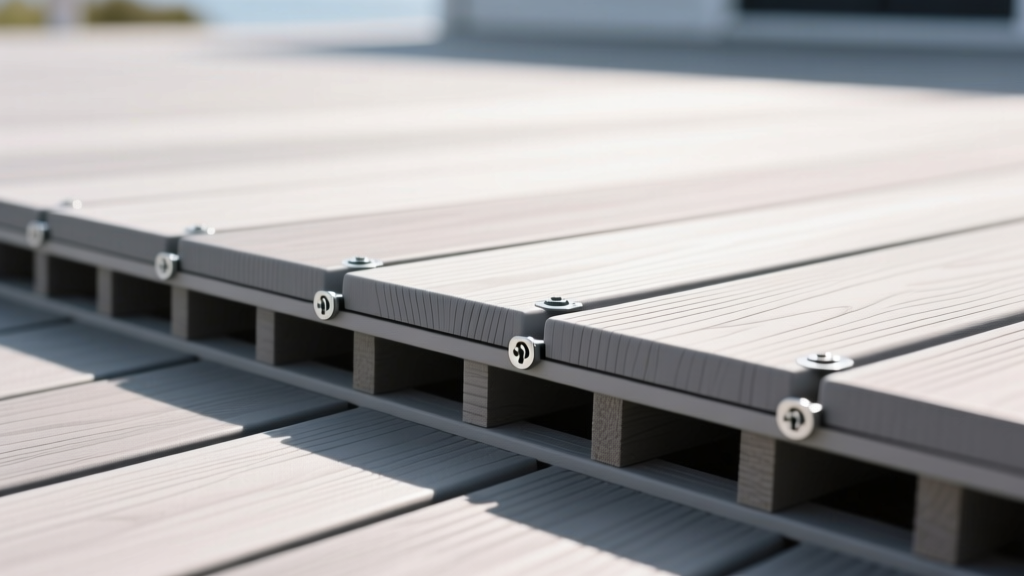
- Hidden Fasteners vs. Face Screws: Hidden clip systems (like Trex Hideaway) are superior for lifespan because they eliminate face-hole penetrations where water can infiltrate the core. If face-screwing is required (e.g., on stairs or perimeter picture-framing), use color-matched composite screws and pre-drill to prevent 'mushrooming' of the polymer cap.
Financial Breakdown: 25-Year Cost of Ownership
When evaluating composite deck lifespan factors, materials and maintenance costs must be analyzed over the lifecycle of the structure, not just the initial build. Below is a comparative cost analysis for a 400-square-foot deck over 25 years.
| Cost Metric | Pressure-Treated Wood | Capped WPC (Mid-Grade) | Advanced PVC (Premium) |
|---|---|---|---|
| Initial Material Cost | $2,400 | $4,800 | $7,200 |
| Annual Maintenance (Stain/Seal) | $12,500 ($500/yr) | $1,250 ($50/yr for cleaner) | $1,250 ($50/yr for cleaner) |
| Replacement at Year 15 | $2,400 | $0 | $0 |
| Total 25-Year Cost | $17,300 | $6,050 | $8,450 |
Expert Troubleshooting: Common Composite Deck Failures
Even with premium materials, specific edge cases can compromise your deck. Industry publications like Deck Magazine frequently highlight these field-tested failure modes:
Minor scratches on uncapped or lightly capped WPC can often be blended using a brass wire brush brushed lightly in the direction of the grain, followed by a heat gun applied on a low setting to slightly melt and blend the polymer. Never attempt this on PVC boards, as PVC melts at a lower temperature and will permanently warp.
Symptom: Board Sagging or 'Bowing'
Cause: Improper joist spacing or failure to account for thermal expansion. If boards are installed tight against each other in cold weather, summer heat will cause them to expand and push against one another, resulting in upward bowing.
Fix: Maintain a strict 1/4-inch gap between board edges and a 1/8-inch gap at end-joints during installation, adjusting slightly based on the ambient temperature on the day of installation.
Symptom: Persistent Black Mold Spots
Cause: Organic debris trapped in the embossed wood-grain texture, combined with high humidity and lack of under-deck ventilation.
Fix: Apply a solution of 1 part white vinegar to 2 parts water, let sit for 15 minutes, and scrub with a stiff nylon brush. Improve airflow by removing lattice skirting or installing under-deck ventilation grates.
Maximizing your composite deck lifespan requires moving beyond the 'install and forget' mentality. By selecting the correct polymer chemistry for your specific climate, executing a rigorous annual cleaning protocol, and fortifying the substructure against moisture, you can ensure your outdoor living space performs flawlessly for decades.
Written by
Priya KapoorPriya Kapoor is a real estate market analyst and construction economics researcher with expertise in housing affordability, development feasibility, and infrastructure investment. She holds a Master of Regional Planning from Cornell University and previously worked as a senior analyst at CBRE's Investment Properties group, where she modeled returns for $4B in mixed-use development pipelines. Priya now runs an independent research practice advising developers, municipalities, and REITs on construction cost forecasting and market timing. She publishes the quarterly "BuildMat Market Pulse" report tracking material price indices across 12 commodity categories. Based in Austin, TX, Priya serves on the board of Habitat for Humanity Austin and is a marathon runner.
More from Priya Kapoor
View all
Construction Cost
Cost to Build a 1600 Sq Ft Home in 2026: Full Breakdown
Accurate 2026 cost to build a 1600 sq ft home—material, labor, and regional pricing breakdowns included. Plan your budget with real-time estimates.
Aug 11, 2026

Wood & Lumber
Name the Types of Wood for Pressure Treatment and Preservation
Learn how to name the types of wood best suited for pressure treatment. Compare species treatability, chemical retention levels, and 2026 preservation costs.
Aug 4, 2026

Stone & Masonry
Stone Veneer Suppliers Lindenhurst: 2026 Cost Analysis
Analyze 2026 stone veneer costs in Lindenhurst, NY. Compare local supplier pricing, delivery fees, and Suffolk County installation labor rates.
Aug 4, 2026