Pool Decking Materials: A Data-Driven Selection Framework
Compare top pool decking materials using our selection framework. Analyze slip resistance, heat retention, costs, and durability for your build.

The Physics of Poolside Surfaces: Beyond Aesthetics
Selecting pool decking materials requires navigating a hostile micro-environment. Unlike standard patios, pool decks endure constant chemical exposure (chlorine, salt, muriatic acid), extreme thermal cycling, and perpetual moisture. A material that performs flawlessly in a dry courtyard may degrade rapidly or become dangerously slick when subjected to splashing and pool chemicals. This framework evaluates materials based on quantifiable physical properties rather than subjective visual appeal.
Critical Metrics: DCOF and SRI
Two metrics dictate the safety and comfort of any poolside surface:
- Dynamic Coefficient of Friction (DCOF): While the ANSI A137.1 standard mandates a DCOF of 0.42 for interior commercial floors, exterior pool decks demand a wet DCOF of at least 0.60 to prevent slip-and-fall accidents. The Pool & Hot Tub Alliance (PHTA) strongly recommends prioritizing high-traction surfaces in wet zones.
- Solar Reflectance Index (SRI): This measures a surface's ability to reject solar heat. Dark stamped concrete can have an SRI below 20, reaching surface temperatures of 140°F+ in direct summer sun. Light-colored natural stone or specialized porcelain maintains an SRI above 40, keeping surface temperatures 20°F to 30°F cooler and safe for bare feet.
Never evaluate pool decking solely on dry traction. Always request the manufacturer's wet DCOF test results. Furthermore, test the material's heat retention by placing a sample in direct midday sun for two hours. If it is too hot to hold the back of your hand against it for 5 seconds, it will burn bare feet.
Material Breakdown: Performance, Cost, and Lifespan
The following matrix compares the five most common pool decking materials based on 2026 installed costs, physical properties, and long-term maintenance requirements.
| Material | Installed Cost (per sq. ft.) | Wet DCOF | SRI (Heat) | Lifespan & Maintenance |
|---|---|---|---|---|
| Broom-Finished Concrete | $8 - $12 | 0.65 - 0.75 | 35 (Light) / 15 (Dark) | 25+ years. Requires sealing every 3-5 years. |
| Stamped Concrete | $15 - $22 | 0.45 (Sealed) | 20 - 30 | 20 years. High maintenance; requires resealing with anti-slip grit every 2 years. |
| Travertine Pavers | $22 - $35 | 0.70 - 0.80 | 45 - 55 | 30+ years. Low maintenance. Vulnerable to acid etching. |
| 20mm Porcelain Pavers | $28 - $45 | 0.60 - 0.70 | 40 - 50 | 50+ years. Near-zero maintenance. Stain and chemical proof. |
| Capped Composite | $18 - $26 | 0.50 - 0.60 | 15 - 25 | 25 years. Low maintenance. High heat retention; fades near saltwater. |
Climate-Specific Decision Tree
Do not select a material based solely on national averages. Your local microclimate dictates the failure modes of your deck. Use this decision framework to match the material to your environment.
Zone A: Sunbelt & High-Heat Regions (AZ, TX, FL, Southern CA)
- Primary Threat: UV degradation, thermal expansion, and barefoot burns.
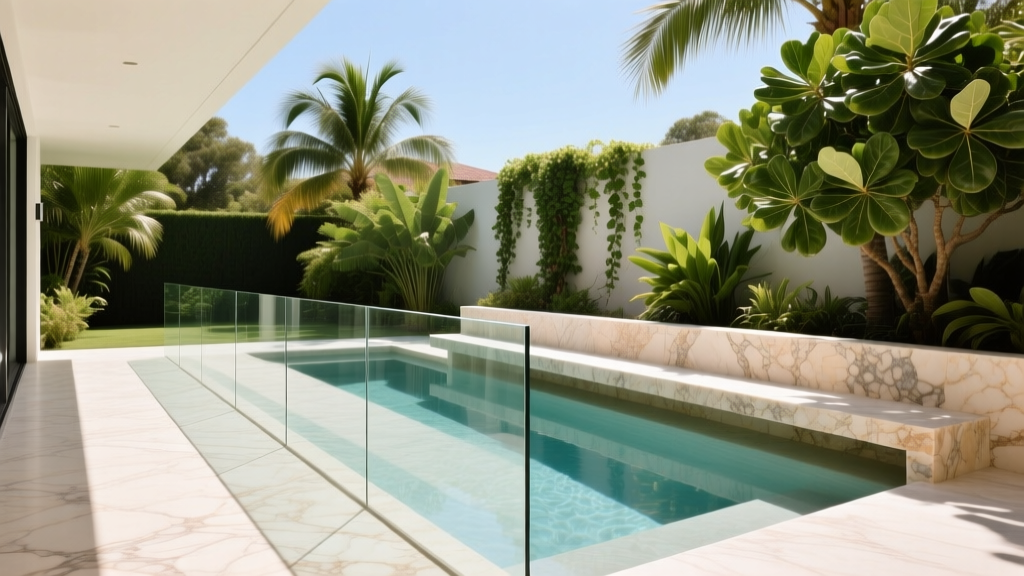
- Optimal Choice: Light-colored Travertine or 20mm Porcelain Pavers. The natural thermal mass and high SRI of these materials keep surface temperatures manageable.
- Avoid: Dark composite decking and stamped concrete. Composite boards in full sun can easily exceed 150°F, causing second-degree burns on contact.
Zone B: Freeze-Thaw & Northern Climates (Midwest, Northeast)
- Primary Threat: Spalling, cracking, and frost heave due to water absorption and freezing.
- Optimal Choice: Air-entrained poured concrete (minimum 4000 PSI with 5-7% air entrainment) or vitrified Porcelain Pavers (water absorption rate of <0.5%).
- Avoid: Natural stone with high porosity (like some sandstones) and mortar-set pavers, which will crack when the substrate shifts during frost heave. Always use a sand-set or pedestal system for pavers in these zones to allow for independent movement.
Zone C: Coastal & Saltwater Environments
- Primary Threat: Chloride-induced corrosion of rebar, salt crystallization, and chemical etching.
- Optimal Choice: Porcelain pavers or exposed aggregate concrete. According to the Natural Stone Institute, dense, non-porous materials resist salt crystallization damage far better than porous alternatives.
- Avoid: Travertine and limestone. These are calcium carbonate-based stones. Saltwater pools generate trace amounts of chlorine gas and acidic splash-out, which will chemically etch and pit the surface of travertine within two to three seasons.
Hidden Costs & Installation Edge Cases
The quoted price per square foot rarely accounts for the complex integration required where the deck meets the pool shell. Budget for these critical edge cases:
1. Coping Integration and Thermal Expansion
The coping (the capstone directly over the pool edge) and the deck must be decoupled. If you pour a concrete deck directly against the pool coping without an isolation joint, the thermal expansion of the deck will push against the pool shell, causing structural cracking. Specification: Always install a 1/2-inch closed-cell polyethylene foam expansion joint between the coping and the deck field. For paver systems, use a flexible polyurethane jointing compound rather than rigid mortar at the coping line.
2. Drainage and Slope Tolerances
Pool decks must slope away from the pool edge to prevent chemically treated splash-out from draining back into the pool, which alters water chemistry and increases filtration loads. Specification: Maintain a strict minimum slope of 1/4 inch per foot (2%) for the first 10 feet away from the pool edge. For large-format porcelain pavers, this requires precise laser-grading of the base aggregate; any deviation will result in birdbaths (standing water) that become slip hazards and algae breeding grounds.
3. The Stamped Concrete Sealer Trap
While stamped concrete offers high visual appeal, the Concrete Network notes that the acrylic sealers required to protect the color and stamp release agents become incredibly slippery when wet. Specification: If you choose stamped concrete, you must broadcast an anti-slip polymer additive (such as SharkGrip or SureCrete SureGrip) into the final coat of sealer. This adds $1.50 to $2.50 per square foot to the initial cost and must be reapplied every time the deck is resealed (every 24 to 36 months).
Final Procurement Strategy
For a zero-compromise, high-traffic residential pool deck in 2026, 20mm vitrified porcelain pavers installed on a pedestal system or compacted aggregate base offer the highest return on investment. They provide the slip resistance of natural stone, the chemical invulnerability of glass, and an SRI high enough to prevent barefoot burns, all while eliminating the resealing costs associated with concrete and natural stone. If budget constraints dictate a concrete solution, opt for a light-colored, exposed aggregate finish with a penetrating siloxane sealer rather than a surface-film acrylic, ensuring long-term traction without the maintenance cycle of stamped alternatives.
Written by
Priya KapoorPriya Kapoor is a real estate market analyst and construction economics researcher with expertise in housing affordability, development feasibility, and infrastructure investment. She holds a Master of Regional Planning from Cornell University and previously worked as a senior analyst at CBRE's Investment Properties group, where she modeled returns for $4B in mixed-use development pipelines. Priya now runs an independent research practice advising developers, municipalities, and REITs on construction cost forecasting and market timing. She publishes the quarterly "BuildMat Market Pulse" report tracking material price indices across 12 commodity categories. Based in Austin, TX, Priya serves on the board of Habitat for Humanity Austin and is a marathon runner.
More from Priya Kapoor
View all
Construction Cost
Cost to Build a 1600 Sq Ft Home in 2026: Full Breakdown
Accurate 2026 cost to build a 1600 sq ft home—material, labor, and regional pricing breakdowns included. Plan your budget with real-time estimates.
Aug 11, 2026

Wood & Lumber
Name the Types of Wood for Pressure Treatment and Preservation
Learn how to name the types of wood best suited for pressure treatment. Compare species treatability, chemical retention levels, and 2026 preservation costs.
Aug 4, 2026

Stone & Masonry
Stone Veneer Suppliers Lindenhurst: 2026 Cost Analysis
Analyze 2026 stone veneer costs in Lindenhurst, NY. Compare local supplier pricing, delivery fees, and Suffolk County installation labor rates.
Aug 4, 2026