Composite Deck Railing Taxonomy: Selecting Core and Cap Materials
Explore the composite deck railing material taxonomy. Compare capped vs. uncapped cores, structural profiles, and 2026 pricing to select the right system.
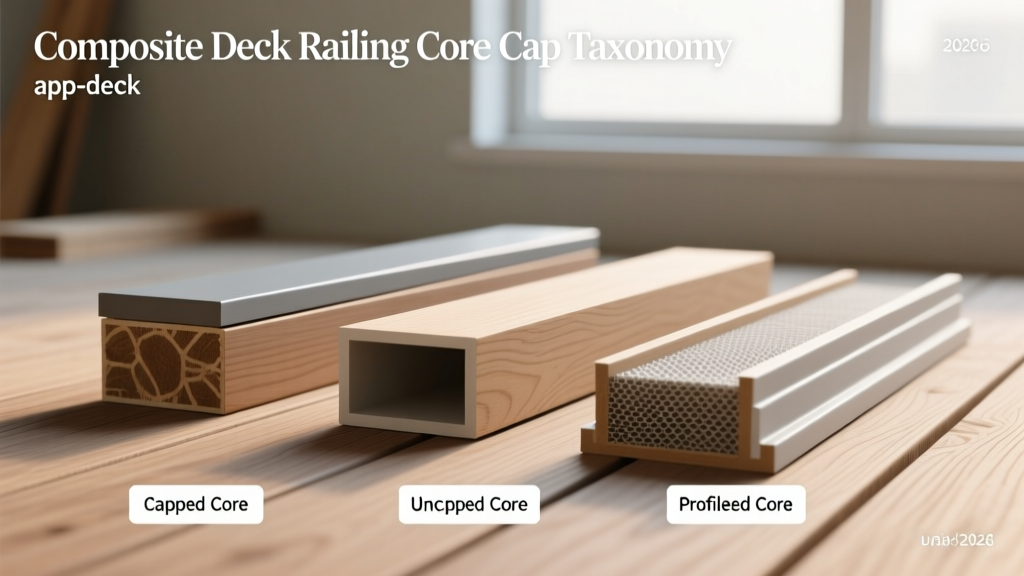
The Material Taxonomy of Composite Deck Railing
Selecting a composite deck railing requires looking past surface colors to understand the underlying chemical and structural taxonomy. Modern composite railings are not a single monolithic material; they are engineered assemblies of wood flour, thermoplastic resins, and coupling agents. The performance, longevity, and structural integrity of the railing depend entirely on the ratio of these components and whether the core is encapsulated by a protective polymer shell.
At the foundational level, the core of a composite railing consists of 40% to 60% wood flour (typically pine or maple sawdust) mixed with a thermoplastic resin matrix. Because wood is hydrophilic (water-attracting) and plastic is hydrophobic (water-repelling), manufacturers must use Maleated Polypropylene (MAPP) or similar coupling agents to bind the two. Without adequate coupling agents, the wood flour separates from the resin over time, leading to microscopic voids that trap moisture, swell, and cause catastrophic structural failure.
Category 1: Fully Capped Composite (Co-Extruded)
Capped composite railings represent the premium tier of the market. During the manufacturing process, a secondary layer of high-density polymer—usually Acrylonitrile Styrene Acrylate (ASA) or rigid PVC—is co-extruded over the wood-plastic core. This cap is typically 1/16 to 1/8 of an inch thick and is heavily loaded with Hindered Amine Light Stabilizers (HALS) and UV inhibitors. The cap completely encapsulates the core, preventing moisture intrusion, mold growth, and UV-induced chalking. Benchmark products in this category include the Trex Transcend and TimberTech Reserve railing lines.
Category 2: Uncapped (Homogeneous) Composite
Uncapped composites feature a through-and-through homogeneous mixture of wood fiber and High-Density Polyethylene (HDPE). While they offer a more natural, matte texture that mimics painted wood, the exposed wood fibers at the surface make them vulnerable to staining from tannins, grease, and organic debris. Uncapped railings require more frequent cleaning and are generally recommended only for covered porches or heavily shaded environments where UV degradation and moisture pooling are minimized.
Category 3: Polyurethane and Fiberglass-Reinforced
A niche but highly structural category, these railings utilize a polyurethane core reinforced with continuous fiberglass strands. They contain zero wood flour, making them completely impervious to rot and insect damage. While technically a distinct material class from traditional wood-plastic composites (WPC), they are frequently merchandised in the composite aisle and offer superior span capabilities without the need for internal metal stiffeners.
| Material Type | Core Resin | Cap / Shell Material | Wood Flour % | Primary Vulnerability |
|---|---|---|---|---|
| Fully Capped (Co-Extruded) | HDPE or Polypropylene | ASA or Rigid PVC | 40% - 50% | Thermal expansion at joints |
| Uncapped (Homogeneous) | HDPE | None (Through-color) | 50% - 60% | Surface staining and mold |
| Fiberglass-Reinforced | Polyurethane / PVC | Acrylic / Polyurethane | 0% | Surface scratching |
Structural Profiles and Load-Bearing Anatomy
The aesthetic profile of a composite top rail—whether flat, rounded, or beveled—dictates its internal structural anatomy. To meet building codes, composite top rails must resist bending under concentrated loads. Manufacturers achieve this through two distinct profile designs:
- Solid Core Profiles: Extruded as a single, dense piece of composite. These are heavy, highly resistant to impact, and naturally meet structural load requirements without secondary reinforcement. However, their weight increases shipping costs and makes on-site cutting labor-intensive.
- Hollow Core Profiles with Internal Stiffeners: To reduce weight and material costs, many modern top rails are extruded with a hollow center. To pass structural testing, these hollow chambers must house a continuous internal aluminum I-beam or a fiberglass reinforcement rod. If the internal stiffener is undersized or terminates short of the post brackets, the rail will sag over a 6-foot span.
Code Compliance: The 4-Inch Sphere and 200-Pound Rules
Regardless of the material taxonomy, all composite deck railings must comply with the International Residential Code (IRC) Section R301.5. The code mandates that guardrails must withstand a concentrated load of 200 pounds applied in any downward or outward direction at any point along the top rail. Furthermore, the intermediate balusters must be spaced closely enough that a 4-inch diameter sphere cannot pass through any opening, a critical safety metric to prevent child entrapment.
When evaluating composite railing systems, verify that the manufacturer has tested the specific assembly—including the exact post sleeve, bracket, top rail, and baluster combination—to the standards outlined in the American Wood Council's DCA 6 Prescriptive Residential Deck Construction Guide. Mixing and matching top rails from one brand with post sleeves from another often voids the structural warranty and fails to meet the 200-pound load requirement due to incompatible bracket geometries. For ongoing safety verification and inspection protocols, contractors and homeowners should consult the North American Decking and Railing Association (NADRA) deck safety guidelines.
The Selection Framework: Matching Profile to Environment
Use this decision framework to select the correct composite railing taxonomy based on your specific project environment:
- Coastal and Saltwater Environments: Select a fully capped composite with a rigid PVC shell. PVC is inherently resistant to salt spray corrosion, whereas exposed HDPE cores can degrade when subjected to continuous salt crystallization in the wood flour voids.
- Heavy Tree Cover and High Humidity: Avoid uncapped composites entirely. The exposed wood fibers will absorb ambient moisture and tannins from falling leaves, leading to rapid black mold growth. Choose a capped composite featuring an integrated antimicrobial surface treatment (e.g., Microban).
- High-Wind and Uplift Zones: Select solid core top rails paired with heavy-gauge aluminum structural post anchors. Hollow-core rails rely heavily on the internal stiffener, which can pull through the composite matrix under extreme lateral wind loads if the bracket screws are over-torqued.
- Commercial and High-Traffic Applications: Opt for fiberglass-reinforced polyurethane railings. They offer superior scratch resistance against heavy equipment, luggage, and high foot traffic compared to traditional wood-plastic composites.
2026 Pricing and Lifetime Cost Analysis
Composite railing pricing has stabilized following the supply chain disruptions of the early 2020s, but premium capped systems command a significant markup over uncapped alternatives. The following table outlines the average installed costs per linear foot (LF) for a standard 36-inch high railing system with square aluminum balusters in 2026.
| System Component | Uncapped Composite | Capped Composite (Premium) |
|---|---|---|
| Post Sleeves & Structural Inserts | $35 - $45 per post | $55 - $85 per post |
| Top Rail (8 ft section) | $60 - $80 per section | $110 - $160 per section |
| Bottom Rail & Baluster Kit | $45 - $65 per section | $75 - $110 per section |
| Professional Installation Labor | $25 - $35 per LF | $35 - $50 per LF |
| Total Estimated Cost (per LF) | $65 - $95 per LF | $115 - $165 per LF |
While the initial capital expenditure for capped composite is up to 75% higher, the lifetime cost analysis heavily favors capped systems. Uncapped composites typically require professional chemical cleaning every two to three years to remove embedded organic stains, adding $3 to $5 per linear foot in ongoing maintenance. Capped systems require only occasional rinsing with a garden hose, effectively reducing the 15-year maintenance cost to near zero.
Installation Edge Cases and Failure Modes
Even the highest-tier capped composite railing will fail if installed without accounting for the material's specific physical properties. The most common field failures stem from three installation errors:
- Screw Mushrooming: Unlike natural wood, composite material does not compress when a fastener is driven into it. If installers use standard wood screws without pre-drilling a clearance hole, the displaced composite material will "mushroom" upward around the screw head, creating an unsightly and sharp burr. Always use manufacturer-specified composite screws with reverse threading near the head, or pre-drill all fastener holes with a 1/8-inch bit.
- Undersized Post Sleeves: Composite post sleeves are non-structural; they are purely aesthetic covers. A common failure mode occurs when builders slide a 4x4 composite sleeve over a standard 4x4 pressure-treated wood post that has warped or twisted. The sleeve will crack at the corners. Always use a true 3.5-inch structural post and ensure it is perfectly plumb before sliding the sleeve over it, securing it with structural adhesive at the base cap.
- Span Deflection: Composite bottom rails are highly susceptible to sagging under the weight of the balusters and snow loads if the span between posts exceeds 6 feet. While the top rail is often reinforced with aluminum, bottom rails are frequently hollow and unreinforced. If your deck design calls for 8-foot post spacing, you must install a hidden steel support rod inside the bottom rail channel to prevent mid-span deflection.
By understanding the precise material taxonomy, structural anatomy, and environmental vulnerabilities of composite deck railings, builders and homeowners can specify systems that deliver both immediate aesthetic impact and multi-decade structural reliability.