Top Boat Deck Material Options Ranked by Durability and Lifespan
Compare top boat deck material options for durability. Discover lifespans, failure modes, and costs for EVA foam, synthetic teak, aluminum, and modified wood.

The Marine Degradation Matrix: Why Standard Decking Fails on Water
Evaluating boat deck material options requires a fundamentally different approach than selecting materials for a residential backyard patio. Marine environments subject decking to a brutal triad of destructive forces: intense UV radiation amplified by water reflection, constant saltwater hydrolysis, and extreme thermal cycling. Standard wood-plastic composites (WPC) that perform well on land frequently delaminate, swell, or suffer core rot when exposed to continuous marine moisture and improper drainage.
To achieve maximum lifespan, marine architects and boat builders select materials based on their resistance to photodegradation, dimensional stability, and galvanic compatibility. Below is a technical breakdown of the most durable boat deck material options available today, ranked by their real-world longevity and failure profiles.
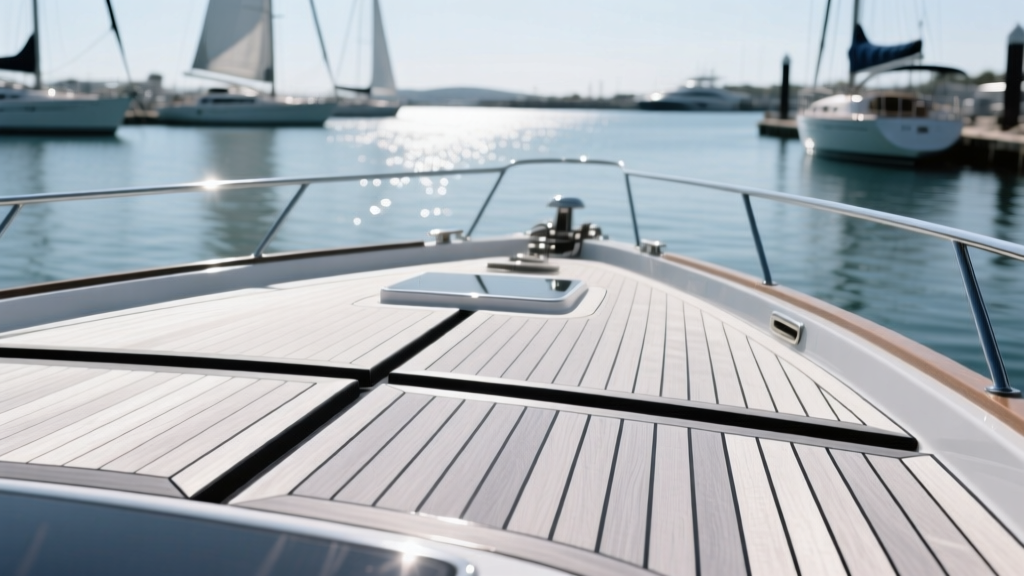
Evaluating Top Boat Deck Material Options by Lifespan
1. Synthetic Teak (Extruded PVC & Polyurethane Blends)
Modern synthetic teak has evolved far beyond early-generation plastics. Premium options like Flexiteek 2G and Esthec utilize advanced UV-inhibited PVC and polyurethane matrices engineered to mimic the grain and warmth of traditional Burmese teak without the biological vulnerabilities.
- Expected Lifespan: 15 to 25 years.
- Cost Range: $14.00 to $22.00 per square foot (fully installed).
- Primary Failure Mode: Heat retention and thermal expansion. Darker synthetic teak colors can reach surface temperatures exceeding 150°F (65°C) in direct midday sun. Furthermore, if installers fail to leave a precise 3mm expansion gap at the perimeter during the marine epoxy bonding process, the material will buckle and separate from the sub-deck.
- Durability Edge: Impervious to rot, mold, and saltwater. Scratches can be sanded out, and the color is consistent throughout the entire thickness of the extrusion.
2. Marine-Grade Aluminum (6061-T6 Alloy)
For commercial workboats, fishing vessels, and modern expedition yachts, marine-grade aluminum is the undisputed champion of structural durability. Specifically, 6061-T6 aluminum alloy offers a yield strength of 40,000 psi while remaining highly resistant to saltwater corrosion when properly anodized or powder-coated.
- Expected Lifespan: 30 to 50+ years (often outlasting the vessel itself).
- Cost Range: $12.00 to $18.00 per square foot.
- Primary Failure Mode: Galvanic corrosion. If aluminum decking is fastened with standard carbon steel or untreated 304 stainless steel hardware without dielectric isolation (such as nylon washers or specialized marine sealants like 3M 5200), it will rapidly pit and corrode.
- Durability Edge: Zero moisture absorption, non-combustible, and requires virtually no maintenance beyond occasional freshwater rinsing. Systems like Craft-Lok feature interlocking extrusions that eliminate the need for surface fasteners, entirely removing corrosion points.
3. Modified Wood (Acetylated and Furfurylated)
For vessel owners who demand the authentic tactile feel and thermal comfort of real wood, chemically modified woods like Accoya (acetylated) and Kebony (furfuryl alcohol modified) have largely replaced endangered, old-growth Burmese teak. The acetylation process alters the wood's cell structure, reducing its equilibrium moisture content and improving dimensional stability by up to 70% compared to untreated hardwoods.
- Expected Lifespan: 25 to 40 years.
- Cost Range: $10.00 to $16.00 per square foot.
- Primary Failure Mode: Surface checking and UV graying. While the structural integrity and rot resistance remain intact for decades, the surface will weather to a silvery patina if not treated annually with specialized marine UV oils (e.g., Rubio Monocoat or Teak Sealer).
- Durability Edge: Swelling and shrinking rates are reduced to below 0.8%, meaning deck caulk lines are far less likely to tear and fail compared to traditional teak decks.
4. Closed-Cell EVA Foam Marine Mats
Ethylene-vinyl acetate (EVA) foam decking, popularized by brands like SeaDek and GatorStep, is a lightweight, shock-absorbent option primarily used on center consoles, swim platforms, and fishing cockpits. It is manufactured with a closed-cell structure that prevents water absorption.
- Expected Lifespan: 5 to 8 years.
- Cost Range: $4.50 to $7.50 per square foot.
- Primary Failure Mode: UV degradation and adhesive failure. Over time, UV exposure breaks down the top layer, causing it to 'chalk' and lose its non-slip texture. Additionally, the pressure-sensitive acrylic adhesives used to bond the foam to the fiberglass sub-deck can crystallize and peel at the seams if exposed to constant high-pressure washdowns.
- Durability Edge: Exceptional fatigue reduction for standing crews and excellent shock absorption, though it offers the shortest structural lifespan of the primary options.
Lifespan vs. Cost Comparison Matrix
| Material Category | Expected Lifespan | Installed Cost (per sq ft) | Heat Retention (Direct Sun) | Maintenance Requirement |
|---|---|---|---|---|
| Marine Aluminum (6061-T6) | 30 - 50+ Years | $12.00 - $18.00 | High (Mitigated by light powder coats) | Very Low |
| Modified Wood (Accoya/Kebony) | 25 - 40 Years | $10.00 - $16.00 | Low (Natural thermal insulation) | Medium (Annual UV oiling) |
| Synthetic Teak (PVC/PU) | 15 - 25 Years | $14.00 - $22.00 | Very High (Requires light colors) | Low (Soap and water) |
| EVA Foam Mats | 5 - 8 Years | $4.50 - $7.50 | Low | Low (Avoid harsh solvents) |
Critical Installation Variables That Dictate Lifespan
Even the most advanced boat deck material options will fail prematurely if the sub-deck preparation and fastening methodologies are flawed. According to standards overseen by ASTM Committee F25 on Ships and Marine Technology, the interface between the decking material and the vessel's core is the most critical point of failure.
When drilling through a fiberglass deck with a balsa or plywood core to install mechanical fasteners, you must 'pot' the holes. This involves over-drilling the hole, removing the core material, and filling the cavity with thickened marine epoxy before drilling the final pilot hole. This prevents water from migrating into the sub-deck core, which is the leading cause of catastrophic deck rot in marine vessels.
Fastener and Adhesive Selection
For mechanical fastening, always specify 316L stainless steel or silicon bronze hardware. 316L contains higher molybdenum than standard 304 stainless, providing superior resistance to pitting in chloride (saltwater) environments. For synthetic teak and EVA foam installations, marine-grade adhesives must be flexible enough to accommodate the differing thermal expansion rates of the decking and the fiberglass hull. Polyurethane-based marine sealants or specialized two-part marine epoxies are mandatory; standard construction adhesives will become brittle and shatter under hull flexing.
Decision Framework: Matching Material to Vessel Application
Selecting the right material requires balancing the vessel's operational profile with the owner's maintenance tolerance. Use this framework to finalize your specification:
- For Commercial Workboats & Expedition Yachts: Specify Marine-Grade Aluminum. The priority is structural longevity, fire resistance, and zero maintenance. The aesthetic is secondary to the 50-year lifecycle and load-bearing capacity.
- For Luxury Motor Yachts & Cruisers: Specify Synthetic Teak (Light Grey/Oyster). This provides the high-end aesthetic demanded in the luxury market without the annual sanding and oiling labor costs associated with real wood. Light colors are mandatory to prevent barefoot burns.
- For Classic Restorations & Sailing Yachts: Specify Modified Wood (Kebony/Accoya). Purists and traditionalists require the authenticity, thermal comfort, and weight characteristics of real wood, but modified wood provides the dimensional stability required to keep modern polyurethane deck caulking intact.
- For Center Consoles, Skiffs & Swim Platforms: Specify EVA Foam. The priority is lightweight performance, shock absorption for anglers, and cost-effectiveness, accepting that the material will need replacement every 5 to 8 years.
For further reading on marine maintenance protocols and material degradation, the BoatUS Magazine archives provide extensive real-world case studies on deck core repairs and synthetic material performance over time. Additionally, reviewing technical data sheets from manufacturers like Flexiteek will provide exact thermal expansion coefficients necessary for your specific installation climate.
Written by
Elena RodriguezElena Rodriguez is a civil engineer and technical writer specializing in concrete technology, masonry systems, and ASTM/ACI compliance. She earned her B.S. in Civil Engineering from Texas A&M University and spent a decade at a materials testing laboratory, performing over 2,000 concrete compressive strength tests and masonry prism evaluations. Elena is an ACI-certified Field Testing Technician (Grade I) and a member of ASTM Committee C12 on Natural Building Stone. She currently consults on forensic engineering cases involving concrete failures and moisture intrusion. Based in San Antonio, TX, Elena is a proud member of the Society of Women Engineers (SWE) and coaches her daughter's FIRST Robotics team.
More from Elena Rodriguez
View all
Walls & Panels
Cost Analysis: Light Gauge Steel Framing Advantages and Disadvantages
Evaluate light gauge steel framing advantages and disadvantages through a strict cost analysis lens, comparing material, labor, and lifecycle expenses.
Aug 4, 2026

Walls & Panels
Gypsum Board Types: Exact Specifications, Thickness & Dimensions
Compare standard, Type X, and moisture-resistant gypsum board types. Get exact specifications, thicknesses, dimensions, and ASTM standards for your project.
Aug 4, 2026

Fire Resistance
Best Fire-Resistant Outdoor Decking Materials: 2026 Buyer Guide
Discover the best fire-resistant outdoor decking materials for 2026. Compare Class A PVC, aluminum, and hardwood options for WUI compliance and safety.
Aug 4, 2026