Best Pool Deck Materials That Stay Cool Underfoot Compared
Compare the best pool deck materials that stay cool underfoot. Expert analysis of travertine, PVC, Kool Deck, and porcelain with SRI data and costs.
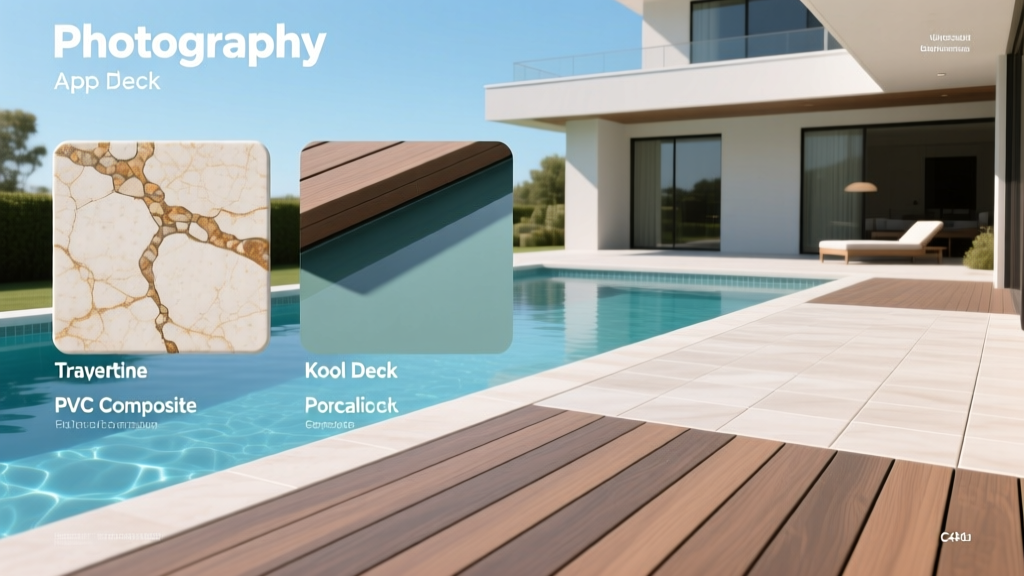
The Physics of Cool Decking: SRI and Thermal Effusivity
When evaluating pool deck materials that stay cool, surface color is only half the equation. The thermal performance of a decking material is dictated by two primary metrics: Solar Reflectance Index (SRI) and thermal effusivity. SRI measures a material's ability to reject solar heat, combining both reflectance (how much light bounces off) and emittance (how well it radiates absorbed heat). According to the Environmental Protection Agency's guidelines on cool pavements, materials with an SRI of 29 or higher are classified as 'cool' and significantly reduce surface temperatures.
Thermal effusivity, meanwhile, dictates how quickly a material transfers heat to your skin. A material with low thermal effusivity (like natural stone with high porosity) will feel cooler to the touch than a dense material (like standard concrete) even if both are at the exact same ambient temperature. Understanding this intersection is critical for selecting a pool deck that won't cause contact burns on a 95°F summer day.
Head-to-Head Comparison Matrix
The following data reflects peak surface temperatures recorded on a 95°F day with direct, unshaded solar exposure. Costs represent fully installed averages for 2026.
| Material | Peak Surface Temp | SRI Value | Installed Cost (per sq.ft.) | Barefoot Comfort Rating |
|---|---|---|---|---|
| Cross-Cut Travertine | 102°F - 108°F | 35 - 45 | $18 - $28 | Excellent |
| Acrylic Coated Concrete (Kool Deck) | 100°F - 105°F | 40 - 50 | $8 - $12 (overlay) | Excellent |
| Capped PVC (CoolDeck Tech) | 115°F - 122°F | 25 - 32 | $22 - $32 | Good |
| Light-Toned Porcelain Pavers | 118°F - 125°F | 30 - 40 | $20 - $30 | Fair to Good |
| Standard Wood-Plastic Composite | 140°F - 155°F | 10 - 15 | $16 - $24 | Poor (Burn Hazard) |
Deep Dive: Top Pool Deck Materials That Stay Cool
1. Cross-Cut Travertine Pavers (The Natural Standard)
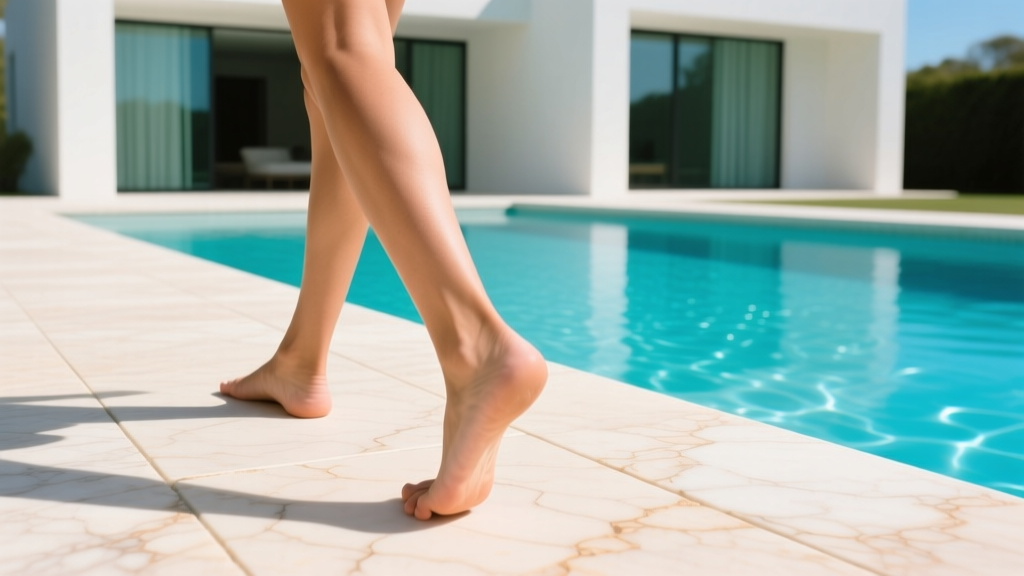
Travertine is a dense, calcium-carbonate stone riddled with microscopic pores. These pores act as natural thermal breaks, giving the stone a low thermal effusivity. When sourcing travertine for a pool deck, you must specify cross-cut rather than vein-cut. Cross-cutting slices the stone against the natural bedding plane, resulting in a uniform, mottled surface without the long, deep fissures that trap dirt and catch bare toes.
- Optimal Finish: Tumbled or honed. Avoid polished travertine, which becomes dangerously slippery when wet and increases solar glare.
- Sealing Protocol: Do not use film-forming acrylic sealers; they trap heat and create a slick surface. Use a non-film-forming penetrating sealer like Tenax Ager or Miracle Sealants 511 Impregnator. This enhances the color without altering the stone's natural thermal properties or slip resistance.
- Color Selection: Ivory, Noce, or Silver. Lighter Ivory yields an SRI near 45, keeping surface temps roughly 30°F cooler than standard gray concrete.
2. Acrylic-Modified Cementitious Coatings (Kool Deck Systems)
Often mistakenly referred to as 'painted concrete,' true Kool Deck (originally developed by Mortex) is a cementitious topping mixed with an acrylic polymer. It is applied as a thick, splatter-textured slurry over freshly poured or properly prepped existing concrete. The textured surface reduces the actual contact area between the deck and the bottom of your foot, while the light-colored acrylic polymers reflect UV radiation.
While highly effective at reducing temperatures to around 100°F on hot days, acrylic coatings require resealing every 2 to 3 years with a compatible acrylic concrete sealer to prevent UV degradation and chipping from dropped pool toys or heavy furniture.
3. Capped PVC with Heat-Reflective Technology
Standard wood-plastic composite (WPC) decking is notorious for absorbing heat, often reaching 150°F in direct sun due to the wood flour mixed into the core. If you want the aesthetic of wood without the burn hazard, you must specify 100% capped PVC featuring engineered heat-reflective pigments. The AZEK Vintage PVC Collection, for example, utilizes proprietary CoolDeck technology that optimizes the infrared reflectance of the polymer cap, keeping boards up to 30% cooler than standard composites.
- Color Constraint: You are limited to lighter, desaturated tones (e.g., Landmark Oak, French White Oak). Darker hues like Mahogany or English Walnut will defeat the heat-reflective pigments and still reach uncomfortable temperatures.
- Framing Consideration: PVC expands and contracts significantly more than wood or stone. Joists must be spaced at a maximum of 12 inches on center (OC) to prevent sagging, and gapping requirements must be strictly followed based on the installation day's temperature.
4. Light-Toned Porcelain Pavers (20mm Thickness)
Porcelain is fired at extreme temperatures, resulting in a nearly impervious, highly dense material. Because it lacks the microscopic pores of travertine, its thermal effusivity is higher, meaning it will transfer heat to your skin faster than natural stone. However, modern 20mm exterior porcelain pavers manufactured in light 'Bianco' or 'Travertino' finishes boast excellent SRI values (often 35+).
Porcelain is the ultimate low-maintenance option. It will never effloresce, it is impervious to pool chlorine and saltwater corrosion, and it requires zero sealing. To maximize barefoot comfort, select pavers with a matte, anti-slip finish (rated R11 or higher for wet areas) and install them over a permeable sand-set base rather than a mortar bed, which can trap and radiate additional heat.
Avoid using bluestone, slate, or dark flagstone around a pool. Despite being natural materials, their low albedo causes them to absorb massive amounts of solar radiation. Dark bluestone can easily exceed 145°F in mid-July, making it functionally identical to dark asphalt in terms of barefoot comfort.
Substrate and Installation Nuances for Thermal Performance
The material you walk on is only the top layer. The substrate beneath it heavily influences the overall thermal mass of the deck.
- Sand-Set vs. Mortar-Set: For pavers (travertine and porcelain), a sand-set installation over a compacted aggregate base is thermally superior to a mortar-set installation over a concrete slab. The air gaps within the sand and gravel base act as an insulating layer, preventing the earth's stored heat from radiating upward through the pavers.
- Concrete Slab Color: If you are pouring a new concrete slab to receive a Kool Deck or acrylic coating, request a light gray or white cement mix rather than standard dark gray. The Lawrence Berkeley National Laboratory notes that the base color of concrete significantly impacts the overall SRI, even when coated, as thin acrylic coatings can become slightly translucent under intense UV exposure over time.
- Drainage Slope: Pool decks must maintain a minimum slope of 1/4 inch per foot away from the pool coping. Standing water on a hot deck will rapidly heat up and degrade certain acrylic sealers, while also creating a severe slip hazard.
Expert Verdict: Which Should You Choose?
Selecting the right pool deck material that stays cool requires balancing your budget, maintenance tolerance, and aesthetic preferences:
- Choose Cross-Cut Travertine if you want the absolute best barefoot comfort, a premium natural aesthetic, and have the budget for a $20+ per sq.ft. installation. It is the gold standard for luxury pool environments.
- Choose Acrylic Coated Concrete (Kool Deck) if you are retrofitting an existing concrete pool deck on a budget. At $8 to $12 per sq.ft. for an overlay, it offers the highest temperature reduction per dollar spent, provided you commit to resealing it every few years.
- Choose Capped PVC (AZEK Vintage) if you are building an elevated pool deck or want a wood-grain aesthetic without the splinters and heat retention of traditional composites. It is ideal for raised pools where stone pavers would be too heavy.
- Choose 20mm Porcelain Pavers if you are installing a saltwater pool or live in a climate with severe freeze-thaw cycles. Its zero-porosity ensures it will never spall, crack, or degrade from chemical exposure, making it the most durable long-term investment.
Written by
James ThorntonJames Thornton is a construction industry veteran with 25 years of hands-on experience in wood framing, lumber grading, and residential building codes. He started as a framing carpenter in rural Oregon, earned his ICC Residential Building Inspector certification, and eventually became a senior plan reviewer for the City of Portland Bureau of Development Services. James holds a B.S. in Wood Science & Technology from Oregon State University and is a certified lumber grader through the West Coast Lumber Inspection Bureau (WCLIB). He has inspected over 3,000 residential construction sites and authored the city's internal guide on advanced framing techniques (2x6 at 24" O.C.). James lives in Bend, OR, where he builds custom timber-frame cabins and competes in lumberjack sports.
More from James Thornton
View all
Insulation
Best Home Insulation Materials: Complete 2026 Guide
Compare top home insulation materials for 2026. Find R-values, installed costs per square foot, and best uses for fiberglass, spray foam, and mineral wool.
Aug 4, 2026

Sustainable Building
Certify Your Green Building Material for LEED and WELL
Step-by-step guide to certifying a green building material for LEED v5 and WELL v2. Master EPDs, HPDs, and VOC limits for 2026 project specifications.
Aug 4, 2026

Stone & Masonry
Veneer Stacked Stone Panels: Interior Design & Style Showcase
Discover how veneer stacked stone panels transform interiors. Explore modern design profiles, material pairings, and technical installation specs.
Aug 4, 2026