How Much Does It Cost to Build a Patio? 2026 Guide
Discover exactly how much it costs to build a patio in 2026. Detailed breakdowns for concrete, pavers, and flagstone, including labor and hidden site fees.
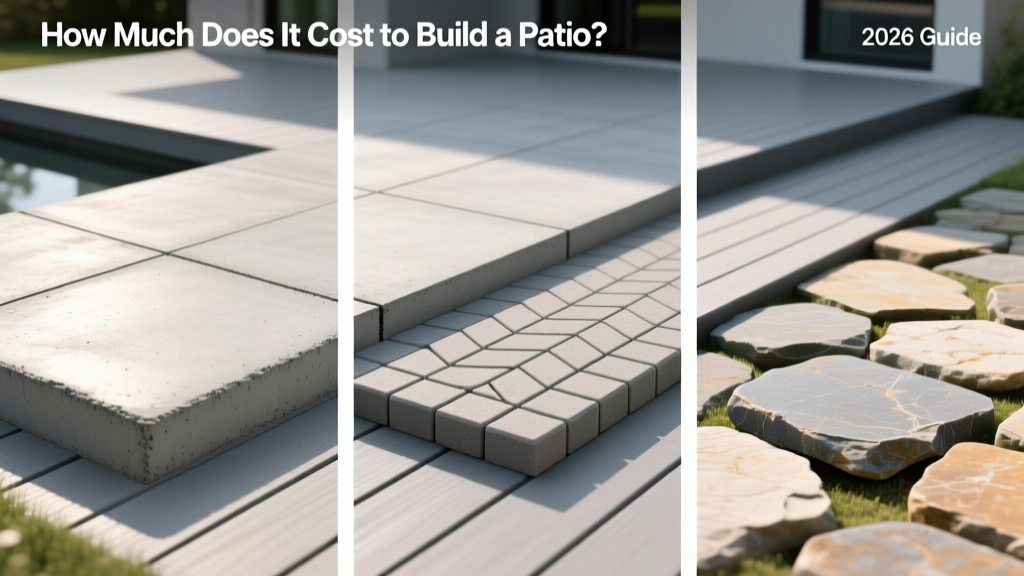
The national average to build a patio in 2026 ranges from $3,200 to $8,500, with most homeowners spending between $12 and $35 per square foot for professional installation. However, quoting a flat average obscures the massive cost disparities driven by material selection, soil conditions, and site accessibility. A basic broom-finished concrete slab operates on an entirely different pricing tier than a dry-laid natural flagstone terrace requiring extensive subgrade stabilization.
This cost breakdown deconstructs the exact material, labor, and hidden site-preparation expenses you will encounter, providing the technical specifications needed to evaluate contractor bids accurately.
2026 Patio Cost Snapshot by Material
Material selection dictates 40% to 60% of your total budget. The table below outlines the installed cost per square foot, factoring in standard base preparation and professional labor.
| Material Type | Material Cost (Per Sq Ft) | Installed Cost (Per Sq Ft) | Expected Lifespan | Maintenance Requirement |
|---|---|---|---|---|
| Poured Concrete (Broom Finish) | $4 - $7 | $10 - $16 | 25 - 30 Years | Low (Annual sealing) |
| Stamped / Colored Concrete | $8 - $14 | $18 - $28 | 25 - 30 Years | Medium (Resealing every 2 yrs) |
| Concrete Pavers | $3 - $8 | $14 - $22 | 40 - 50 Years | Medium (Weeding, sand topping) |
| Clay Brick Pavers | $6 - $12 | $18 - $30 | 50+ Years | Low |
| Natural Flagstone (Dry-set) | $15 - $25 | $30 - $45 | 50+ Years | Low |
| Decomposed Granite / Gravel | $1 - $3 | $6 - $12 | 10 - 15 Years | High (Raking, topping up) |
Deconstructing Labor and Site Preparation Costs
Amateur budgets often focus entirely on the surface material, ignoring the subgrade. According to HomeGuide's 2026 landscaping cost data, site preparation accounts for 20% to 30% of the total project cost. If your soil is expansive clay or the site has a severe slope, these costs will scale rapidly.
Excavation and Grading
- Standard Excavation: $2 to $4 per square foot. This involves removing 6 to 10 inches of topsoil to reach stable subgrade.
- Slope Correction & Retaining: If your yard slopes more than 2 inches per 10 feet, you will need cut-and-fill grading ($3 to $6 per square foot) or a timber/segmental retaining wall ($25 to $45 per square foot of wall face) to hold back the earth.
- Haul Away: Dirt removal costs $150 to $250 per dump truck load. A 400-square-foot patio requiring an 8-inch excavation generates roughly 15 cubic yards of soil, necessitating two truckloads.
The Base Aggregate Layer
For pavers and natural stone, the base is the structural foundation. The Interlocking Concrete Pavement Institute (ICPI) mandates a minimum 4-to-6-inch layer of compacted, angular aggregate (typically 3/4-inch minus crushed rock) for pedestrian patios. In regions with heavy frost heave or poorly draining clay soils, this base must be increased to 8 to 10 inches, and a non-woven geotextile fabric ($0.40 per square foot) must be laid beneath the aggregate to prevent clay migration.
Material Deep Dive: Technical Specifications and Pricing
Poured Concrete Patios
A standard concrete patio requires a minimum 3000 PSI mix, though 4000 PSI is strongly recommended for climates with freezing winters to resist spalling. The slab should be poured at a 4-inch thickness over a 4-inch compacted gravel base.
- Reinforcement: Welded wire mesh (6x6 W1.4xW1.4) costs about $0.50 per square foot, while a #3 (3/8-inch) rebar grid spaced at 18 inches on center costs $1.25 per square foot. Rebar is vastly superior for preventing structural cracking.
- Control Joints: Contractors must cut control joints every 10 to 12 feet to guide inevitable shrinkage cracking. Ensure your bid includes saw-cutting rather than relying solely on hand-tooled joints, which are often too shallow to be effective.
Concrete and Clay Pavers
Paver pricing is heavily influenced by the laying pattern. A simple running bond pattern is the cheapest to install. Complex patterns like herringbone or circular cobblestone require 10% to 15% more material due to edge cuts and increase labor time by up to 30%.
- Bedding Sand: A 1-inch layer of coarse, sharp concrete sand (never masonry or play sand) is screeded over the base.
- Edge Restraint: This is non-negotiable. Without a rigid plastic or aluminum edge restraint spiked into the base every 12 inches, the perimeter pavers will migrate outward, destroying the interlocking friction. Budget $4 to $7 per linear foot for professional-grade restraint installation.
- Jointing Sand: Standard polymeric sand costs $35 to $50 per 50-lb bag, covering roughly 60 to 80 square feet. It hardens when wet, locking the pavers and preventing weed growth.
The Hidden Cost Drivers That Blow Up Budgets
- Tree Root Excavation: Cutting through roots larger than 3 inches in diameter to level a patio can cost $200 to $500 per root and may require an arborist's consultation to prevent killing the tree.
- Drainage Integration: If the patio butts against the home's foundation, a French drain or channel drain ($40 to $70 per linear foot) must be integrated to prevent water from pooling against the siding and causing basement leaks.
- Utility Rerouting: Relocating existing sprinkler lines, gas lines for a fire pit, or low-voltage lighting cables beneath the patio footprint typically costs $500 to $1,200 depending on the complexity.
- Permits and HOA Fees: Municipal permits for impervious surface expansion range from $75 to $250. HOAs may require specific material approvals or architectural review fees ($100 to $300).
Size Multipliers and Economies of Scale
The cost per square foot decreases as the total square footage increases. Fixed costs like equipment mobilization, concrete truck minimum delivery fees, and permit acquisition are amortized over a larger area.
- Small Patio (100 - 200 sq ft): $25 - $45 per sq ft. (High cost per sq ft due to concrete truck minimums and equipment rental flat rates).
- Medium Patio (300 - 500 sq ft): $16 - $28 per sq ft. (The sweet spot for standard residential backyards).
- Large Terrace (600 - 1,000+ sq ft): $12 - $22 per sq ft. (Bulk material discounts and continuous labor flow reduce the per-unit price).
Professional Installation vs. DIY: The Real Delta
According to Bob Vila's outdoor construction guides, DIY patio installation can save 40% to 60% on labor, but the margin for error on base compaction is unforgiving. If you choose the DIY route for a paver patio, factor in the following equipment rentals:
- Vibratory Plate Compactor: $85 to $120 per day. (Required for both the base aggregate and the final paver surface).
- Concrete Saw / Block Splitter: $60 to $90 per day for cutting edge pavers.
- Laser Level and Transit: $45 per day to ensure the mandatory 1/4-inch per foot slope away from the house for drainage.
For poured concrete, DIY is strongly discouraged for slabs larger than 10x10 feet. Concrete sets rapidly, and managing the screeding, floating, and troweling phases before the slab cures requires a coordinated crew of at least three people.
Frequently Asked Questions
Does a patio add value to a home's resale price?
Yes, but with diminishing returns. A well-constructed patio typically yields a 50% to 75% return on investment at resale. Appraisers view it as an enhancement to the outdoor living space, but they will penalize the valuation if the patio lacks proper drainage or shows signs of frost heave and settling.
What is the cheapest patio material to install?
Decomposed granite (DG) or crushed gravel is the cheapest upfront, costing $6 to $12 per square foot installed. However, it requires annual raking and topping up, and it is difficult to clear snow from or place heavy patio furniture on without sinking.
How thick does a concrete patio need to be?
A standard residential patio requires a 4-inch slab thickness. If you plan to place exceptionally heavy loads on it, such as a built-in masonry outdoor kitchen, a pizza oven, or a hot tub, the slab must be thickened to 6 inches and reinforced with a heavy rebar grid to prevent differential settling.
Written by
David NakamuraDavid Nakamura is a licensed architect (AIA) and construction technology writer focused on sustainable building methods, mass timber engineering, and high-performance building envelopes. He holds a Master of Architecture from the University of Washington and is a certified Passive House Consultant (CPHC). David spent eight years at the Seattle firm Mithun, where he led the design of three LEED Platinum projects, before founding his own practice specializing in net-zero residential design. He serves on the editorial advisory board of GreenBuilder Magazine and has authored peer-reviewed papers on cross-laminated timber (CLT) connections for the Journal of Structural Engineering. In his spare time, David teaches woodworking at Pratt Fine Arts Center and kayaks the Puget Sound.
More from David Nakamura
View all
Construction Cost
Labor Cost to Build a Deck Per Sq Ft: 2026 Installation Guide
Discover the exact labor cost to build a deck per sq ft in 2026. This installation guide breaks down contractor rates, complexity factors, and hidden fees.
Aug 4, 2026

Construction Cost
How Much Does It Cost to Build a 3 Bedroom House? Financing Guide
Learn exactly how much it costs to build a 3 bedroom house and explore 2026 financing options, construction loan types, and budget frameworks for your build.
Aug 4, 2026

Construction Cost
Cost to Build a Tennis Court: 2026 Guide
How much does it cost to build a tennis court in 2026? Breakdowns for asphalt, concrete, and synthetic surfaces plus fencing and lighting.
Jul 30, 2026