Installing Deck Materials Barnstable Contractors Use for Coastal Homes
Master the installation of deck materials in Barnstable. Learn coastal framing, 316 stainless fastening, and PVC decking techniques for Cape Cod homes.

Navigating Barnstable's Coastal Building Environment
Building a deck in Barnstable, Massachusetts, requires more than standard carpentry; it demands a rigorous understanding of coastal degradation. Situated on Cape Cod, Barnstable properties face relentless salt spray, high-humidity Nor'easters, and severe freeze-thaw cycles. Standard pressure-treated pine and basic galvanized hardware will fail rapidly in this microclimate. As of 2026, the installation of premium deck materials in this region requires strict adherence to marine-grade fastening protocols and advanced moisture-management framing techniques.
According to the FEMA Coastal Construction Manual (P-55), structures within 3,000 feet of the coastline must account for accelerated corrosion rates that are up to four times faster than inland environments. This guide details the exact materials, structural framing methods, and fastening schedules required to install a code-compliant, long-lasting deck in Barnstable.
Material Selection Matrix for Cape Cod Homes
Wood decking is largely obsolete for direct oceanfront properties in Barnstable due to the maintenance burden of salt and UV exposure. The market has shifted heavily toward cellular PVC and capped polymer composites. Below is a comparison of the top-performing materials for coastal installations.
| Material Brand & Line | Type | Salt/UV Resistance | 2026 Material Cost (per sq. ft.) | Best Application |
|---|---|---|---|---|
| AZEK Vintage (Landmark) | Cellular PVC | Exceptional (No wood fibers) | $10.50 - $13.00 | Direct oceanfront, dockside |
| Fiberon Paramount PVC | Cellular PVC | Exceptional (Micro-dome texture) | $9.50 - $11.50 | High-traffic coastal patios |
| Trex Transcend Lineage | Capped Composite | High (Contains wood fibers in core) | $8.50 - $10.50 | Sheltered coastal yards, inland Barnstable |
| Wahoo Decks (AridDek) | Marine Aluminum | Superior (Powder-coated extruded) | $14.00 - $17.00 | Over-water docks, flat-roof deck drainage |
Pre-Installation: Marine-Grade Framing and Flashing
The most common failure point in coastal deck construction is not the decking itself, but the substructure. Barnstable's salt air will corrode standard galvanized joist hangers within three to five years, leading to catastrophic structural failure.
1. Lumber Selection and Treatment
For the substructure, specify UC4B (Ground Contact, Heavy Duty) pressure-treated Southern Yellow Pine for any joists or beams within 18 inches of the soil or sand. For elevated structures further from the ground, UC4A is acceptable. However, the treatment chemicals (copper azole or ACQ) are highly corrosive to standard metals.
2. The 316 Stainless Steel Mandate
Do not use Simpson Strong-Tie ZMAX (G185 galvanized) or even 304-grade stainless steel for direct oceanfront properties in Barnstable. You must specify Type 316 Stainless Steel hardware. Type 316 contains molybdenum, which specifically resists chloride (salt) pitting. Use Simpson Strong-Tie's 316 SS line for all joist hangers, tension ties, and structural screws.
3. Joist Tape and Moisture Management
Before laying a single deck board, apply a high-butyl joist tape (such as G-Tape or Trex Protect) to the top of every joist and beam. This prevents saltwater from pooling on the horizontal wood surfaces, which is the primary cause of substructure rot in coastal environments. Ensure the tape wraps over the edges of the joists by at least 1/4 inch to seal the end-grain of any fastener penetrations.
Step-by-Step Deck Board Installation Protocol
Follow this precise sequence to ensure warranty compliance and structural integrity in high-wind zones.
- Acclimate the Material: Store PVC or composite boards on-site in Barnstable for at least 48 hours prior to installation, keeping them shaded and off the ground. This allows the core temperature of the boards to equalize with the ambient coastal air.
- Establish the Starter Line: Use a chalk line to mark your first board. For coastal installations, maintain a strict 1/4-inch gap between the decking and the house siding to allow wind-driven rain and salt spray to wash through, preventing moisture entrapment against the home's weather-resistant barrier.
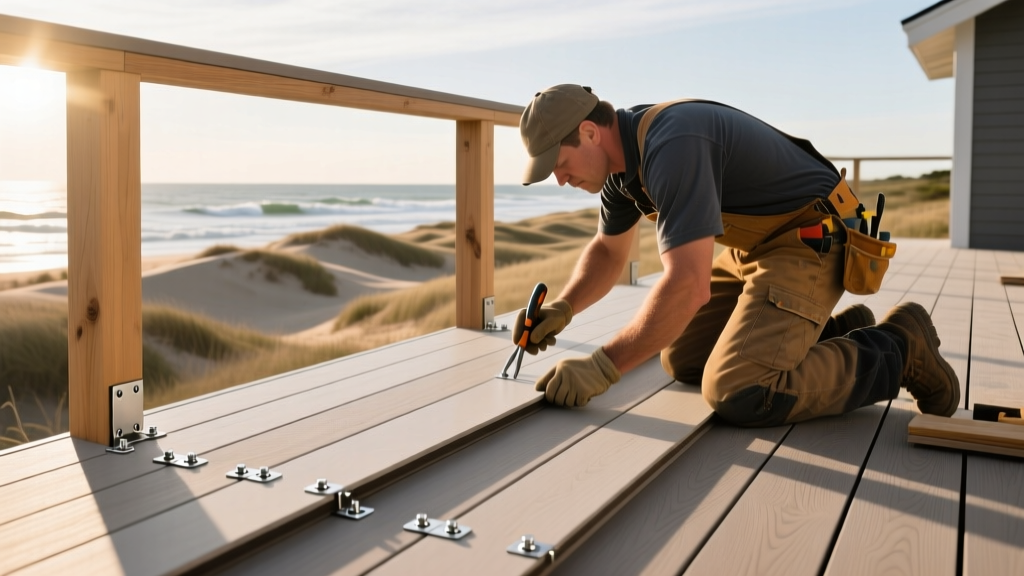
- Hidden Fastener Engagement: Use manufacturer-approved hidden fastening systems (e.g., AZEK Concealoc or Trex Universal). Drive the stainless steel starter screws at a precise 45-degree angle. Warning: Do not use standard carbon-steel screws provided in some generic fastener kits; swap them immediately for 316 SS screws.
- Manage the Gaps: Maintain a consistent 3/16-inch side-to-side gap between boards. In Barnstable's humid summers, this gap allows for adequate drainage of heavy Nor'easter rainfall and prevents mold spores from taking root in tight, shaded crevices.
- Picture-Framing the Perimeter: Because PVC boards can have slight color variations at the cut ends, use picture-framing (fascia boards) around the perimeter. Miter the corners at 45 degrees and use color-matched PVC shiplap glue (like AZEK Fusion) combined with 316 SS trim screws to lock the joints against 115 mph wind uplift.
Barnstable Permitting and Code Compliance
Before breaking ground, you must navigate local regulatory frameworks. The Barnstable Building Division requires standard building permits for decks over 30 inches in height. However, coastal properties often trigger additional reviews.
- Conservation Commission: If your property is within 100 feet of a coastal bank, salt marsh, or beach (Buffer Zone), you must file a Notice of Intent (NOI) with the local Conservation Commission under the Massachusetts Wetlands Protection Act.
- Cape Cod Commission: While the Cape Cod Commission regulatory framework primarily handles large-scale developments, any deck project that significantly alters the footprint of a home in a designated historic district (like Barnstable Village) may require a Certificate of Appropriateness.
- Footings in Sand: Standard 12-inch sonotube footings are often insufficient in Barnstable's sandy, shifting soils. The AWC Prescriptive Residential Deck Construction Guide recommends helical piles or bell-bottom footings poured below the 48-inch frost line to prevent winter frost heave from lifting the deck structure.
Frequently Asked Coastal Installation Questions
Can I use composite decking directly over a flat rubber roof in Barnstable?
Yes, but you must use a pedestal paver system (like Bison Pedestals) rather than attaching sleepers directly to the EPDM or TPO membrane. Pedestal systems allow for unrestricted water drainage and airflow, which is critical to preventing membrane degradation from trapped saltwater and UV reflection.
How do I remove salt stains from PVC decking after a winter storm?
Cellular PVC is highly resistant to salt etching. Mix a solution of warm water and a mild, non-abrasive detergent (like Dawn dish soap). Use a soft-bristle nylon brush to agitate the surface, and rinse thoroughly with fresh water. Never use a pressure washer above 1,300 PSI, as it will scar the cellular foam core and create micro-grooves where future dirt and salt will accumulate.
Are glass railings code-compliant for oceanfront decks here?
Tempered or laminated glass railings are code-compliant and highly recommended for Barnstable oceanfront homes to preserve ocean views. However, ensure the glass is set in marine-grade aluminum or 316 stainless steel channels. The hardware holding the glass must be rated for the same 115 mph wind loads as the deck structure itself, and the glass must feature a protective anti-spall coating to resist micro-scratching from wind-blown beach sand.
Written by
Priya KapoorPriya Kapoor is a real estate market analyst and construction economics researcher with expertise in housing affordability, development feasibility, and infrastructure investment. She holds a Master of Regional Planning from Cornell University and previously worked as a senior analyst at CBRE's Investment Properties group, where she modeled returns for $4B in mixed-use development pipelines. Priya now runs an independent research practice advising developers, municipalities, and REITs on construction cost forecasting and market timing. She publishes the quarterly "BuildMat Market Pulse" report tracking material price indices across 12 commodity categories. Based in Austin, TX, Priya serves on the board of Habitat for Humanity Austin and is a marathon runner.
More from Priya Kapoor
View all
Construction Cost
Cost to Build a 1600 Sq Ft Home in 2026: Full Breakdown
Accurate 2026 cost to build a 1600 sq ft home—material, labor, and regional pricing breakdowns included. Plan your budget with real-time estimates.
Aug 11, 2026

Wood & Lumber
Name the Types of Wood for Pressure Treatment and Preservation
Learn how to name the types of wood best suited for pressure treatment. Compare species treatability, chemical retention levels, and 2026 preservation costs.
Aug 4, 2026

Stone & Masonry
Stone Veneer Suppliers Lindenhurst: 2026 Cost Analysis
Analyze 2026 stone veneer costs in Lindenhurst, NY. Compare local supplier pricing, delivery fees, and Suffolk County installation labor rates.
Aug 4, 2026