Floating Deck Materials Compared: Wood, Composite, and PVC
Compare the best floating deck materials. We break down costs, durability, and installation for wood, composite, and PVC decking systems.

The Engineering Challenge of Floating Decks
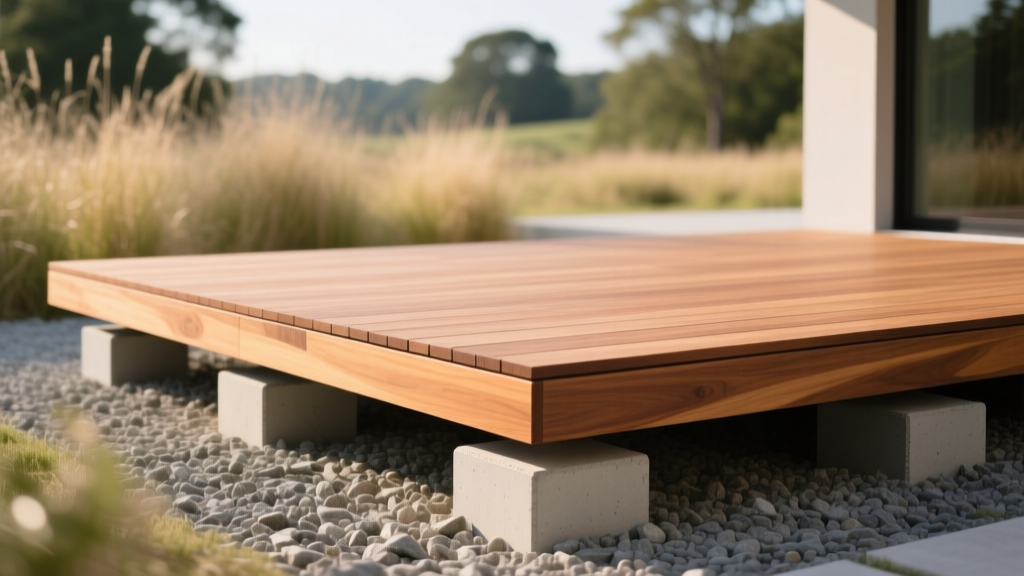
Floating decks—freestanding structures typically resting on concrete deck blocks or gravel pads less than 24 inches above grade—present a unique microclimate challenge. Because the underside clearance is so low, cross-ventilation is severely restricted. Ground moisture evaporates and becomes trapped beneath the deck, while the top surface is exposed to direct UV radiation and thermal cycling. This creates a severe moisture and temperature gradient across the thickness of the decking board.
If the chosen material lacks dimensional stability, this gradient causes differential expansion and contraction, leading to cupping, warping, and fastener pop. Selecting the right floating deck materials is not just about aesthetics; it is about mitigating the physics of low-clearance moisture traps. Below, we compare the three primary material categories based on their performance in these specific conditions.
Floating Deck Materials Comparison Matrix
| Material Category | Required Specification | Avg. Material Cost (2026) | Water Absorption Rate | Thermal Expansion (per 10ft / 10°F) | Min. Recommended Clearance |
|---|---|---|---|---|---|
| Pressure-Treated Pine | UC4B Ground Contact, KDAT | $3.50 - $5.50 / sq ft | 15% - 25% (Varies by moisture) | Negligible (Swells instead) | 18 inches (with 6" gravel base) |
| Capped Composite (WPC) | 4-Sided Polyethylene Cap | $8.00 - $11.50 / sq ft | < 5% (Core dependent) | ~1/16 inch | 12 inches (unobstructed airflow) |
| Cellular PVC | Cellular Core, Capped/Uncapped | $10.00 - $14.50 / sq ft | < 1% (ASTM D570) | ~3/32 inch | 12 inches (unobstructed airflow) |
Pressure-Treated Lumber: The Budget Baseline
Wood remains the most cost-effective option, but standard above-ground lumber will fail rapidly on a floating deck. The trapped humidity beneath a low-profile deck mimics direct soil contact. According to the American Wood Protection Association (AWPA), you must specify UC4B (Heavy Duty Ground Contact) treated lumber for the joists and decking, even if the wood never physically touches the soil.
Critical Wood Specifications for Floating Decks
- KDAT (Kiln-Dried After Treatment): Standard treated lumber is sold wet and will shrink significantly as it dries, causing fastener loosening and splintering. KDAT lumber is pre-shrunk, minimizing post-installation movement.
- Preservative Chemistry: Look for MCA-C (Micronized Copper Azole) or CA-C (Copper Azole Type C). These formulations offer superior mold resistance compared to older ACQ treatments, which is vital in the damp underside environment of a floating deck.
- Failure Mode: If you use UC3B (Above Ground) rated wood on a floating deck, expect fungal decay and structural softening in the joists within 3 to 5 years due to the lack of underside airflow.
Capped Wood-Plastic Composite (WPC)
Composite decking is the most popular choice for modern floating decks, but the manufacturing profile dictates its viability. Early-generation composites and modern 3-sided capped composites are highly vulnerable in low-clearance applications. If the bottom of the board is exposed wood-flour core, it will absorb trapped ground moisture, swell, and cause the top cap to delaminate.
Why 4-Sided Capping is Non-Negotiable
For a floating deck, you must specify fully capped (4-sided) composite boards. Premium lines like Trex Transcend Lineage or TimberTech Pro feature a continuous polyethylene or polypropylene shell that completely encases the wood-plastic core. This shell prevents moisture ingress from the humid air trapped beneath the deck.
However, composites are heavy and retain heat. In full-sun applications, dark-colored composite boards can reach surface temperatures of 140°F to 160°F. Because the underside of a floating deck remains cool and damp, this extreme temperature differential can induce thermal bowing. To mitigate this, select lighter colorways (e.g., coastal gray, pale teak) and ensure a minimum of 12 inches of clearance from the grade to the bottom of the joists, as recommended by the North American Decking and Railing Association (NADRA) for adequate cross-ventilation.
Cellular PVC: The Ultimate Moisture Defender
Cellular PVC (Polyvinyl Chloride) decking, such as the AZEK Vintage Collection, contains zero wood flour. It is manufactured through an extrusion process that creates a closed-cell foam core, resulting in a water absorption rate of less than 1% when tested under ASTM D570 standards. For floating decks built over damp soil, near water features, or in heavily shaded areas prone to moss and mildew, PVC is the most dimensionally stable option available.
Trade-offs of PVC on Grade-Level Decks
- Thermal Expansion: PVC expands and contracts more than composite—roughly 3/32 of an inch per 10 feet for every 10°F change. On a floating deck, you must use slotted fastening holes at the butt joints and leave a strict 1/4-inch gap between board ends to prevent buckling during summer heat waves.
- Stiffness and Joist Spacing: Cellular PVC is slightly less rigid than dense hardwoods or composites. To prevent a spongy feel on a floating deck (which may have slight settling in the deck blocks), frame your joists at 12 inches on-center (OC) rather than the standard 16 inches OC.
- Cost Premium: Expect to pay between $10.00 and $14.50 per square foot for the decking material alone, making it a 200% to 300% premium over pressure-treated pine.
Low-Clearance Fastening Strategies
The defining constraint of a floating deck is that once the decking is laid, you cannot crawl underneath to access the joists. This eliminates traditional hidden clip systems that require a screw to be driven at a 45-degree angle from below.
Top-Down Hidden Fasteners vs. Face Screws
For a clean, fastener-free surface on a floating deck, utilize a top-down hidden fastening system like the CAMO Marksman Pro. This tool drives 3/16-inch stainless steel screws through the edges of the boards at a precise angle, hiding the heads in the side gaps. This is vastly superior to trying to install underside clips blind.
Alternatively, if using PVC or composite, face-screwing with color-matched composite plugs is highly recommended for floating decks. While more labor-intensive, face screws allow you to easily pull and replace a single damaged board in the center of the deck without having to dismantle the entire structure—a critical maintenance advantage for low-clearance builds.
Site-Specific Decision Framework
Use the following logic tree to finalize your floating deck material selection based on your specific site conditions:
If the deck sits over clay soil, a shaded ravine, or an area where water pools after rain, choose Cellular PVC. The near-zero water absorption prevents the mold and rot that will destroy wood and degrade composite cores in perpetually damp microclimates.
If the floating deck is in direct, unshaded southern exposure, choose Light-Colored Capped Composite or KDAT Pressure-Treated Wood (stained with UV-reflective pigment). Avoid dark PVC, which will experience excessive thermal expansion and may warp if the joist spacing exceeds 12 inches OC.
If the floating deck is a budget build or intended to be moved in 5-10 years, use UC4B Ground Contact KDAT Pine. Frame with 2x6 joists at 16 inches OC, and commit to an annual penetrating oil sealant maintenance cycle to combat the underside moisture gradient.
Framing Considerations for Material Longevity
The best decking material will fail if the substructure rots. For floating decks resting on deck blocks, the joists are highly susceptible to splash-back and ground humidity. If using wood decking, frame with UC4B treated southern yellow pine. If investing in premium PVC or Composite decking, upgrade the substructure to galvanized steel framing (such as Fortress Evolution or Dexx) or apply a self-adhering joist tape (like Trex Protect) to the top edges of treated wood joists. Joist tape prevents moisture from pooling between the decking board and the joist, eliminating the primary failure point for rot in low-clearance deck assemblies.
Written by
Priya KapoorPriya Kapoor is a real estate market analyst and construction economics researcher with expertise in housing affordability, development feasibility, and infrastructure investment. She holds a Master of Regional Planning from Cornell University and previously worked as a senior analyst at CBRE's Investment Properties group, where she modeled returns for $4B in mixed-use development pipelines. Priya now runs an independent research practice advising developers, municipalities, and REITs on construction cost forecasting and market timing. She publishes the quarterly "BuildMat Market Pulse" report tracking material price indices across 12 commodity categories. Based in Austin, TX, Priya serves on the board of Habitat for Humanity Austin and is a marathon runner.
More from Priya Kapoor
View all
Construction Cost
Cost to Build a 1600 Sq Ft Home in 2026: Full Breakdown
Accurate 2026 cost to build a 1600 sq ft home—material, labor, and regional pricing breakdowns included. Plan your budget with real-time estimates.
Aug 11, 2026

Wood & Lumber
Name the Types of Wood for Pressure Treatment and Preservation
Learn how to name the types of wood best suited for pressure treatment. Compare species treatability, chemical retention levels, and 2026 preservation costs.
Aug 4, 2026

Stone & Masonry
Stone Veneer Suppliers Lindenhurst: 2026 Cost Analysis
Analyze 2026 stone veneer costs in Lindenhurst, NY. Compare local supplier pricing, delivery fees, and Suffolk County installation labor rates.
Aug 4, 2026