2026 Cost of Deck Materials: Complete Pricing Breakdown
Discover the true 2026 cost of deck materials. Compare pricing for pressure-treated wood, composite, PVC, and aluminum to budget your build accurately.

The Real Cost of Deck Materials in 2026: Beyond the Surface Price
Calculating the true cost of deck materials requires looking past the per-board retail price. A comprehensive material budget must account for the decking surface, structural framing, hidden fasteners, joist protection, and railings. In 2026, supply chain stabilization has leveled out the extreme price volatility seen in previous years, but material tiers remain distinctly separated by performance characteristics and manufacturing processes.
2026 Quick-Reference Surface Material Costs (Per Square Foot)
- Pressure-Treated Pine: $3.50 – $5.50
- Capped Composite (Mid-Tier): $6.00 – $9.00
- Premium Composite / PVC: $10.00 – $16.00
- Marine-Grade Aluminum: $15.00 – $22.00
According to Angi's comprehensive deck cost guide, the national average for a complete deck build ranges from $4,500 to over $15,000, with materials accounting for roughly 40% to 50% of that total. Below, we break down the exact material costs and technical specifications you need to finalize your 2026 budget.
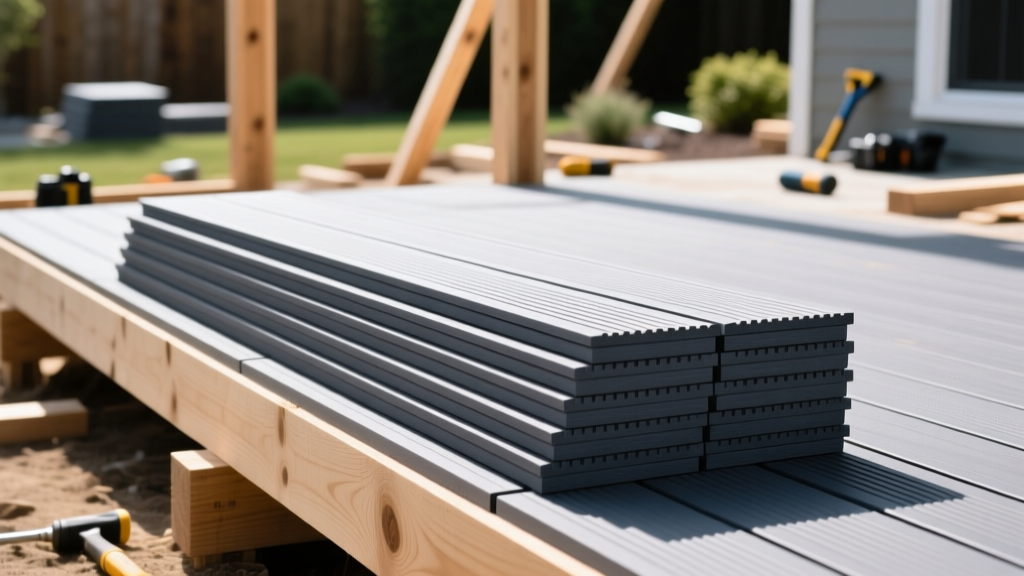
Pressure-Treated Lumber: The Baseline Budget Option
Pressure-treated (PT) Southern Yellow Pine remains the most economical decking surface. However, not all PT lumber is created equal. For decking, you must specify the correct retention level to prevent premature rot.
Understanding AWPA Use Categories
The American Wood Protection Association (AWPA) U1 standards dictate chemical retention levels. For deck boards (above ground), UC3B is the minimum standard. However, for joists, beams, and posts that contact concrete or soil, you must purchase UC4A (Ground Contact) or UC4B (Heavy-Duty Ground Contact). UC4A lumber contains roughly 40% more copper azole or micronized copper preservative than UC3B, increasing the material cost by approximately $0.40 to $0.60 per linear foot, but it is non-negotiable for structural longevity.
The Hidden Maintenance Multiplier
While the upfront cost of PT decking is low ($3.50 to $5.50 per sq. ft.), the 10-year Total Cost of Ownership (TCO) is significantly higher. PT wood requires cleaning and sealing with a penetrating oil or semi-transparent stain every 18 to 24 months. At an average material cost of $0.75 per sq. ft. for high-quality sealants (like Armstrong Clark or TWP) and $1.50 per sq. ft. for professional application, a 400-square-foot deck will incur $900 in maintenance materials and labor every two years.
Composite and PVC Decking: The Mid-to-Premium Tiers
Composite decking (a blend of wood fibers and recycled plastics) and PVC (100% synthetic polyvinyl chloride) dominate the mid-to-high-end market. The cost of deck materials in this category is dictated by the capping technology and core density.
Capped Composite Pricing and Performance
Modern capped composites feature a polymer shell that resists staining and fading. Trex official decking specifications highlight the difference between their tier lines, which perfectly illustrates the market's pricing structure:
| Product Line | Material Cost (per sq. ft.) | Core Technology | Warranty |
|---|---|---|---|
| Trex Enhance (Basics) | $5.50 – $6.50 | Scalloped bottom (lighter) | 25-Year Limited |
| Trex Select | $7.00 – $8.50 | Solid core, standard shell | 35-Year Limited |
| Trex Transcend Lineage | $10.50 – $13.00 | Solid core, heat-mitigating pigments | 50-Year Limited |
Expert Insight: If your deck faces direct southern exposure, the extra $3.00 to $4.50 per sq. ft. for heat-mitigating premium lines (like Trex Transcend Lineage or TimberTech AZEK Landmark) is critical. Standard dark composites can reach surface temperatures of 150°F+ in direct summer sunlight, whereas heat-mitigating pigments can reduce surface temperatures by up to 30°F.
PVC and Aluminum: The Premium Extremes
PVC decking, such as TimberTech AZEK, contains no wood flour, making it entirely impervious to moisture absorption and mold. Expect to pay $12.00 to $16.00 per sq. ft. for premium PVC. The trade-off is thermal expansion; PVC expands and contracts significantly more than composite, requiring strict adherence to manufacturer-specified gapping (usually 1/8 inch per 10 feet of board length at installation temperatures of 70°F).
Aluminum decking (e.g., AridDeck or Wahoo Decks) costs $15.00 to $22.00 per sq. ft. It is completely non-combustible, impervious to rot, and requires zero maintenance. It is primarily used in wildfire-prone zones (WUI zones) where building codes mandate non-combustible exterior attachments, or for second-story decks where its integrated drainage channels protect the space below.
The Forgotten Costs: Framing, Fasteners, and Accessories
Focusing solely on the deck boards will derail your budget. The substructure and hardware often account for 35% to 45% of your total material bill.
Structural Framing Breakdown
For a standard 16-inch on-center joist layout using 2x8 pressure-treated Southern Yellow Pine, framing materials will cost between $2.50 and $4.00 per square foot of deck area. If you are building over 6 feet off the ground, engineering requirements may dictate 2x10 or 2x12 joists, or even steel framing (like Trex Elevations), which pushes framing costs to $8.00 – $12.00 per sq. ft.
Fasteners and Joist Protection
Do not use standard deck screws for composite or PVC. The material requires hidden fastener systems to allow for thermal expansion and provide a clean surface.
- Hidden Fasteners (e.g., Tiger Claw TC-G3): $1.15 – $1.40 per sq. ft. These stainless-steel clips grip the grooved edges of the boards and screw directly into the joists.
- Joist Protection Tape (e.g., Trex Protect or G-Tape): $0.35 – $0.50 per linear foot. Applying butyl tape to the top of every joist prevents moisture intrusion and protects the wood from the corrosive effects of composite decking preservatives. For a 400 sq. ft. deck, expect to spend roughly $150 on tape.
- Structural Connectors (Simpson Strong-Tie): Budget $150 – $300 for galvanized or ZMAX-coated joist hangers, post bases, and structural screws. Never use standard indoor hardware outdoors; the copper in modern PT lumber will rapidly corrode uncoated steel.
15-Year Total Cost of Ownership (TCO) Matrix
To make a financially sound decision, evaluate the cost of deck materials over a 15-year lifecycle, factoring in initial purchase, installation hardware, and mandatory maintenance.
| Material Type | Initial Material Cost (400 sq ft) | 15-Yr Maintenance Cost | 15-Year TCO |
|---|---|---|---|
| Pressure-Treated Pine | $1,800 | $4,500 (Stain/Seal 7x) | $6,300 |
| Mid-Tier Capped Composite | $3,000 | $300 (Soap/Water Cleaning) | $3,300 |
| Premium PVC | $5,600 | $300 (Soap/Water Cleaning) | $5,900 |
Procurement Strategy: Order all composite or PVC materials from the same manufacturing lot. Dye lots vary slightly in color, and mixing batches across different production runs can result in visible shading inconsistencies across your deck surface once installed.
Sourcing and Procurement Strategies for 2026
To optimize your material spend without sacrificing structural integrity, implement the following procurement tactics:
- Buy Framing in Winter/Early Spring: Lumber yards experience peak demand for PT framing in May and June. Purchasing your joists, beams, and posts in February or March can yield a 10% to 15% discount on dimensional lumber.
- Utilize Contractor Pro Desks: Even if you are a DIYer, apply for a commercial account at major suppliers like Home Depot or Lowe's. Volume pricing tiers often kick in at $1,500 and $5,000, offering automatic 5% to 12% discounts on composite decking and fasteners.
- Calculate Waste Accurately: Standard straight-lay decking requires a 10% waste factor. If you are designing a diagonal pattern, herringbone, or picture-frame border, increase your waste factor to 15% - 20%. Ordering short by even three boards can delay your project by weeks if the specific color and lot are out of stock regionally.
Written by
Priya KapoorPriya Kapoor is a real estate market analyst and construction economics researcher with expertise in housing affordability, development feasibility, and infrastructure investment. She holds a Master of Regional Planning from Cornell University and previously worked as a senior analyst at CBRE's Investment Properties group, where she modeled returns for $4B in mixed-use development pipelines. Priya now runs an independent research practice advising developers, municipalities, and REITs on construction cost forecasting and market timing. She publishes the quarterly "BuildMat Market Pulse" report tracking material price indices across 12 commodity categories. Based in Austin, TX, Priya serves on the board of Habitat for Humanity Austin and is a marathon runner.
More from Priya Kapoor
View all
Construction Cost
Cost to Build a 1600 Sq Ft Home in 2026: Full Breakdown
Accurate 2026 cost to build a 1600 sq ft home—material, labor, and regional pricing breakdowns included. Plan your budget with real-time estimates.
Aug 11, 2026

Wood & Lumber
Name the Types of Wood for Pressure Treatment and Preservation
Learn how to name the types of wood best suited for pressure treatment. Compare species treatability, chemical retention levels, and 2026 preservation costs.
Aug 4, 2026

Stone & Masonry
Stone Veneer Suppliers Lindenhurst: 2026 Cost Analysis
Analyze 2026 stone veneer costs in Lindenhurst, NY. Compare local supplier pricing, delivery fees, and Suffolk County installation labor rates.
Aug 4, 2026