How Much Does It Cost to Build a Deck? 2026 Lifespan & ROI Guide
Discover how much it costs to build a deck in 2026. We analyze upfront pricing vs. long-term durability, maintenance, and true lifecycle ROI.

The Upfront Reality: How Much Does It Cost to Build a Deck?
When homeowners ask, "how much does it cost to build a deck?", they are usually looking for a single baseline number. In 2026, the national average to build a standard 400-square-foot deck ranges from $16,000 to $28,000, fully installed. However, focusing exclusively on the initial invoice is a financial trap that leads to premature structural failure, endless maintenance cycles, and early replacement.
To truly understand deck construction costs, you must evaluate the lifecycle cost—the upfront investment divided by the material's functional lifespan, plus cumulative maintenance. A budget-friendly pressure-treated wood deck might cost $10,000 today, but if it requires $1,200 in annual staining and rots in 12 years, its true cost vastly exceeds a $24,000 capped composite deck that requires zero sealing and lasts 30 years.
2026 Material Cost & Lifespan Matrix
The table below breaks down the true cost of ownership for a 400-square-foot deck across the four primary material categories, factoring in 2026 labor rates ($65–$95 per hour) and material pricing.
| Decking Material | Upfront Cost (400 sq ft) | Expected Lifespan | 10-Year Maintenance | Annualized True Cost |
|---|---|---|---|---|
| Pressure-Treated Pine | $9,500 - $13,000 | 10 - 15 Years | $4,500 - $6,000 | $966 - $1,266 / yr |
| Capped Wood-Composite | $16,000 - $22,000 | 25 - 30 Years | $300 - $500 | $652 - $750 / yr |
| Cellular PVC | $22,000 - $28,000 | 30 - 50 Years | $100 - $200 | $444 - $564 / yr |
| Aluminum Decking | $28,000 - $36,000 | 50 - 75+ Years | $0 | $373 - $480 / yr |
Note: Annualized True Cost is calculated by adding the upfront cost and 10-year maintenance, then dividing by the material's minimum expected lifespan.
Material Durability Profiles: Where Your Money Actually Goes
Choosing a decking material is an exercise in balancing immediate budget constraints against long-term durability. Here is how the top materials perform in real-world conditions.
Pressure-Treated Pine (The High-Maintenance Budget Option)
Modern pressure-treated lumber uses Micronized Copper Azole (MCA) or Alkaline Copper Quaternary (ACQ) preservatives. While safer and more environmentally friendly than the older CCA treatments, these modern preservatives are highly corrosive to standard steel fasteners. You must use hot-dipped galvanized or stainless steel hardware, which adds 10% to 15% to your fastener budget. According to the USDA Forest Products Laboratory, untreated wood exposed to ground contact and moisture can decay in under three years; even with chemical treatment, the constant expansion and contraction from freeze-thaw cycles will cause surface checking and splintering within 36 months unless sealed annually.
Capped Wood-Composite (The Lifecycle Sweet Spot)
Composite decking (like Trex Transcend or TimberTech Pro) features a core of recycled wood fibers and HDPE plastic, wrapped in a protective polymer cap. This cap is the critical durability feature—it prevents moisture intrusion, mold growth, and UV fading. While early-generation composites from the 2000s suffered from severe staining and mold issues, modern 2026 capped composites carry 25- to 50-year fade and stain warranties. The upfront premium over wood is typically recouped by year seven through eliminated staining and sealing costs.
Cellular PVC (The Legacy Investment)
Cellular PVC (such as AZEK Landmark or Wolf Serenity) contains no wood fibers whatsoever. It is impervious to rot, termites, and moisture absorption. PVC boards can be submerged in water indefinitely without degrading, making them the mandatory choice for ground-level decks, dock systems, or homes in high-humidity coastal zones. The primary drawback is thermal expansion; PVC expands and contracts significantly with temperature swings, requiring strict adherence to manufacturer-specified gapping during installation to prevent buckling.
Aluminum Decking (The Indestructible Option)
Aluminum decking systems (like Wahoo Decks or Ariddek) represent the pinnacle of structural longevity. They are non-combustible, impervious to rot, and feature integrated water-shedding channels that keep the substructure completely dry. While the material cost is high and the aesthetic is distinctly modern/industrial, aluminum offers the lowest annualized cost of ownership because it will easily outlive the house it is attached to.
The most common point of failure in high-end deck builds is not the decking surface, but the substructure. Homeowners frequently spend $25,000 on premium PVC or composite decking, only to install it over standard pressure-treated pine joists. Within 12 to 15 years, the pine joists will begin to rot at the top edges where water pools, compromising the structural integrity of the entire deck. The Fix: If you are investing in composite or PVC, you must protect the framing. Apply a butyl-based joist tape (like Trex Protect or G-Tape) to the top of every joist and beam before laying the deck boards. For maximum lifespan, upgrade the substructure to light-gauge steel framing (e.g., Fortress Evolution), which guarantees the frame will last as long as the decking.
Maintenance Costs That Destroy Long-Term ROI
To accurately answer how much it costs to build a deck, you must underwrite the maintenance. Wood decks demand a relentless cycle of chemical and labor investments to stave off biological decay.
- Annual Cleaning: $150 - $250 for specialized deck washes and oxygen bleach solutions.
- Bi-Annual Sealing/Staining: High-quality penetrating oil-based sealants (like Cabot or TWP) cost $55 to $85 per gallon. A 400-square-foot deck requires 2 to 3 gallons per coat. Professional application labor runs $2.50 to $4.00 per square foot.
- Board Replacement: Warped or rotted boards on a wood deck require selective replacement. Due to color fading on the existing boards, replacing a single rotten plank often results in a glaring visual mismatch, prompting premature full-deck resurfacing.
Conversely, composite and PVC decks require only bi-annual washing with mild soap and water to maintain their warranty, reducing maintenance costs to virtually zero.
Resale Value and Market ROI
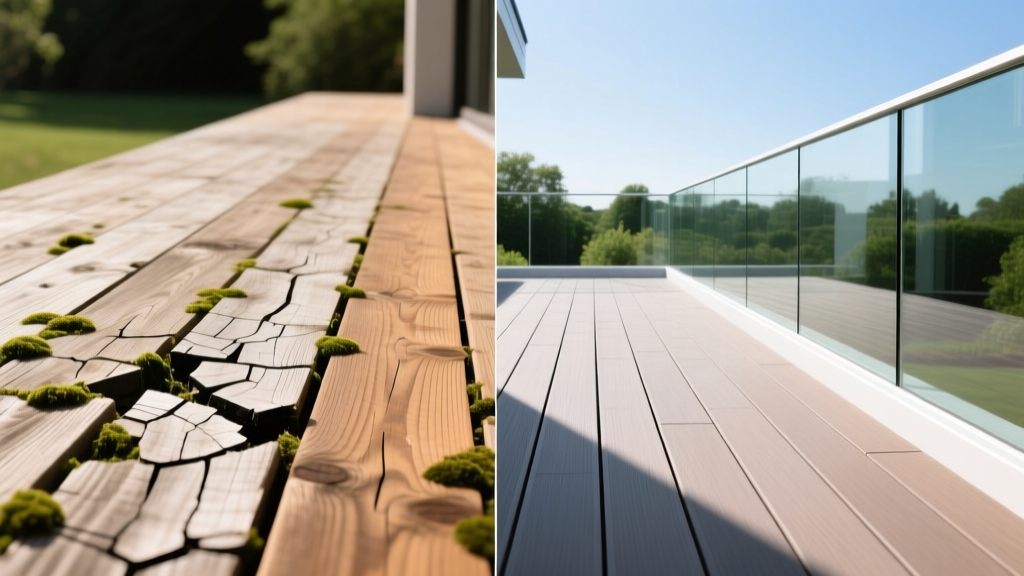
Durability also impacts your home's equity. According to Remodeling Magazine's Cost vs. Value Report, a mid-range wood deck replacement recoups roughly 35% to 40% of its cost at resale, largely because buyers factor in the immediate maintenance burden. Composite decks, however, consistently yield higher ROI percentages because homebuyers recognize the transferability of the 25-year warranty and the absence of immediate maintenance requirements. A structurally sound, low-maintenance deck is appraised as a permanent outdoor living room, whereas a weathering wood deck is appraised as a deferred maintenance liability.
Decision Framework: Matching Material to Your Timeline
Use this framework to determine which material aligns with your specific financial and temporal horizon:
- The 5-to-7 Year Horizon (Selling Soon): Build with Pressure-Treated Pine. Minimize your upfront capital expenditure. Perform one high-quality stain job before listing the home to maximize curb appeal without over-investing in long-term polymers.
- The 10-to-20 Year Horizon (Forever Home Phase 1): Build with Capped Wood-Composite. You will eliminate weekend staining chores during your peak earning/career years, and the deck will remain pristine through your primary residency. Use joist tape to protect the wood framing.
- The 30+ Year Horizon (Generational/Legacy Build): Build with Cellular PVC or Aluminum over a Steel Substructure. This is a permanent architectural addition. The upfront cost is 2.5x that of wood, but you will never pay for a deck replacement or structural repair for the rest of your life.
Ultimately, asking "how much does it cost to build a deck" requires shifting your perspective from a single transaction to a multi-decade asset management strategy. By calculating the annualized cost and protecting your substructure, you can build an outdoor space that delivers true financial and structural longevity.
Written by
Priya KapoorPriya Kapoor is a real estate market analyst and construction economics researcher with expertise in housing affordability, development feasibility, and infrastructure investment. She holds a Master of Regional Planning from Cornell University and previously worked as a senior analyst at CBRE's Investment Properties group, where she modeled returns for $4B in mixed-use development pipelines. Priya now runs an independent research practice advising developers, municipalities, and REITs on construction cost forecasting and market timing. She publishes the quarterly "BuildMat Market Pulse" report tracking material price indices across 12 commodity categories. Based in Austin, TX, Priya serves on the board of Habitat for Humanity Austin and is a marathon runner.
More from Priya Kapoor
View all
Construction Cost
Cost to Build a 1600 Sq Ft Home in 2026: Full Breakdown
Accurate 2026 cost to build a 1600 sq ft home—material, labor, and regional pricing breakdowns included. Plan your budget with real-time estimates.
Aug 11, 2026

Wood & Lumber
Name the Types of Wood for Pressure Treatment and Preservation
Learn how to name the types of wood best suited for pressure treatment. Compare species treatability, chemical retention levels, and 2026 preservation costs.
Aug 4, 2026

Stone & Masonry
Stone Veneer Suppliers Lindenhurst: 2026 Cost Analysis
Analyze 2026 stone veneer costs in Lindenhurst, NY. Compare local supplier pricing, delivery fees, and Suffolk County installation labor rates.
Aug 4, 2026