Approx Cost to Build a Deck: 2026 Material Comparison Guide
Discover the approx cost to build a deck in 2026. Compare wood, composite, PVC, and aluminum pricing, hidden fees, and 10-year total cost of ownership.

The True Approx Cost to Build a Deck: Beyond the Square Footage
When homeowners research the approx cost to build a deck, they frequently encounter misleading square-foot averages that only account for surface decking boards. In 2026, a realistic deck budget requires a holistic view of material science, structural framing, and long-term maintenance liabilities. The national average for a professionally installed 300-square-foot deck ranges from $9,000 for basic pressure-treated lumber to over $24,000 for premium cellular PVC or extruded aluminum systems.
According to Angi's comprehensive deck cost analysis, labor and site preparation now account for 50% to 60% of the total project cost. However, the choice of decking material dictates not only the upfront material expense but also the required framing upgrades, fastener systems, and decade-long maintenance schedules. This guide deconstructs the exact costs, failure modes, and performance profiles of the four primary decking categories to help you engineer a budget that reflects reality.
- Pressure-Treated Wood: $7,500 – $10,500 installed
- Capped Composite: $13,500 – $18,000 installed
- Cellular PVC: $16,500 – $22,500 installed
- Extruded Aluminum: $19,500 – $26,000 installed
Material Comparison Matrix: Upfront Pricing & Lifecycle Metrics
The following matrix isolates the material-specific costs and lifecycle expectations for 2026. Note that "Installed Cost" assumes a standard single-level platform with 16-inch on-center (OC) joist spacing.
| Material Type | Board Cost (Per Linear Ft.) | Installed Cost (Per Sq. Ft.) | Expected Lifespan | 10-Yr Maintenance Cost |
|---|---|---|---|---|
| Pressure-Treated Pine | $2.50 – $4.00 | $25 – $35 | 10 – 15 Years | $1,800 – $3,000 |
| Capped Composite | $7.50 – $11.00 | $45 – $60 | 25 – 30 Years | $200 – $400 |
| Cellular PVC | $10.00 – $14.50 | $55 – $75 | 30 – 50+ Years | $150 – $300 |
| Extruded Aluminum | $16.00 – $24.00 | $65 – $90 | 50+ Years | $0 – $100 |
Deep Dive: Decking Material Costs & Performance Profiles
1. Pressure-Treated Lumber (The Budget Baseline)
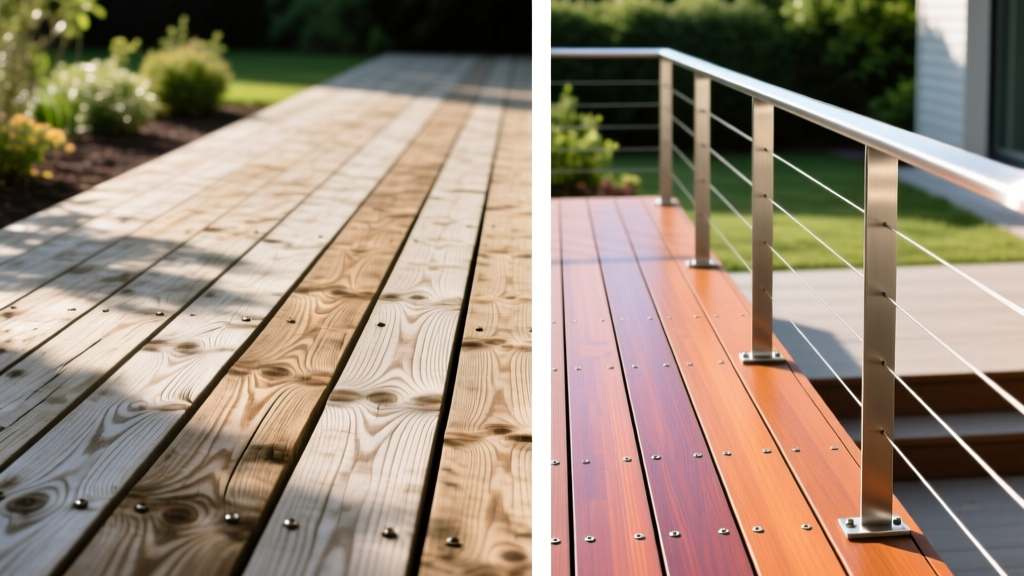
Pressure-treated (PT) Southern Yellow Pine remains the most common choice for budget-conscious builds. The lumber is infused with alkaline copper quaternary (ACQ) or copper azole preservatives to resist fungal decay and termite damage. For deck boards, builders typically use #2 grade or "Prime" grade boards, while structural posts require UC4A (ground-contact) rated lumber.
The Hidden Reality: PT wood is highly hygroscopic. It absorbs and releases moisture rapidly, leading to inevitable cupping, checking (splitting), and warping within the first 24 months if not properly sealed. To maintain the warranty and structural integrity, PT decks require power washing and re-sealing with a penetrating oil-based sealer (such as Cabot Australian Timber Oil) every 1.5 to 2 years. Over a 10-year period, the maintenance labor and material costs often eclipse the initial savings compared to composite alternatives.
2. Capped Wood-Plastic Composite (The Mid-Tier Standard)
Modern composite decking consists of a wood-flour and recycled polyethylene core, wrapped in a protective polymer cap. Premium lines like Trex Transcend Lineage or TimberTech Landmark utilize advanced PVC or ASA (Acrylonitrile Styrene Acrylate) caps that provide superior UV and stain resistance compared to older, uncapped composites.
Installation Gotcha: Composite boards are significantly heavier than wood and exhibit high thermal expansion. Installers must strictly follow manufacturer gapping guidelines—typically leaving a 1/4-inch gap at board ends for every 50-degree temperature swing between installation and peak summer heat. Failure to account for this thermal movement results in buckled boards and popped fasteners. Furthermore, composite requires specialized hidden fastener systems (like TigerClaw or Trex Hideaway), which add roughly $1.50 to $2.50 per square foot to the material budget.
3. Cellular PVC (The Premium Moisture Barrier)
Cellular PVC (Polyvinyl Chloride) contains no wood fibers, making it entirely impervious to moisture absorption, rot, and mold. Brands like AZEK Vintage manufacture boards with a dense, closed-cell structure that mimics the grain of natural hardwoods like mahogany and ipe. Because it lacks organic material, PVC is the undisputed choice for ground-level decks, docks, or heavily shaded areas where composite might otherwise develop surface mildew.
Structural Consideration: PVC lacks the rigid stiffness of wood or composite. To prevent sagging or a "spongy" feel underfoot, the American Wood Council's DCA-6 prescriptive deck construction guide and PVC manufacturers mandate tighter joist spacing. While wood can span 16 inches OC, PVC deck boards installed at a 45-degree angle require 12-inch OC joist framing, which increases the cost of the structural sub-floor by 15% to 20%.
4. Powder-Coated Aluminum (The Niche Fire-Rated Option)
Extruded aluminum decking, such as LockDry or Wahoo Decks, represents the pinnacle of durability. The interlocking planks create a completely waterproof surface, allowing homeowners to create dry, usable patio space directly beneath the deck. Aluminum is non-combustible, making it a mandatory choice for homes in Wildland-Urban Interface (WUI) zones in California and Colorado where wood and plastic composites are banned due to fire codes.
The Trade-offs: Aluminum decking carries the highest approx cost to build a deck surface. Beyond the premium price tag, aluminum conducts heat rapidly. In direct, unshaded southern exposures, dark-colored aluminum boards can become uncomfortably hot under bare feet. Additionally, the interlocking metal design can produce a hollow, echoing sound during heavy rain or hail, which some homeowners find disruptive.
Hidden Cost Variables That Inflate Your Budget
Focusing solely on the decking boards will result in severe budget overruns. The following structural and site-specific variables drastically alter the final approx cost to build a deck:
- Foundation Systems: Traditional concrete sonotubes require extensive digging and curing time. In regions with deep frost lines or poor soil, helical piles (e.g., Techno Metal Post) are increasingly preferred. They cost $250 to $450 per pier installed but can be loaded immediately, bypassing frost heave risks and saving days of labor.
- Framing Upgrades & Joist Tape: The leading cause of deck failure is not the surface board, but the rotting of the wooden joists beneath it. Applying a waterproof butyl joist tape (like Trex Protect or G-Tape) over all framing members costs roughly $0.75 per linear foot but doubles the lifespan of the substructure. For composite and PVC, upgrading from standard SPF lumber to pressure-treated or steel framing is highly recommended to match the 25+ year lifespan of the surface boards.
- Railing Systems: Railings often account for 20% to 30% of the total deck cost. Standard pressure-treated wood picket railings cost $25–$40 per linear foot. Upgrading to tempered glass panels or cable railings (like Feeney CableRail) pushes the cost to $120–$250+ per linear foot, drastically altering the overall budget.
10-Year Total Cost of Ownership (TCO) Framework
To make a financially sound decision, evaluate the Total Cost of Ownership rather than just the day-one installation price. The Trex Deck Cost Calculator and independent lifecycle analyses demonstrate how maintenance shifts the financial advantage over time.
Scenario: 300 Sq. Ft. Deck over 10 Years
- Pressure-Treated Pine: Initial Cost ($9,000) + 5 Professional Sealings at $400 each ($2,000) + 1 Minor Board Replacement ($300) = $11,300 TCO.
- Capped Composite: Initial Cost ($15,500) + Annual Soap/Water Cleaning ($50/yr = $500) = $16,000 TCO.
- Cellular PVC: Initial Cost ($19,000) + Annual Cleaning ($50/yr = $500) = $19,500 TCO.
While wood appears to win on upfront costs, the gap narrows significantly by year 7 when factoring in the compounding labor costs of sanding, staining, and replacing warped boards. If you plan to stay in your home for less than 5 years, PT wood offers the best ROI. For long-term residency (10+ years), capped composite provides the optimal balance of upfront approx cost to build a deck and minimal lifecycle maintenance.
FAQs: Deck Building Cost Realities
Does adding a deck increase home resale value in 2026?
Yes, but the ROI depends on the material and regional market. According to real estate remodeling impact reports, a mid-range composite deck addition typically recoups 65% to 75% of its cost at resale. Wood decks may recoup slightly more (up to 80%) simply because the initial investment is lower, but appraisers increasingly note the remaining lifespan of low-maintenance materials as a premium feature.
Can I install composite decking over my existing wood frame?
Technically yes, but it is rarely advisable. Existing wood framing is often spaced at 16 inches OC, which may not meet the 12-inch OC requirement for diagonal composite patterns. Furthermore, if the existing joists are more than 7 years old, they have already experienced moisture cycling and fastener fatigue. Tying a 25-year composite surface to a degraded substructure creates a massive liability. Always inspect and reinforce old framing with joist tape and sistered lumber before resurfacing.
What is the cheapest way to reduce the approx cost to build a deck?
The most effective cost-reduction strategy is optimizing the deck's dimensions to match standard material lengths. Decking boards are typically sold in 12, 16, and 20-foot lengths. Designing a deck that is 15 feet 10 inches deep allows you to use 16-foot boards with minimal waste, whereas a 17-foot depth requires purchasing 20-foot boards and cutting off 3 feet of scrap per board, instantly inflating your material waste factor by 15% to 20%.
Written by
Marcus ChenMarcus Chen is a licensed structural engineer (PE) and building materials analyst with over 12 years of experience across residential, commercial, and industrial construction. He holds a Master of Science in Civil Engineering from UC Berkeley and spent six years at Thornton Tomasetti before transitioning to independent consulting and technical writing. Marcus specializes in material selection for seismic-prone regions, concrete reinforcement strategies, and lifecycle cost analysis. His work has been cited by the American Concrete Institute (ACI) and the Structural Engineers Association of California (SEAOC). When he is not on a job site or at his desk, you will find him hiking the Sierra Nevada or restoring a 1920s craftsman bungalow in Oakland, CA.
More from Marcus Chen
View all
Construction Cost
How Much Did the Eiffel Tower Cost to Build?
How much did the Eiffel Tower cost to build in 1889? We adjust for inflation and compare its budget to modern skyscraper construction.
Aug 4, 2026

Fire Resistance
What Is a Fire Resistant Material? Testing & Certification Guide
Discover what is a fire resistant material through ASTM and UL testing. Learn how fire ratings, certifications, and assemblies work in construction.
Aug 4, 2026

Construction Cost
How Much Did the Burj Khalifa Cost to Build?
How much did the Burj Khalifa cost to build? We break down the $1.5B project and extract 5 money-saving strategies for your next build.
Jul 30, 2026