Durability of Deck Materials: Wood vs Composite vs PVC
Compare the lifespan and durability of wood, composite, and PVC deck materials. Discover failure modes, maintenance costs, and 2026 product picks.
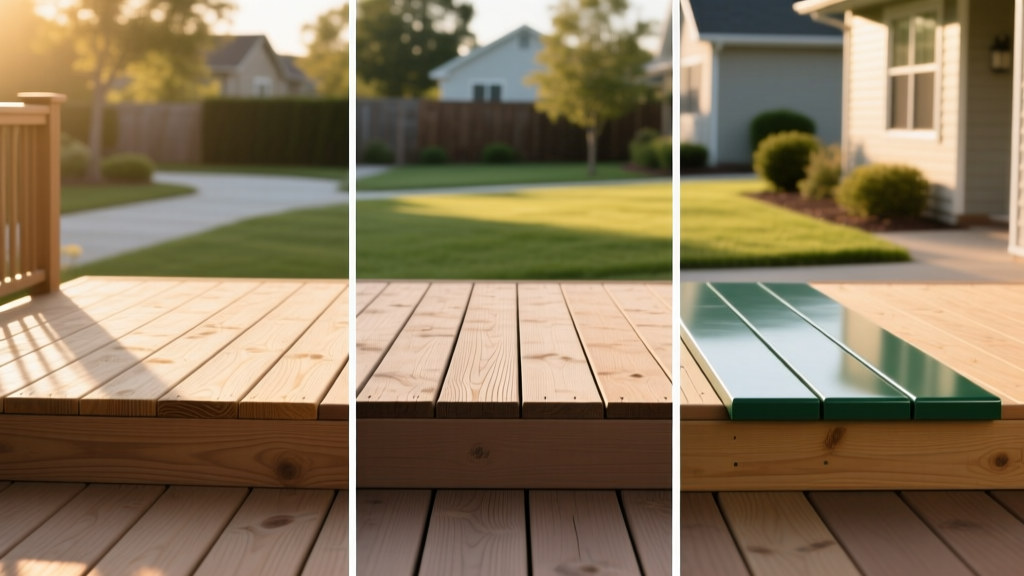
The Real Cost of Deck Material Degradation
When evaluating outdoor structures, the lifespan of deck materials is rarely defined by catastrophic structural collapse. Instead, functional lifespan ends when aesthetic degradation, splintering, or surface failure makes the space unusable or unsafe. While manufacturers market 25-year and 50-year warranties, these documents cover specific manufacturing defects, not the natural wear caused by UV radiation, freeze-thaw cycles, and microbial decay. Understanding the precise failure modes of wood, capped composite, cellular PVC, and aluminum is critical for calculating true lifecycle costs.
Most composite and PVC decking warranties are heavily prorated after year 10. Furthermore, they explicitly exclude fading, staining from organic matter, and damage from improper gapping. Always read the exclusion clauses regarding thermal expansion and joist spacing before purchasing.
Pressure-Treated Pine & Tropical Hardwoods: Organic Decay Timelines
Wood remains the baseline for deck construction, but its lifespan is entirely dependent on preservative chemistry and natural cellular density. The American Wood Council (AWC) outlines strict preservative retention levels in their DCA-6 Prescriptive Residential Wood Deck Construction Guide to prevent premature structural failure.
Pressure-Treated Southern Yellow Pine (SYP)
Modern pressure-treated lumber relies on Micronized Copper Azole (MCA-C) or Copper Quaternary (CQ). The lifespan hinges on the American Wood Protection Association (AWPA) Use Category:
- UC4A (Above Ground): Retention level of 0.25 pcf (pounds per cubic foot). Expected lifespan: 10-15 years before severe checking and warping.
- UC4B (Ground Contact): Retention level of 0.60 pcf. Required for posts and joists. Expected structural lifespan: 40+ years.
Primary Failure Mode: Longitudinal checking (splitting) and cupping. As SYP dries, the outer shell shrinks faster than the core. Without annual sealing, water infiltrates these checks, accelerating internal rot.
Tropical Hardwoods (Ipe, Cumaru, Tigerwood)
Tropical hardwoods bypass chemical preservatives through sheer density and natural extractives. According to the USDA Forest Products Laboratory Wood Handbook, Ipe (Tabebuia spp.) boasts a Janka hardness of 3,680 lbf and a natural decay resistance rating that rivals treated lumber.
- Ipe: 25-40+ year lifespan. Highly resistant to rot and insects.
- Cumaru: 20-30 year lifespan. Slightly more prone to surface checking than Ipe.
Primary Failure Mode: UV graying and surface checking. Hardwoods do not rot easily, but they will turn silver-gray within 6 months if left un-oiled. Penetrating oil finishes (like Messmer's UV Plus) must be reapplied every 12-18 months to maintain the original color.
Capped Composite Decking: The 25-to-30-Year Reality
Capped composite decking consists of a wood-plastic composite (WPC) core encased in a protective polymer shield. The core provides structural rigidity, while the cap resists moisture ingress and UV fading. Modern composites are evaluated under EPA guidelines for outdoor material safety and ASTM D7032 standards for flexural strength and freeze-thaw durability.
Polyethylene (PE) vs. Polypropylene (PP) Caps
Not all caps are created equal. The polymer chemistry dictates scratch resistance and thermal performance:
| Polymer Type | Leading Product Lines | Pros | Cons |
|---|---|---|---|
| Polyethylene (PE) | Trex Transcend Lineage, TimberTech Prime+ | Deep wood-grain embossing, highly resistant to impact cracking. | Softer surface, prone to scratching from heavy furniture. |
| Polypropylene (PP) | Fiberon Promenade, Deckorators Mineral-Based | Superior scratch resistance, higher melting point, lighter weight. | Can feel more "plastic" underfoot, higher cost. |
Primary Failure Mode: Cap delamination and uncapped edge vulnerability. If the ends of composite boards are not sealed or properly hidden by fascia, moisture wicks into the exposed WPC core. This causes the core to swell, leading to a phenomenon known as "mushrooming" where the core pushes past the cap, creating tripping hazards and mold breeding grounds.
Cellular PVC Decking: Maximum Lifespan, Hidden Trade-offs
Cellular PVC (Polyvinyl Chloride) contains zero wood fiber. It is a fully synthetic, closed-cell foam extrusion that is completely impervious to water absorption, rot, and termites. Brands like AZEK Landmark and Wolf Serenity dominate this space.
The Thermal Expansion Challenge
The critical engineering constraint of PVC is its Coefficient of Linear Thermal Expansion (CLTE). PVC expands and contracts at a rate of approximately 3.0 x 10^-5 in/in/°F. By comparison, wood expands at roughly 1.0 x 10^-6 in/in/°F.
Field Calculation: A 20-foot PVC deck board installed at 40°F will expand by nearly 1/4 inch when summer temperatures reach 100°F. If installers do not leave precise 1/8-inch to 3/16-inch gapping at the ends and sides, the boards will buckle and warp off the joists.
Primary Failure Mode: Surface chalking and thermal bowing. While PVC won't rot, prolonged UV exposure breaks down the surface polymers, causing a chalky residue that rubs off on clothing. High-end PVC uses advanced acrylic capping to mitigate this, but lighter colors (white, light gray) will eventually show dirt accumulation and scuffing far more than darker composites.
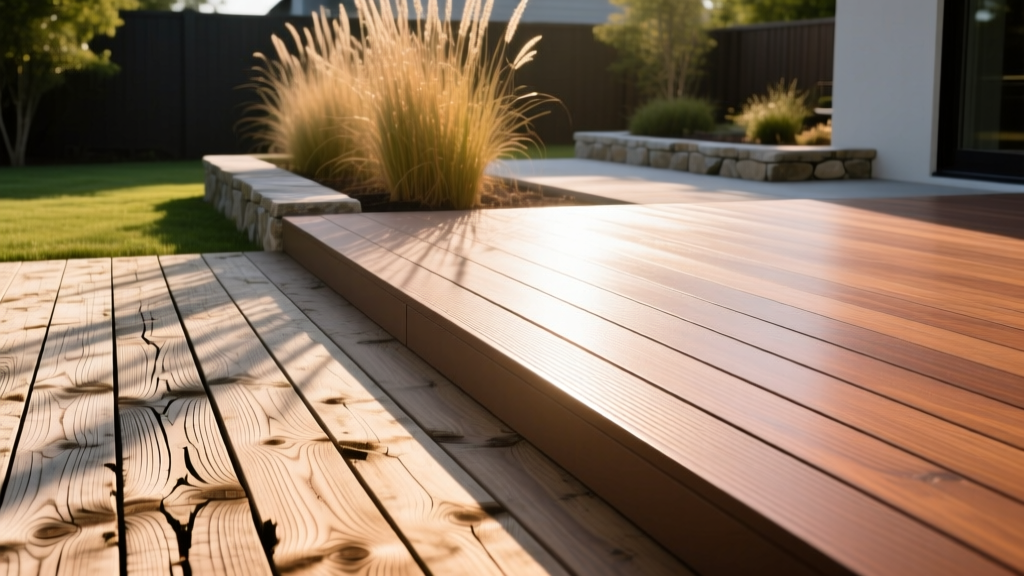
Aluminum Decking: The 50-Year Outlier
For absolute maximum lifespan with zero organic decay, extruded aluminum decking (such as Wahoo Decks or Nexan) offers a 50+ year functional life. Manufactured from 6061-T6 marine-grade aluminum alloy, these boards are powder-coated to AAMA 2604 standards for extreme UV and salt-air resistance.
- Cost: $15.00 - $22.00 per linear foot (material only).
- Lifespan: 50+ years (structural), 20-30 years (powder coat aesthetic).
- Best Use Case: Over-living spaces (balconies, second-story decks) because aluminum systems feature integrated watertight interlocking channels that eliminate the need for separate under-deck drainage membranes.
Primary Failure Mode: Powder coat degradation in high-salt environments, and acoustic resonance (a hollow, metallic "pinging" sound during heavy rain or hail, though modern designs include rubberized sound-dampening strips).
Decision Matrix: Matching Material to Microclimate
Selecting the right material requires matching the board's physical properties to your specific environmental stressors. Use this framework to eliminate unsuitable options immediately.
| Climate / Environment | Recommended Material | Materials to Avoid | Primary Threat Mitigated |
|---|---|---|---|
| High Humidity / Heavy Shade | Cellular PVC or Aluminum | Pressure-Treated Wood, Uncapped Composite | Mold, mildew, and organic rot. |
| Extreme Heat / Direct Sun (Southwest US) | Light-colored Capped Composite (with cooling tech) | Dark PVC, Dark Hardwoods, Aluminum | Thermal expansion buckling and barefoot burn hazards. |
| Coastal / Salt Air | Cellular PVC or Tropical Hardwood (Ipe) | Aluminum (unless marine-grade coated), Steel framing | Galvanic corrosion and salt-spray degradation. |
| Heavy Snow Load / Freeze-Thaw | PP-Capped Composite or Aluminum | Standard PT Pine (cupping from ice melt) | Moisture absorption leading to freeze-cracking. |
Maintenance Schedules to Hit Maximum Lifespan
No deck material is truly "maintenance-free." To achieve the upper limits of the lifespans outlined above, adhere to these strict maintenance protocols:
Wood (PT Pine & Hardwoods)
- Bi-Annual: Clear debris from joist gaps to prevent moisture damming.
- Annual: Apply a penetrating oil-based sealer (for hardwoods) or a high-solids acrylic water repellent (for PT Pine). Do not use film-forming polyurethanes, which will peel and trap moisture.
Composite & PVC
- Quarterly: Wash with a mild, non-abrasive soap and a soft-bristle brush. Never use a pressure washer above 1,500 PSI or hold the nozzle closer than 8 inches, as this will etch the polymer cap and void the warranty.
- As Needed: Remove organic stains (leaves, pollen) within 48 hours. Tannins from oak leaves can permanently stain composite caps if left to sit through a rain cycle.
The deck boards are only as durable as the joists beneath them. If you are investing in 30-year PVC or composite boards, upgrade your substructure. Use ground-contact rated (UC4B) pressure-treated joists, or apply a butyl-based joist tape (like Trex Protect or G-Tape) to the top of every wooden joist before laying the boards. This prevents water from pooling on the joist tops, effectively doubling the lifespan of your wooden substructure.
Written by
Elena RodriguezElena Rodriguez is a civil engineer and technical writer specializing in concrete technology, masonry systems, and ASTM/ACI compliance. She earned her B.S. in Civil Engineering from Texas A&M University and spent a decade at a materials testing laboratory, performing over 2,000 concrete compressive strength tests and masonry prism evaluations. Elena is an ACI-certified Field Testing Technician (Grade I) and a member of ASTM Committee C12 on Natural Building Stone. She currently consults on forensic engineering cases involving concrete failures and moisture intrusion. Based in San Antonio, TX, Elena is a proud member of the Society of Women Engineers (SWE) and coaches her daughter's FIRST Robotics team.
More from Elena Rodriguez
View all
Walls & Panels
Cost Analysis: Light Gauge Steel Framing Advantages and Disadvantages
Evaluate light gauge steel framing advantages and disadvantages through a strict cost analysis lens, comparing material, labor, and lifecycle expenses.
Aug 4, 2026

Walls & Panels
Gypsum Board Types: Exact Specifications, Thickness & Dimensions
Compare standard, Type X, and moisture-resistant gypsum board types. Get exact specifications, thicknesses, dimensions, and ASTM standards for your project.
Aug 4, 2026

Fire Resistance
Best Fire-Resistant Outdoor Decking Materials: 2026 Buyer Guide
Discover the best fire-resistant outdoor decking materials for 2026. Compare Class A PVC, aluminum, and hardwood options for WUI compliance and safety.
Aug 4, 2026