The Coolest Decking Material for Bare Feet: 2026 Heat Guide
Discover the coolest decking material for bare feet in hot climates. We compare surface temps, costs, and top 2026 heat-resistant composite and PVC brands.

The Thermodynamics of Decking: Why Composites Get Hot
Standard capped composite decking can reach surface temperatures of 155°F to 165°F on a 90°F summer day. At 125°F, human skin experiences pain; at 140°F, third-degree burns can occur in seconds. The search for the coolest decking material requires understanding three physical properties: thermal conductivity, thermal mass, and solar reflectance (albedo).
Traditional wood decking stays relatively cool because its cellular structure contains microscopic air pockets that act as natural thermal breaks. Conversely, first-generation and standard modern composites are manufactured from a dense blend of wood flour and high-density polyethylene (HDPE). This high density gives composites their durability and rot resistance, but it also creates a high thermal mass that absorbs and traps infrared (IR) radiation. According to material science data from the USDA Forest Products Laboratory, the thermal conductivity of solid wood is significantly lower than that of dense thermoplastics, explaining why wood feels cooler underfoot despite identical sun exposure.
To solve this, manufacturers have shifted focus to the cap layer. By integrating inorganic, IR-reflective pigments and microscopic glass beads into the polymer shell, modern decking can reflect solar radiation before it converts to heat, a principle heavily documented in the U.S. Department of Energy's guidelines on cool exterior surfaces.
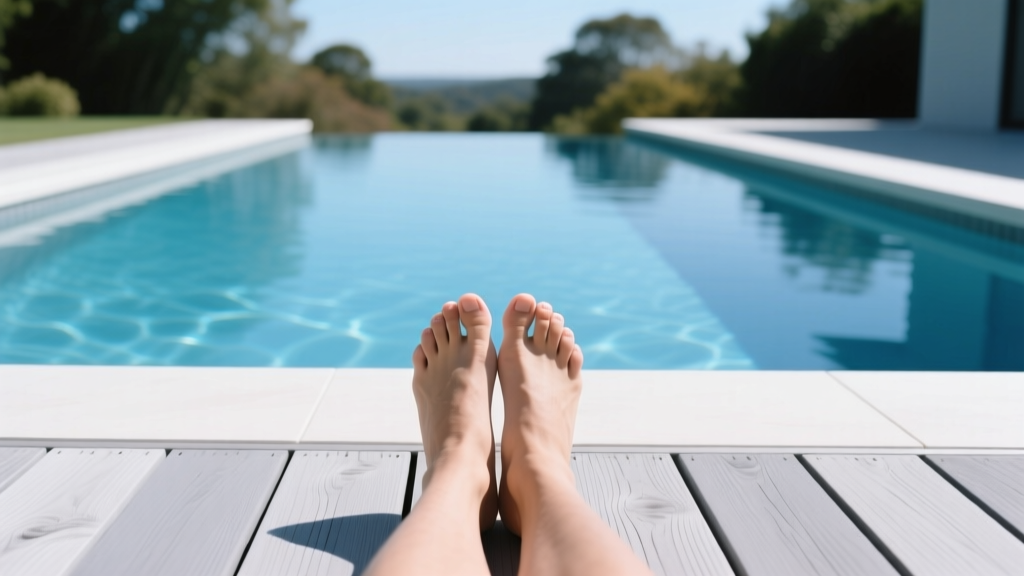
2026 Heat Index: Decking Material Surface Temperatures
Not all materials react to direct sunlight equally. The following matrix compares the average surface temperatures of leading decking materials on a 90°F day with direct, unshaded solar exposure. Data is synthesized from independent thermal imaging tests and manufacturer specifications aligned with ASTM E1980 standards for solar reflectance.
| Material Category | Specific Product Example | Avg Surface Temp (90°F Ambient) | Installed Cost / Sq Ft | Barefoot Comfort |
|---|---|---|---|---|
| Extruded Aluminum | Wahoo Decks AridDek | 98°F - 105°F | $18.00 - $24.00 | Excellent |
| Advanced PVC | TimberTech Landmark (Light) | 115°F - 122°F | $12.00 - $15.00 | Good |
| Thermally Modified Wood | Thermory Benchmark Ash | 110°F - 118°F | $9.00 - $12.00 | Good |
| Heat-Reflective Composite | Trex Transcend Lineage | 120°F - 128°F | $10.00 - $13.00 | Fair / Good |
| Tropical Hardwood | Ipe (Ironwood) | 118°F - 125°F | $14.00 - $18.00 | Good |
| Standard Dark Composite | Generic Capped Composite | 145°F - 160°F | $7.00 - $10.00 | Poor (Burn Risk) |
Top Contenders for the Coolest Decking Material
1. Extruded Aluminum Decking Systems
If absolute temperature reduction is the primary metric, aluminum is the undisputed champion. Products like Wahoo Decks AridDek utilize marine-grade extruded aluminum with an integrated interlocking drainage channel. Aluminum has high thermal conductivity but exceptionally low thermal mass; it dissipates heat almost as quickly as it absorbs it, keeping surface temperatures within 10°F to 15°F of the ambient air temperature.
Expert Caveat: Aluminum decking requires specialized installation. You must use aluminum-compatible hidden fasteners or stainless steel screws to prevent galvanic corrosion. Furthermore, the metallic surface can feel slippery when wet and lacks the natural acoustic dampening of wood or composite, resulting in a distinct 'pinging' sound during heavy rain.
2. Advanced PVC with Cooling Technology
For homeowners who want the cool-touch benefits of synthetic materials without the industrial aesthetic of aluminum, Advanced PVC is the optimal middle ground. The TimberTech Advanced PVC Landmark Collection uses a proprietary cellular PVC core that is inherently less dense than wood-flour composites. Because it lacks organic fillers, it absorbs less heat. When paired with their lighter colorways (like French White Oak or Sea Salt Gray), the surface temperature drops by up to 30°F compared to traditional dark composites.
3. Next-Generation Heat-Reflective Composites
Historically, composite decking was a poor choice for hot climates. However, the Trex Transcend Lineage series has fundamentally altered the category. By formulating the outer polymer cap with specialized, inorganic IR-reflective pigments, the boards bounce solar radiation away rather than absorbing it. While it will still feel warm to the touch on a 100°F Texas afternoon, it remains comfortably walkable for brief periods, eliminating the severe burn risks associated with legacy composite boards.
Color and Albedo: The Hidden Temperature Multiplier
The material you choose is only half the equation; color dictates the rest. The Light Reflectance Value (LRV) measures the percentage of visible and UV light a surface reflects. A dark brown composite board might have an LRV of 8, absorbing 92% of solar energy. A light gray or tan board can have an LRV of 45 or higher.
Framing and Airflow Hacks to Drop Surface Temps
Even the coolest decking material will trap heat if the substructure is poorly designed. Implement these framing strategies to actively lower your deck's ambient microclimate:
- Reduce Joist Spacing for Thinner Profiles: While 16-inch on-center (OC) is standard, dropping to 12-inch OC allows for better cross-ventilation beneath the boards, preventing hot air from pooling directly under the decking surface.
- Calculate Net Free Vent Area (NFVA) for Skirting: Enclosing your deck with skirting traps radiant heat underneath, baking the boards from below. The building code rule of thumb requires 1 square foot of NFVA for every 150 square feet of enclosed under-deck space. Use heavy-duty, UV-resistant lattice or vented aluminum soffit panels to ensure continuous cross-breezes.
- Install a Radiant Barrier: If you are building a second-story deck over a patio, staple a foil-faced radiant barrier to the underside of the joists. This reflects heat back up and away from the patio below, while also preventing the dark joist shadows from superheating the underside of your deck boards.
The Barefoot Decision Framework
Selecting the right material requires balancing your budget, aesthetic preferences, and local climate. Use this framework to finalize your choice:
- The Zero-Compromise Heat Solution: If your budget exceeds $18/sq ft, you live in a desert or extreme-heat climate, and you prioritize barefoot comfort above all else, specify Extruded Aluminum (Wahoo Decks) in a light powder-coated finish.
- The High-End Wood Alternative: If your budget is $12-$15/sq ft, you want the realistic look of interior hardwood, and you need low maintenance, choose Advanced PVC (TimberTech Landmark) in a high-LRV colorway like Sea Salt Gray.
- The Eco-Conscious Middle Ground: If your budget is $10-$13/sq ft, you prefer recycled materials, and you live in a moderate-to-hot climate, select Heat-Reflective Composite (Trex Lineage) in Biscuit or Jasper, ensuring you incorporate maximum under-deck ventilation.
Final Inspection Note: Always request physical samples of your top three material choices. Leave them in direct, unshaded sunlight on your actual job site for four hours during peak afternoon sun. The 'barefoot test' on your specific property's microclimate is the only empirical data that truly matters before signing a purchase order.
Written by
Marcus ChenMarcus Chen is a licensed structural engineer (PE) and building materials analyst with over 12 years of experience across residential, commercial, and industrial construction. He holds a Master of Science in Civil Engineering from UC Berkeley and spent six years at Thornton Tomasetti before transitioning to independent consulting and technical writing. Marcus specializes in material selection for seismic-prone regions, concrete reinforcement strategies, and lifecycle cost analysis. His work has been cited by the American Concrete Institute (ACI) and the Structural Engineers Association of California (SEAOC). When he is not on a job site or at his desk, you will find him hiking the Sierra Nevada or restoring a 1920s craftsman bungalow in Oakland, CA.
More from Marcus Chen
View all
Construction Cost
How Much Did the Eiffel Tower Cost to Build?
How much did the Eiffel Tower cost to build in 1889? We adjust for inflation and compare its budget to modern skyscraper construction.
Aug 4, 2026

Fire Resistance
What Is a Fire Resistant Material? Testing & Certification Guide
Discover what is a fire resistant material through ASTM and UL testing. Learn how fire ratings, certifications, and assemblies work in construction.
Aug 4, 2026

Construction Cost
How Much Did the Burj Khalifa Cost to Build?
How much did the Burj Khalifa cost to build? We break down the $1.5B project and extract 5 money-saving strategies for your next build.
Jul 30, 2026